Structure and position
The Periodic Table arranges elements in order of increasing proton number. Horizontal rows are periods; vertical columns are groups. Elements in the same group have similar chemical properties because they have the same number of outer-shell electrons.
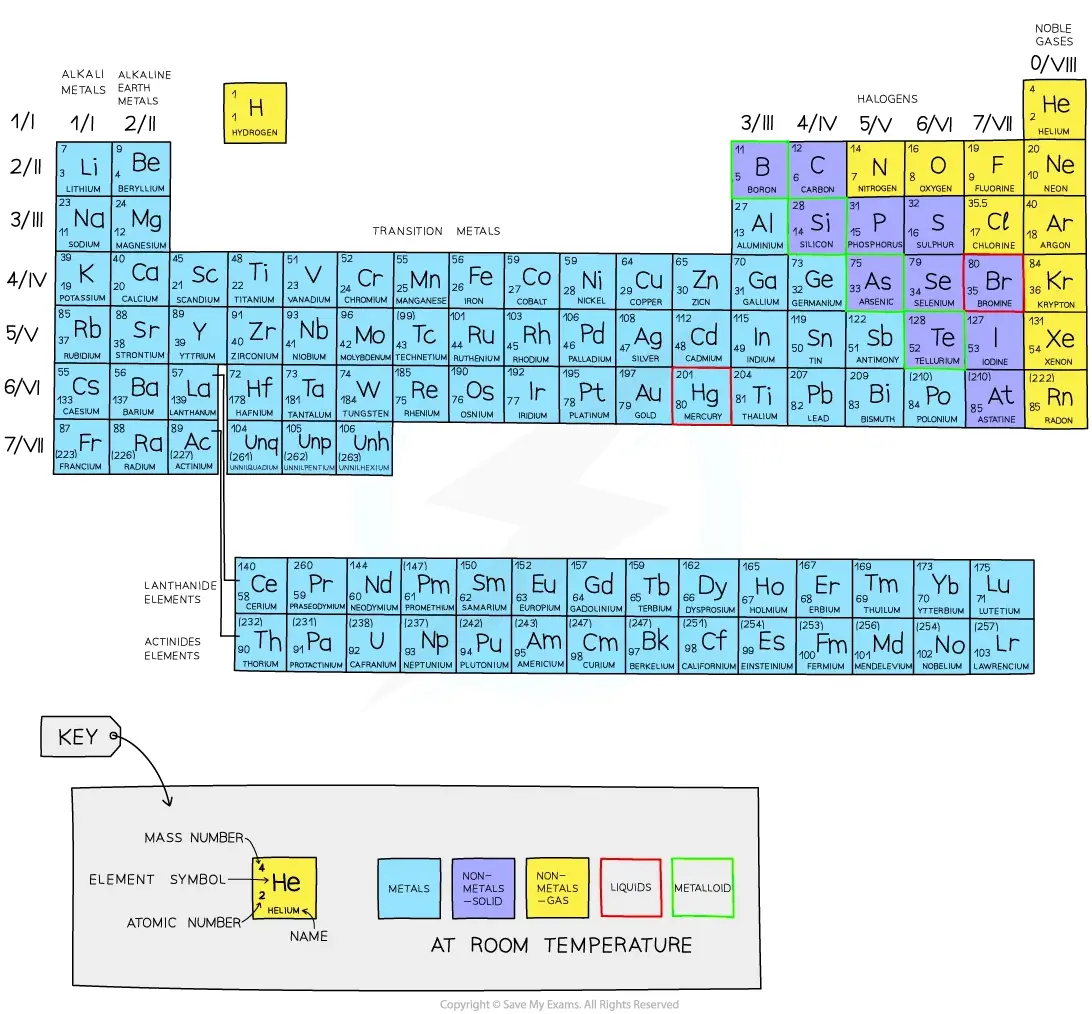
Across a period, metallic character generally decreases and non-metallic character increases.
Position predicts electronic configuration, ion charge, reactivity, and physical properties.
Group I atoms lose one outer electron to form $+1$ ions; Group VII atoms gain one electron to form $-1$ ions, because both processes produce a full outer shell.
Typical simple-ion charges are:
| Group | Common ion charge |
|---|---|
| I | $+1$ |
| II | $+2$ |
| III | $+3$ |
| IV | No usual simple ion; commonly forms covalent compounds |
| V | $-3$ |
| VI | $-2$ |
| VII | $-1$ |
| VIII | No simple ions; full outer shell |
Group I: alkali metals
Group I metals are relatively soft. Down the group:
- melting point decreases
- density generally increases according to the syllabus trend
- reactivity increases because the outer electron is further from the nucleus and easier to lose
They react with cold water to form a metal hydroxide and hydrogen. Reactivity increases from lithium to potassium, so potassium reacts more vigorously than sodium. A heavier Group I element should therefore react more vigorously and form a $+1$ ion.
Group VII: halogens
Halogens are diatomic non-metals. Their molecules are $\mathrm{F_2}$, $\mathrm{Cl_2}$, $\mathrm{Br_2}$, and $\mathrm{I_2}$.
| Halogen | State and appearance at room temperature |
|---|---|
| Chlorine | Pale yellow-green gas |
| Bromine | Red-brown liquid |
| Iodine | Grey-black solid |
Halide displacement
Down the group, density increases and reactivity decreases because an incoming electron is further from the nucleus. A more reactive halogen displaces a less reactive halide:
$$\mathrm{Cl_2+2KBr \rightarrow 2KCl+Br_2}$$
The observation is a red-brown colour from bromine. Chlorine displaces bromide and iodide, but bromine does not displace chloride. Down Group VII, density and boiling point generally increase, while reactivity and oxidising power decrease.
Transition elements
Transition elements have high density and high melting points. They form coloured compounds, often act as catalysts, and can form ions with variable oxidation numbers, such as $\mathrm{Fe^{2+}}$ and $\mathrm{Fe^{3+}}$.
Group VIII: noble gases
Noble gases are monatomic and very unreactive because their outer electron shells are full. Helium has a full first shell; other noble gases have full outer shells.
Interpreting trends
When given data, identify the group, arrange elements in increasing proton number, and describe the consistent change. Link the trend to outer-shell electrons and distance from the nucleus. Do not infer a trend from one isolated value.