Equations, Factors, and Formulae
1. Equations
Linear Equations in One Unknown
Solving for a variable by isolating it using inverse operations:
- Addition $\leftrightarrow$ Subtraction
- Multiplication $\leftrightarrow$ Division
- Squaring $\leftrightarrow$ Square Root
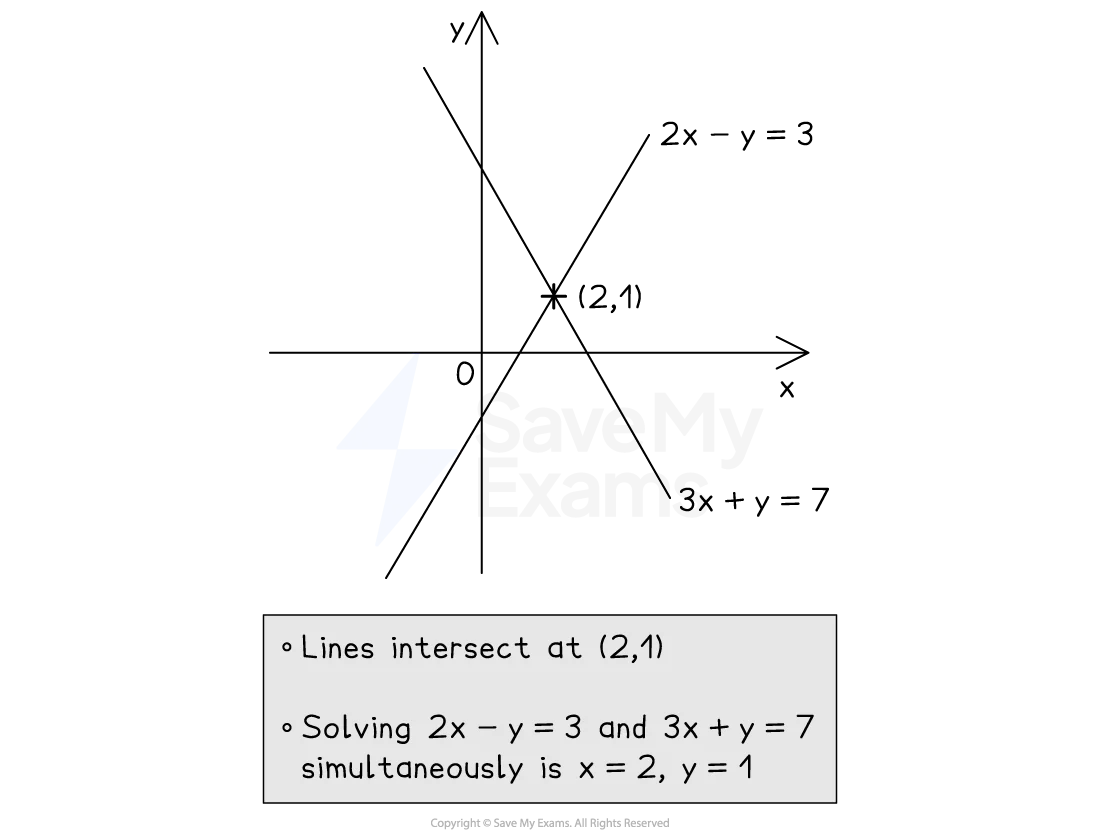
Simultaneous Linear Equations
Finding a common solution $(x, y)$ for two linear equations.
- Substitution Method: Express one variable in terms of the other from one equation, then substitute into the second.
- Elimination Method: Multiply equations to make coefficients of one variable equal (or opposite), then add or subtract the equations to eliminate that variable.
2. Factorisation
Extracting Common Factors
Finding the highest common factor (HCF) of all terms and placing it outside the bracket.
Example: Factorise $6x^2 + 9x$
- Step 1: Find HCF of $6x^2$ and $9x \rightarrow 3x$
- Step 2: Divide each term by $3x \rightarrow \frac{6x^2}{3x} + \frac{9x}{3x}$
- Step 3: Write in factored form $\rightarrow 3x(2x + 3)$
Advanced Factorisation
-
Quadratic Expressions: Factorising $ax^2 + bx + c$ into $(px + q)(rx + s)$.
Example: Factorise $x^2 + 5x + 6$- Step 1: Find numbers that multiply to 6 and add to 5 $\rightarrow 2, 3$
- Step 2: Split middle term $\rightarrow x^2 + 2x + 3x + 6$
- Step 3: Factor by grouping $\rightarrow x(x + 2) + 3(x + 2)$
- Step 4: Final result $\rightarrow (x + 3)(x + 2)$
-
Difference of Two Squares: $a^2 - b^2 = (a - b)(a + b)$.
Example: Factorise $16x^2 - 25$- Step 1: Identify as squares $\rightarrow (4x)^2 - (5)^2$
- Step 2: Apply identity $(a-b)(a+b) \rightarrow (4x - 5)(4x + 5)$
-
Grouping: Factoring by grouping terms in pairs to find a common binomial factor.
Example: Factorise $x^3 + 2x^2 + 3x + 6$- Step 1: Group in pairs $\rightarrow (x^3 + 2x^2) + (3x + 6)$
- Step 2: Factor each pair $\rightarrow x^2(x + 2) + 3(x + 2)$
- Step 3: Extract common binomial $\rightarrow (x^2 + 3)(x + 2)$
3. Formulae
Simple Formulae
- Construction: Creating an algebraic expression to represent a real-world relationship.
- Changing the Subject: Rearranging a formula to isolate a specific variable. Example: $y = mx + c \rightarrow x = \frac{y - c}{m}$.
Complex Subject Changes
- Subject Appears Twice: Collect all terms containing the subject on one side and factorise the subject out.
- Powers and Roots: Use inverse operations to isolate the subject. Example: $s = \sqrt{\frac{h}{k}} \rightarrow s^2 = \frac{h}{k} \rightarrow k = \frac{h}{s^2}$.
Comprehensive Example:
Make $x$ the subject of $y = \sqrt{\frac{ax + b}{cx + d}}$
- Step 1: Remove square root (Square both sides) $\rightarrow y^2 = \frac{ax + b}{cx + d}$
- Step 2: Remove fraction (Multiply by denominator) $\rightarrow y^2(cx + d) = ax + b$
- Step 3: Expand brackets $\rightarrow cy^2x + dy^2 = ax + b$
- Step 4: Collect $x$ terms on one side $\rightarrow cy^2x - ax = b - dy^2$
- Step 5: Factorise $x$ $\rightarrow x(cy^2 - a) = b - dy^2$
- Step 6: Isolate $x$ (Divide) $\rightarrow x = \frac{b - dy^2}{cy^2 - a}$