Fractions, Percentages, and Standard Form
1. Fractions
Definitions
- Proper Fraction: Numerator is smaller than denominator (e.g., $1/2, 3/4$).
- Improper Fraction: Numerator is greater than or equal to denominator (e.g., $5/4, 7/3$).
- Mixed Number: Combination of a whole number and a proper fraction (e.g., $1 \frac{1}{4}$).
Conversions
- Mixed Number $\rightarrow$ Improper Fraction: $\text{Whole} \times \text{Denominator} + \text{Numerator} / \text{Denominator}$.
- Improper Fraction $\rightarrow$ Mixed Number: Divide numerator by denominator; quotient is whole number, remainder is numerator.
Basic Operations
- Addition/Subtraction: Find a common denominator, then add/subtract numerators.
- Example: $\frac{1}{4} + \frac{2}{3} = \frac{3}{12} + \frac{8}{12} = \frac{11}{12}$
- Example: $\frac{3}{4} - \frac{1}{6} = \frac{9}{12} - \frac{2}{12} = \frac{7}{12}$
- Multiplication: Multiply numerators together and denominators together.
- Example: $\frac{2}{3} \times \frac{4}{5} = \frac{2 \times 4}{3 \times 5} = \frac{8}{15}$
- Division: Multiply by the reciprocal of the divisor (Keep-Change-Flip).
- Example: $\frac{2}{3} \div \frac{5}{7} = \frac{2}{3} \times \frac{7}{5} = \frac{14}{15}$
2. Percentages
- Percentage of a Quantity: $\frac{\text{percentage}}{100} \times \text{quantity}$.
- Percentage Increase/Decrease:
- $\text{Change} = \frac{\text{percentage}}{100} \times \text{original}$.
- $\text{New Value} = \text{original} \pm \text{change}$.
- Simple Interest: $I = P \times R \times T$ (Principal $\times$ Rate $\times$ Time).
- Compound Interest: $A = P(1 + \frac{r}{100})^n$ (Total amount after $n$ years).
- Reverse Percentages: Finding the original value after a percentage change.
- $\text{Original} = \frac{\text{New Value}}{1 \pm \frac{\text{percentage}}{100}}$.
- Repeated Percentage Change: Applying a percentage change multiple times sequentially.
- Exponential Growth and Decay:
- Growth: $y = a(1 + r)^x$
- Decay: $y = a(1 - r)^x$
- Where $a$ is initial value, $r$ is rate, and $x$ is time.
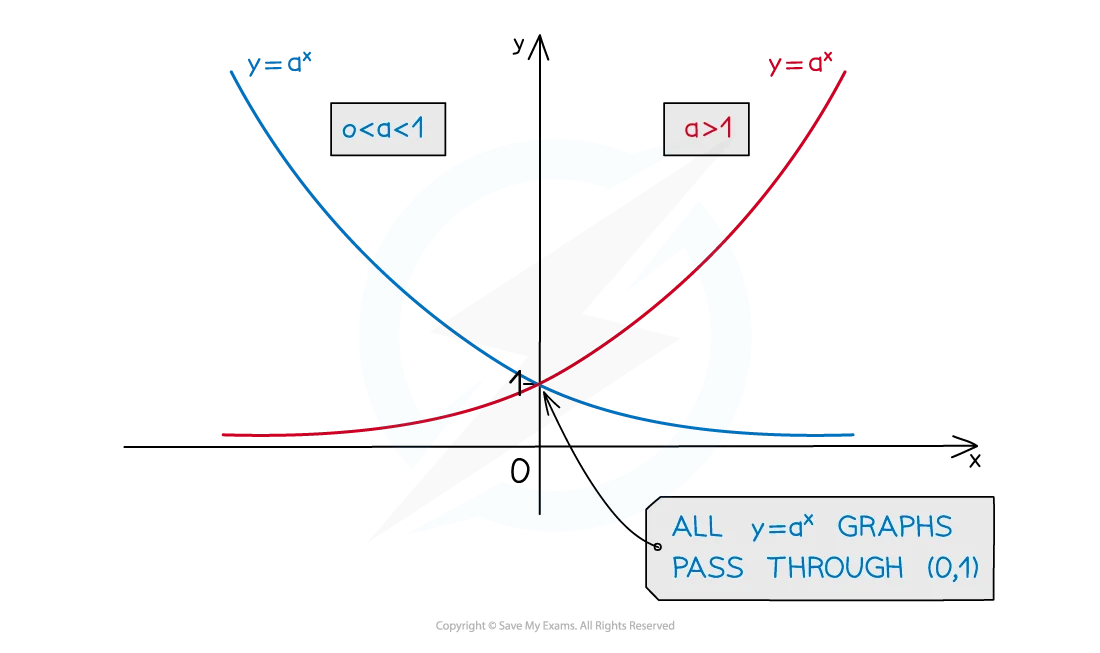
Blue is decay and red is growth
3. Standard Form
Definition
A number is in standard form if it is written as: $$A \times 10^n$$ where $1 \le A < 10$ and $n$ is an integer.
Conversion
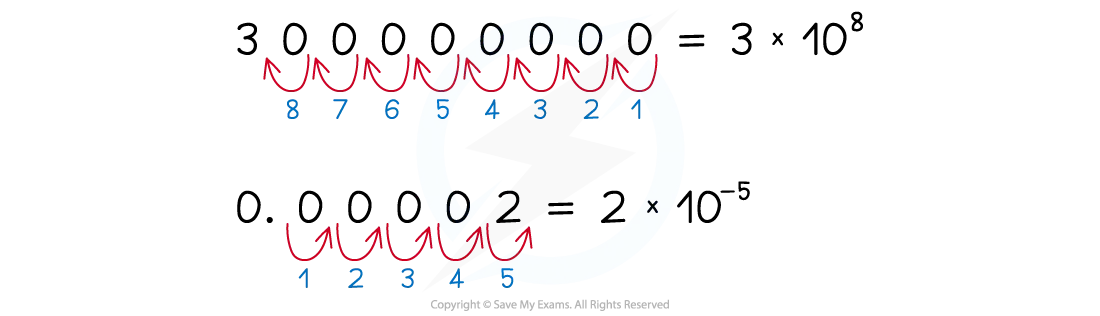
- Ordinary $\rightarrow$ Standard Form: Move decimal point to get $A$ ($1 \le A < 10$). $n$ is the number of places moved (positive for large numbers, negative for small numbers).
- Standard Form $\rightarrow$ Ordinary: Move decimal point $n$ places to the right (if $n > 0$) or left (if $n < 0$).
Calculations
- Multiplication: Multiply coefficients ($A$), add exponents ($n$).
- Division: Divide coefficients ($A$), subtract exponents ($n$).
- Addition/Subtraction: Convert both numbers to ordinary form or ensure they have the same power of 10 before operating.