Further Solving of Equations and Inequalities
1. Simultaneous Equations
Two linear equations with two unknowns (usually $x$ and $y$) that must be solved simultaneously.
Methods of Solution
- Elimination: Multiply equations so that coefficients of one variable are the same (or opposites), then add or subtract the equations to eliminate that variable.
- Substitution: Rearrange one equation to express one variable in terms of the other (e.g., $x = \dots$), then substitute this expression into the second equation.
Worked example (elimination): Solve
$$ \begin{aligned} 2x+y&=7\\ \\ 3x-y&=8 \end{aligned} $$
-
Add the two equations. The $+y$ and $-y$ cancel:
$$ \begin{aligned} (2x+y)+(3x-y)&=7+8\\ \\ 5x&=15 \end{aligned} $$
-
Divide both sides by $5$:
$$x=3$$
-
Substitute $x=3$ into the first equation:
$$2(3)+y=7$$
-
Simplify and solve for $y$:
$$ \begin{aligned} 6+y&=7\\ \\ y&=1 \end{aligned} $$
-
Check both values in the original equations:
$$2(3)+1=7$$
$$3(3)-1=8$$
-
Write the solution as an ordered pair:
$$(x,y)=(3,1)$$

2. Linear Inequalities
Inequalities describe a range of values rather than a single value.
Solving Inequalities
Solve as you would a linear equation, with one critical rule: When multiplying or dividing by a negative number, reverse the inequality sign.
- Example: $-2x < 6 \implies x > -3$
Representation
- Number Line:
- Open circle $\circ$ for $<$ or $>$.
- Closed circle $\bullet$ for $\le$ or $\ge$.
- Regions in a Plane:
- Solid line for $\le$ or $\ge$.
- Dashed line for $<$ or $>$.
- Shade the region that satisfies the inequality.
- To choose the side, test a point not on the boundary. For $y>2x+1$, test $(0,0)$: $0>1$ is false, so shade the side not containing $(0,0)$.
- Read boundary lines carefully: a solid boundary means equality is included; a dashed boundary means it is excluded.
A shaded region can be described by listing every boundary inequality. Check a point inside the shaded region in every inequality, then check that points on solid boundaries satisfy equality.

3. Quadratic Methods
Solving equations of the form $ax^2 + bx + c = 0$.
The Quadratic Formula
Use this when factorisation is difficult or impossible:
$$x = \frac{-b \pm \sqrt{b^2 - 4ac}}{2a}$$
For $ax^2+bx+c=0$, identify $a$, $b$, and $c$ before substituting. The term $b^2-4ac$ is the discriminant:
- $b^2-4ac>0$: two distinct real roots;
- $b^2-4ac=0$: one repeated real root;
- $b^2-4ac<0$: no real roots.
Worked example: For $2x^2+3x-2=0$, use $(a,b,c)=(2,3,-2)$:
$$x=\frac{-3\pm\sqrt{3^2-4(2)(-2)}}{2(2)}=\frac{-3\pm5}{4}$$
Hence $x=\frac12$ or $x=-2$.
Completing the Square
Completing the square rewrites a quadratic expression exactly. It is useful for solving quadratic equations and finding the turning point of a quadratic graph.
A perfect square has the form of one squared bracket. For example:
$$x^2+4x+4=(x+2)^2$$
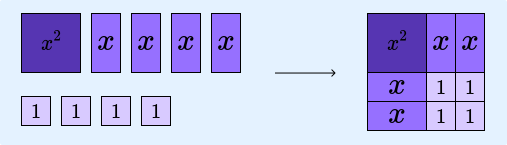
Most quadratic expressions are not perfect squares. Add and subtract the same number so part of the expression becomes a perfect square. This keeps the equality exact.
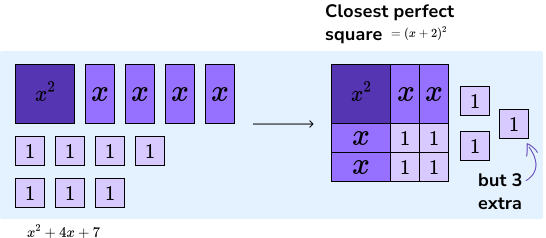
Some expressions have an extra amount:
$$x^2+4x+7=(x+2)^2+3$$
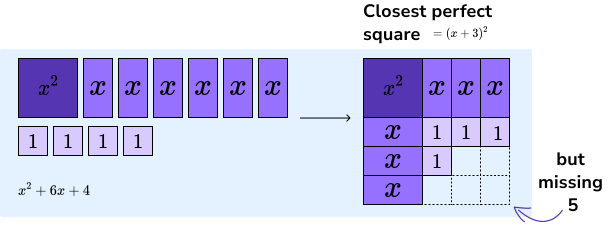
Some expressions are missing an amount:
$$x^2+6x+4=(x+3)^2-5$$
For larger coefficients, halve the coefficient of $x$ and square the result. For a quadratic with an outside factor, use the coefficient of $x$ inside the brackets.
Completing the square is useful for solving quadratic equations and finding the maximum or minimum of a quadratic graph.
The completed-square form is:
$$a(x+p)^2+q$$
For this form, the turning point is $(-p,q)$.
Completing the square where $a\neq1$
If the coefficient of $x^2$ is not $1$, first factor it out from the $x^2$ and $x$ terms. Then use the coefficient of $x$ inside the brackets.
For example:
$$2x^2+8x+10=2\left(x^2+4x+5\right)$$
The coefficient to halve is now $4$, not the original $8$.
Step-by-step example: Solve:
$$2x^2+8x-10=0$$
-
Factor out $2$ from the quadratic and linear terms:
$$2(x^2+4x-5)=0$$
-
Halve the coefficient of $x$ inside the brackets and square the result:
$$\frac{4}{2}=2, \qquad 2^2=4$$
-
Add and subtract $4$ inside the brackets. This keeps the expression equal:
$$ \begin{aligned} 2(x^2+4x-5)&=2\left(x^2+4x+4-4-5\right)\\ \\ &=2\left(x^2+4x+4-9\right)\\ \\ &=2\left((x+2)^2-9\right) \end{aligned} $$
-
Distribute the outside factor:
$$2\left((x+2)^2-9\right)=2(x+2)^2-18$$
-
Solve the equation:
$$ \begin{aligned} 2(x+2)^2-18&=0\\ \\ 2(x+2)^2&=18\\ \\ (x+2)^2&=9\\ \\ x+2&=\pm\sqrt{9}=\pm3 \end{aligned} $$
-
Find both solutions:
$$x+2=3 \quad\Rightarrow\quad x=1$$
$$x+2=-3 \quad\Rightarrow\quad x=-5$$
-
Check both solutions in the original equation:
$$2(1)^2+8(1)-10=0$$
$$2(-5)^2+8(-5)-10=0$$
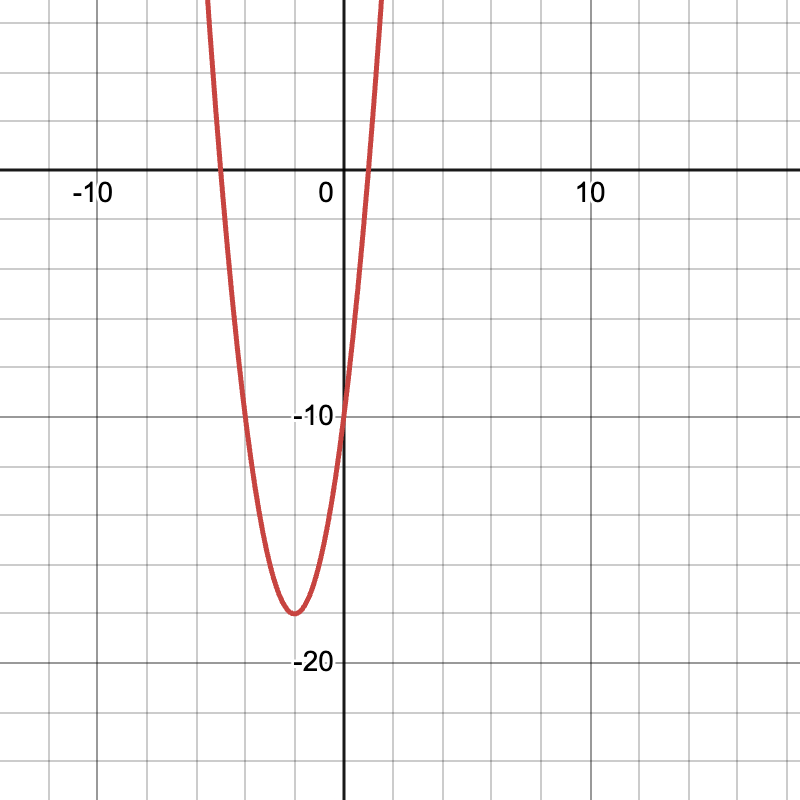
Therefore, the roots, or $x$-intercepts, are $x=1$ and $x=-5$. For the graph $y=2x^2+8x-10$, the turning point is $(-2,-18)$.
4. Quadratic Factorisation
Factorising $ax^2 + bx + c$ where $a \neq 1$.
Method: Split the Middle Term
- Find two numbers that multiply to $ac$ and add to $b$.
- Rewrite $bx$ using these two numbers.
- Factorise by grouping.
Example 1: Factorise and solve:
$$2x^2+7x+3=0$$
-
Find two numbers that multiply to $ac$ and add to $b$:
$$ac=2(3)=6, \qquad b=7$$
The numbers are $6$ and $1$ because:
$$6(1)=6, \qquad 6+1=7$$
-
Split the middle term:
$$2x^2+7x+3=2x^2+6x+x+3$$
-
Factorise by grouping:
$$2x^2+6x+x+3=2x(x+3)+1(x+3)$$
-
Take out the common bracket:
$$2x^2+7x+3=(2x+1)(x+3)$$
-
Set each factor equal to zero:
$$2x+1=0 \quad\Rightarrow\quad x=-\frac{1}{2}$$
$$x+3=0 \quad\Rightarrow\quad x=-3$$
Therefore, the solutions are:
$$x=-\frac{1}{2} \quad\text{or}\quad x=-3$$
Example 2: Factorise and solve $6x^2-x-2=0$.
-
Find two numbers that multiply to $ac$ and add to $b$:
$$ac=6(-2)=-12, \qquad b=-1$$
The numbers are $3$ and $-4$ because:
$$3(-4)=-12, \qquad 3+(-4)=-1$$
-
Split the middle term:
$$6x^2-x-2=6x^2+3x-4x-2$$
-
Factorise by grouping:
$$6x^2+3x-4x-2=3x(2x+1)-2(2x+1)$$
-
Take out the common bracket:
$$6x^2-x-2=(3x-2)(2x+1)$$
-
Solve by setting each factor equal to zero:
$$3x-2=0 \quad\Rightarrow\quad x=\frac{2}{3}$$
$$2x+1=0 \quad\Rightarrow\quad x=-\frac{1}{2}$$
Therefore, the solutions are:
$$x=\frac{2}{3} \quad\text{or}\quad x=-\frac{1}{2}$$