Perimeter, Area, and Volume
1. 2D Shapes
Area and Perimeter
| Shape | Perimeter | Area |
|---|---|---|
| Rectangle | $2(l + w)$ | $l \times w$ |
| Triangle | - | $\frac{1}{2} \times \text{base} \times \text{height}$ |
| Parallelogram | - | $\text{base} \times \text{height}$ |
| Trapezium | - | $\frac{1}{2}(a + b)h$ |
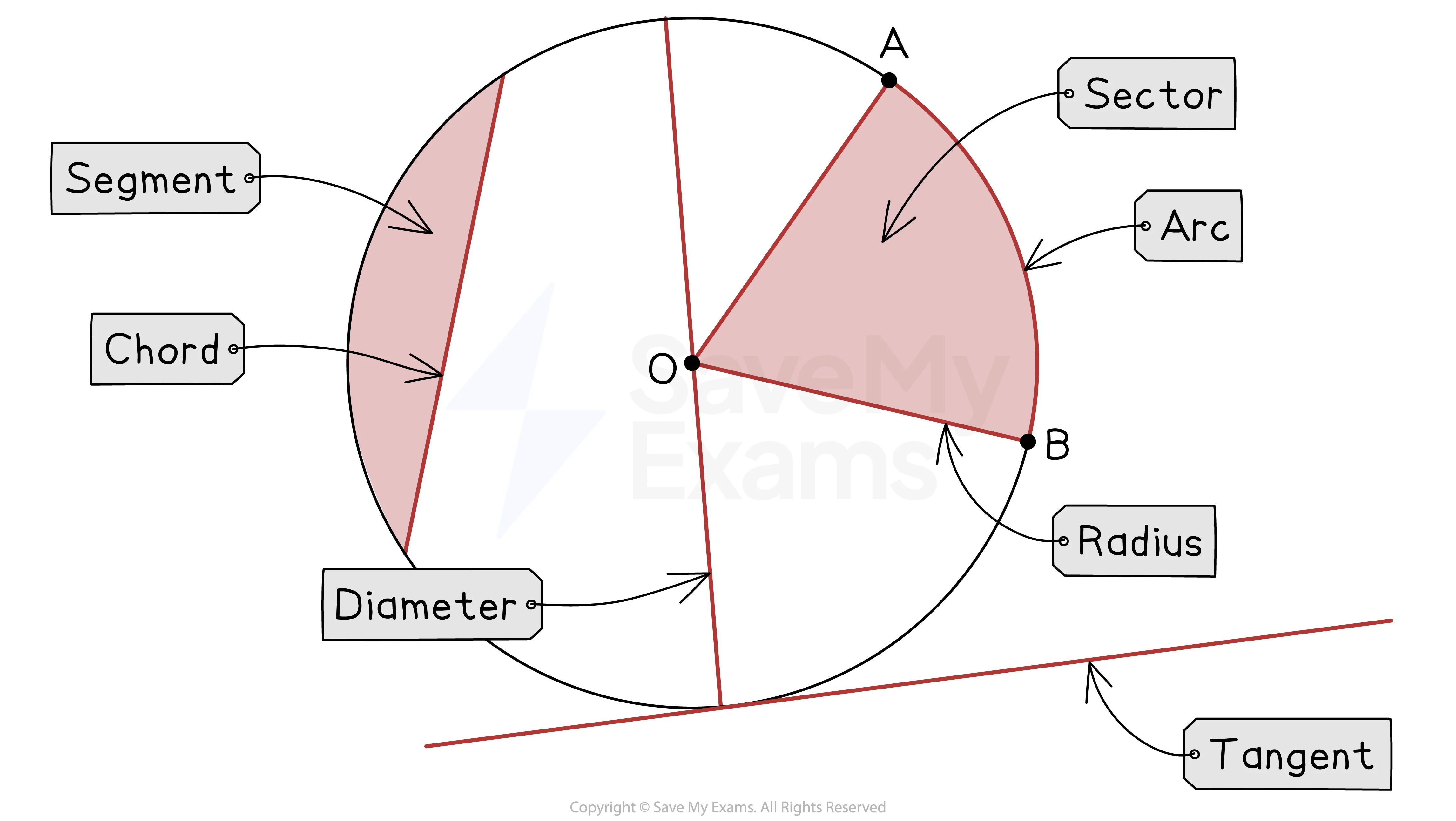
Circles
- Circumference: $C = 2\pi r$ or $\pi d$.
- Area: $A = \pi r^2$.
- Arc Length: $L = \frac{\theta}{360} \times 2\pi r$.
- Sector Area: $A = \frac{\theta}{360} \times \pi r^2$.
- For major sectors, $\theta$ is the reflex angle.
2. 3D Shapes
Surface Area and Volume
| Shape | Volume | Surface Area |
|---|---|---|
| Cuboid | $l \times w \times h$ | $2(lw + lh + wh)$ |
| Prism | $\text{Cross-section Area} \times \text{length}$ | - |
| Cylinder | $\pi r^2 h$ | $2\pi r^2 + 2\pi rh$ |
| Sphere | $\frac{4}{3}\pi r^3$ | $4\pi r^2$ |
| Pyramid | $\frac{1}{3} \times \text{Base Area} \times h$ | - |
| Cone | $\frac{1}{3}\pi r^2 h$ | $\pi r^2 + \pi rl$ (where $l$ is slant height) |
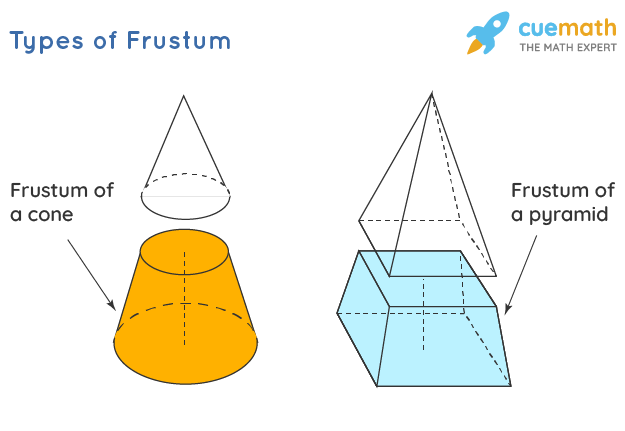
Frustums
A frustum is the part of a cone or pyramid that remains after the top is cut off by a plane parallel to the base.
- Volume: $V_{\text{frustum}} = V_{\text{large}} - V_{\text{small}}$.
- Surface Area: Sum of base areas and the lateral area (curved surface of the original minus the removed part).
3. Compound Shapes
- Perimeter: Sum of all external boundaries.
- Area: Split the composite 2D shape into simple rectangles, triangles, or circles. Add or subtract areas as necessary.
- Volume: Split the composite 3D solid into simpler prisms, cylinders, or spheres. Sum the individual volumes.