Pythagoras’ Theorem and Similar Shapes
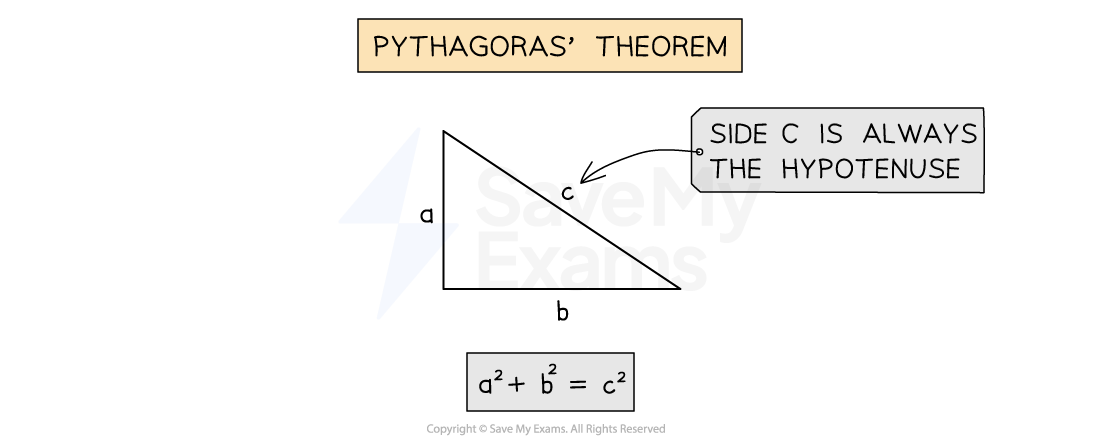
1. Pythagoras’ Theorem
Applies only to right-angled triangles.
The Formula
In a right-angled triangle with legs $a, b$ and hypotenuse $c$ (the side opposite the right angle): $$a^2 + b^2 = c^2$$
Calculations
- Finding the Hypotenuse: $c = \sqrt{a^2 + b^2}$.
- Finding a Shorter Side: $a = \sqrt{c^2 - b^2}$.
2. Similarity
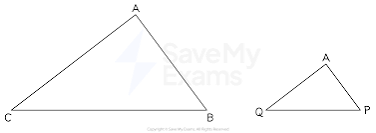
Two shapes are similar if they have the same shape but different sizes.
Key Properties
- Corresponding Angles: Are equal.
- Corresponding Sides: Are in the same ratio.
Scale Factor ($k$)
The ratio of any two corresponding lengths: $$k = \frac{\text{New Length}}{\text{Original Length}}$$
- To find a new length: $\text{New} = k \cdot \text{Original}$.
- To find the original length: $\text{Original} = \frac{\text{New}}{k}$.
Similar Triangles
Triangles are similar if:
- All corresponding angles are equal (AA similarity).
- All corresponding sides are proportional.
3. Congruence
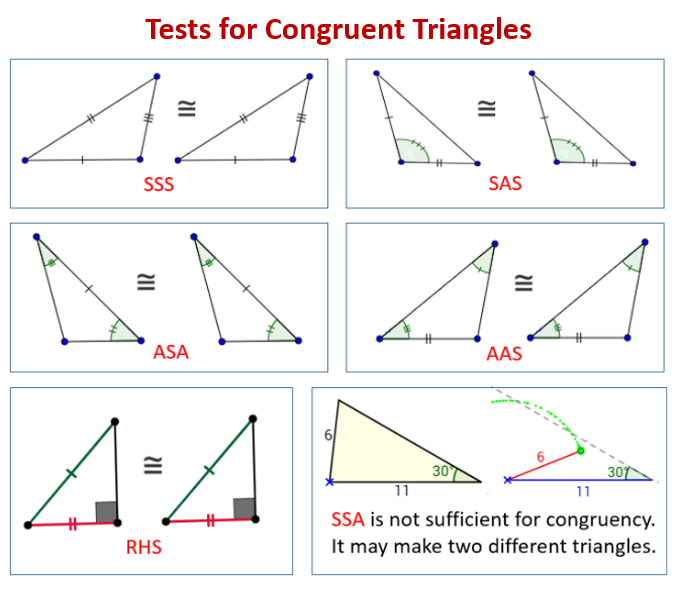
Two shapes are congruent if they are identical in shape and size.
Criteria for Congruent Triangles
Two triangles are congruent if any of the following are true:
- SSS (Side-Side-Side): All three corresponding sides are equal.
- SAS (Side-Angle-Side): Two sides and the included angle are equal.
- ASA (Angle-Side-Angle): Two angles and the included side are equal.
- RHS (Right angle-Hypotenuse-Side): The right angle, the hypotenuse, and one other side are equal.