Review of Number Concepts
1. Types of Numbers
Classifications
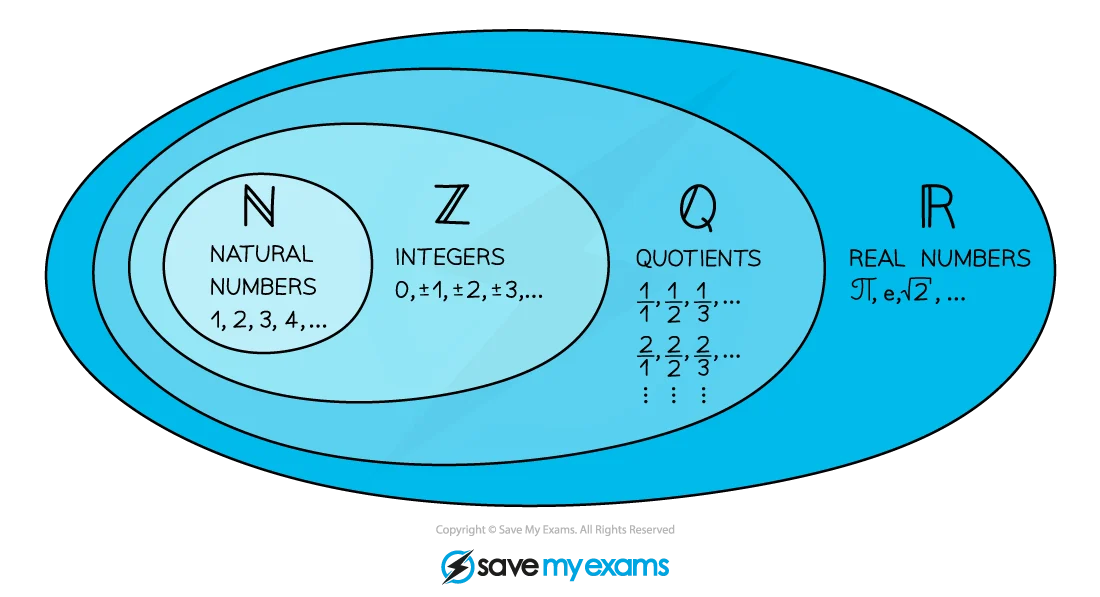
- Natural Numbers ($\mathbb{N}$): Counting numbers starting from 1 (1, 2, 3, …).
- Integers ($\mathbb{Z}$): Whole numbers, including negatives and zero (…, -2, -1, 0, 1, 2, …).
- Prime Numbers: Natural numbers greater than 1 with exactly two factors: 1 and themselves (2, 3, 5, 7, 11, …). Note: 1 is not prime; 2 is the only even prime.
- Square Numbers: Result of multiplying an integer by itself ($1, 4, 9, 16, 25, \dots$).
- Cube Numbers: Result of multiplying an integer by itself twice ($1, 8, 27, 64, 125, \dots$).
- Rational Numbers ($\mathbb{Q}$): Numbers that can be written as a fraction $\frac{a}{b}$ where $a, b$ are integers and $b \neq 0$. Includes terminating and recurring decimals.
- Irrational Numbers: Numbers that cannot be written as simple fractions (e.g., $\pi, \sqrt{2}, \sqrt{3}$). Their decimal expansions are non-terminating and non-recurring.
- Reciprocals: The reciprocal of a number $x$ is $\frac{1}{x}$. The product of a number and its reciprocal is always 1.
2. Prime Factorization, HCF, and LCM
- Prime Factorization: Expressing a composite number as a product of its prime factors using a factor tree or division method.
- Highest Common Factor (HCF): The largest factor shared by two or more numbers. Found by multiplying the lowest powers of common prime factors.
- Lowest Common Multiple (LCM): The smallest multiple shared by two or more numbers. Found by multiplying the highest powers of all prime factors present.
3. Powers, Roots, and Indices
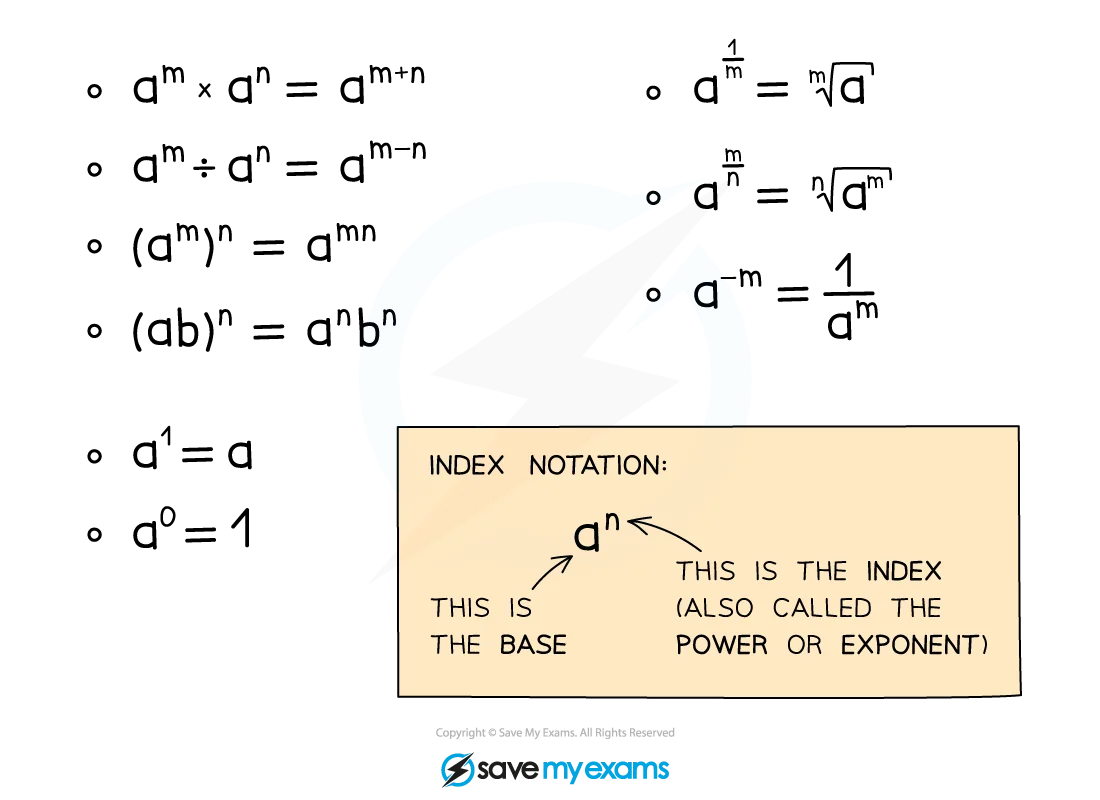
- Multiplication: $a^m \times a^n = a^{m+n}$
- Division: $a^m \div a^n = a^{m-n}$
- Power of a Power: $(a^m)^n = a^{mn}$
- Zero Index: $a^0 = 1$ (for $a \neq 0$)
- Negative Index: $a^{-n} = \frac{1}{a^n}$
- Fractional Indices: $a^{1/n} = \sqrt[n]{a}$ and $a^{m/n} = (\sqrt[n]{a})^m$
4. Order of Operations (BIDMAS/BODMAS)
Calculations must follow this priority:
- Brackets
- Indices (Powers/Roots)
- Division and Multiplication (Left to right)
- Addition and Subtraction (Left to right)
5. Rounding and Estimation
Accuracy
- Decimal Places (dp): Rounding to a specific number of digits after the decimal point.
- Significant Figures (sf): Rounding based on the first non-zero digit.
- Estimation: Rounding numbers to 1 significant figure before calculating to find an approximate answer.
Bounds
- Lower Bound: The smallest possible value a number could have been before rounding.
- Upper Bound: The smallest value that would round up to the next unit (effectively the ceiling).
- When calculating with bounds:
- Max value of $A + B = \text{Upper } A + \text{Upper } B$
- Min value of $A + B = \text{Lower } A + \text{Lower } B$
- Max value of $A - B = \text{Upper } A - \text{Lower } B$
- Min value of $A - B = \text{Lower } A - \text{Upper } B$
6. Directed Numbers
- Addition/Subtraction: Use a number line. Adding a negative is the same as subtracting; subtracting a negative is the same as adding.
- Multiplication/Division:
- Same signs $\rightarrow$ Positive result $(+ \times + = +$ or $- \times - = +)$
- Different signs $\rightarrow$ Negative result $(+ \times - = -$ or $- \times + = -)$