Scale Drawings, Bearings and Trigonometry
1. Scale Drawings
Scale drawings represent real-life objects or areas at a reduced size while maintaining proportions.
Scale Factors
A scale is written as $\text{Drawing Distance} : \text{Real Distance}$ (e.g., $1 : 50,000$).
- Finding Real Distance: $\text{Real Distance} = \text{Drawing Distance} \times \text{Scale Factor}$.
- Finding Drawing Distance: $\text{Drawing Distance} = \text{Real Distance} \div \text{Scale Factor}$.
2. Bearings
Bearings are used for navigation to specify direction.
Three-Figure Bearings
- Measured from North.
- Measured Clockwise.
- Always written as three digits (e.g., $045^\circ$ instead of $45^\circ$).
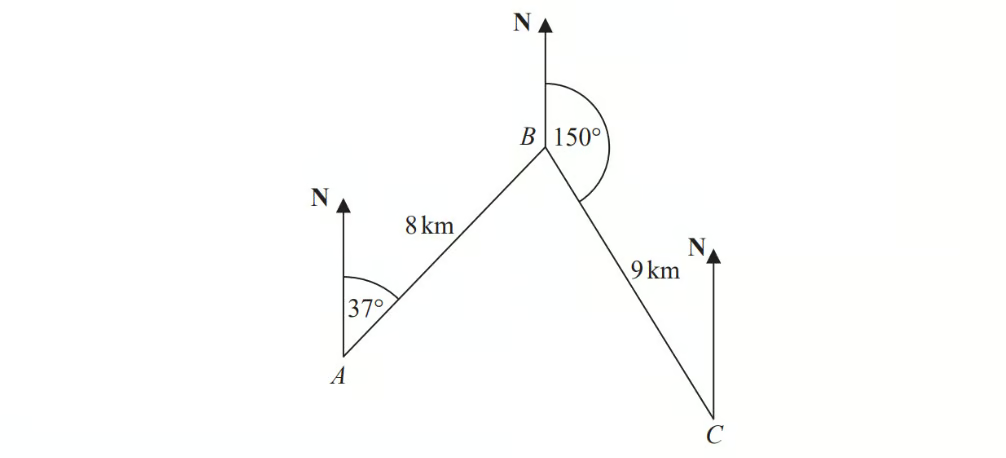
Reverse Bearings: To find the bearing from B back to A:
- If bearing $A \rightarrow B$ is $\theta$, then bearing $B \rightarrow A = \theta + 180^\circ$ (if $\theta < 180^\circ$) or $\theta - 180^\circ$ (if $\theta \ge 180^\circ$).
3. Right-Angle Trigonometry
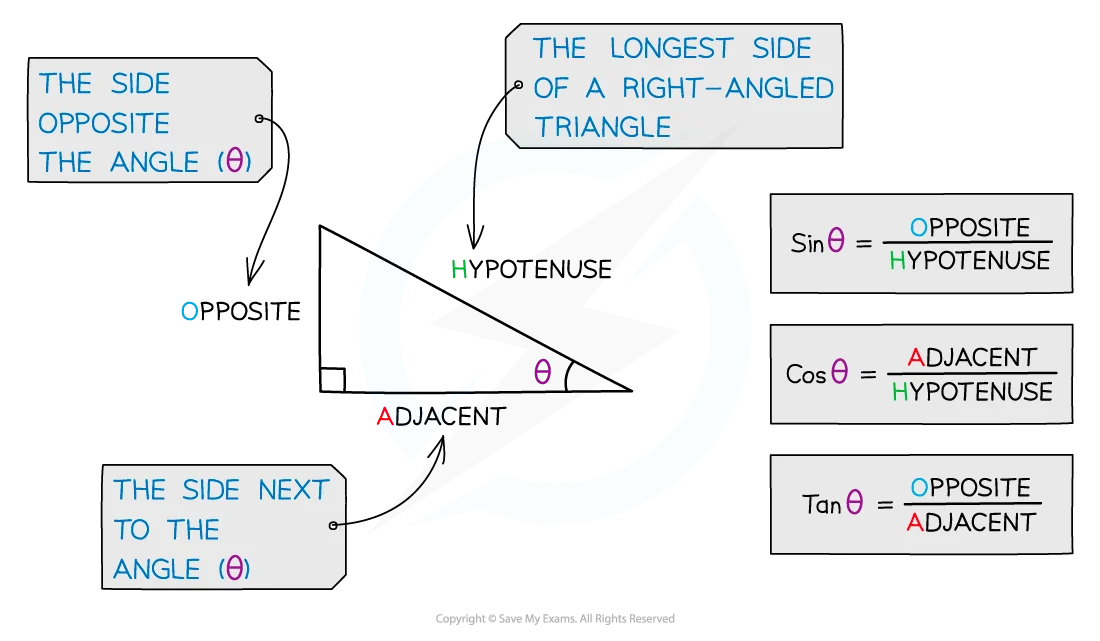
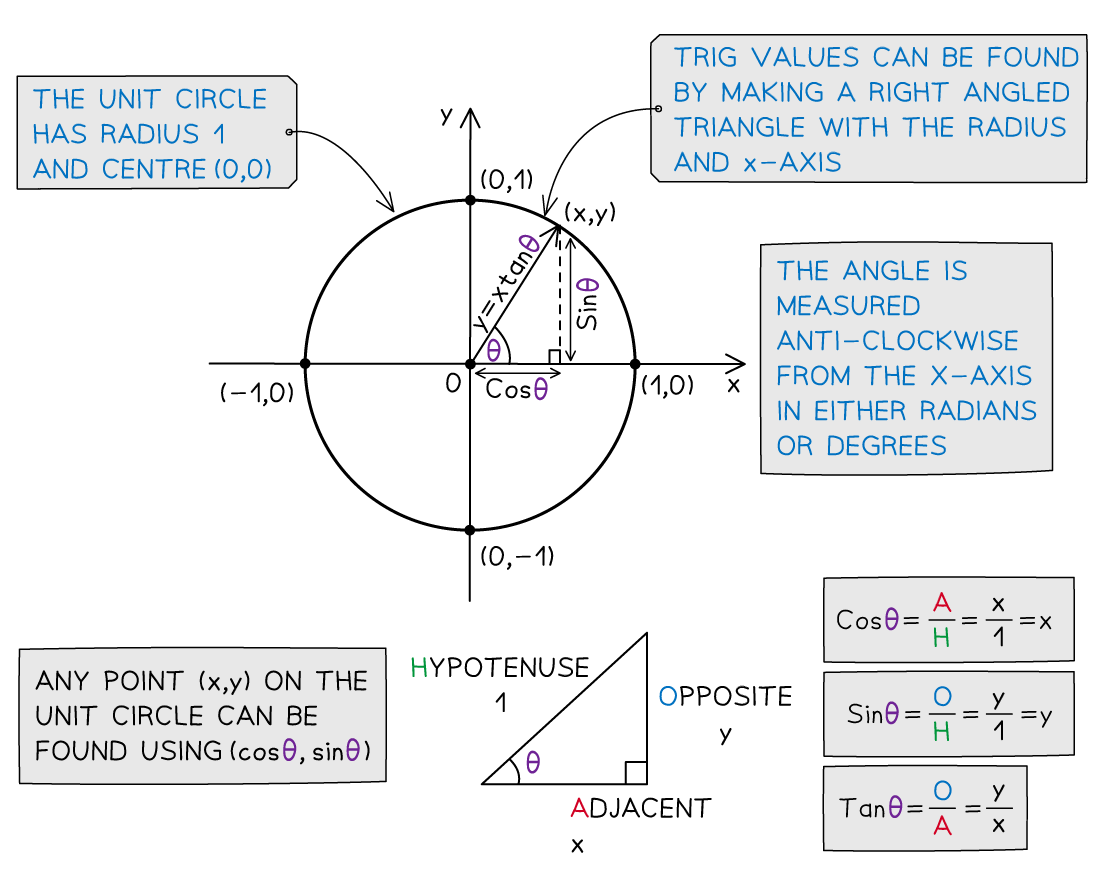
Applied to triangles with a $90^\circ$ angle.
SOH CAH TOA
- $\sin(\theta) = \frac{\text{Opposite}}{\text{Hypotenuse}}$
- $\cos(\theta) = \frac{\text{Adjacent}}{\text{Hypotenuse}}$
- $\tan(\theta) = \frac{\text{Opposite}}{\text{Adjacent}}$
Solving for Sides and Angles
- Sides: Use the ratio $\times$ the known side.
- Angles: Use the inverse function ($\sin^{-1}, \cos^{-1}, \tan^{-1}$).
4. Exact Trigonometric Values
Certain angles have exact ratios that should be memorized.
| $\theta$ | $0^\circ$ | $30^\circ$ | $45^\circ$ | $60^\circ$ | $90^\circ$ |
|---|---|---|---|---|---|
| $\sin \theta$ | $0$ | $1/2$ | $1/\sqrt{2}$ | $\sqrt{3}/2$ | $1$ |
| $\cos \theta$ | $1$ | $\sqrt{3}/2$ | $1/\sqrt{2}$ | $1/2$ | $0$ |
| $\tan \theta$ | $0$ | $1/\sqrt{3}$ | $1$ | $\sqrt{3}$ | Undef |
5. Non-Right-Angle Trigonometry
Applied to any triangle $ABC$ with sides $a, b, c$ opposite to angles $A, B, C$.
Sine Rule
Used when we have a “matching pair” (angle and opposite side). $$\frac{a}{\sin A} = \frac{b}{\sin B} = \frac{c}{\sin C}$$
Cosine Rule
Used when we have SAS (Side-Angle-Side) or SSS (Side-Side-Side).
- Finding Side: $a^2 = b^2 + c^2 - 2bc \cos A$
- Finding Angle: $\cos A = \frac{b^2 + c^2 - a^2}{2bc}$
Area of a Triangle
$$\text{Area} = \frac{1}{2}ab \sin C$$
6. Advanced Trigonometry
Angles $> 90^\circ$
When angles exceed $90^\circ$, trigonometric values repeat or change signs based on the quadrant of the angle.
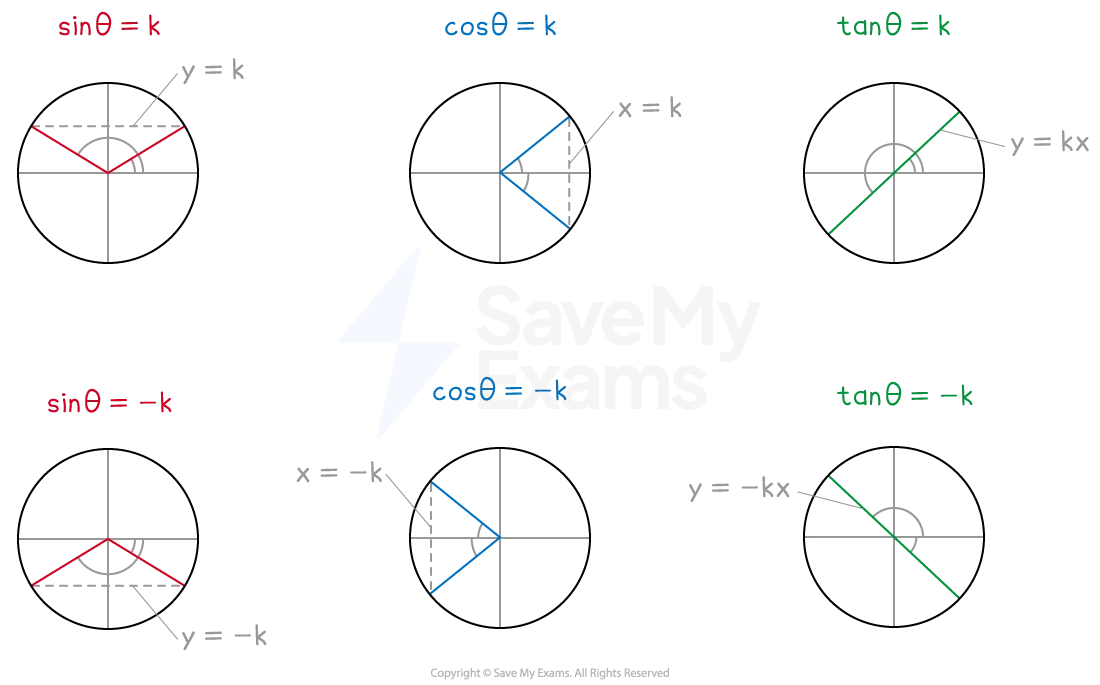
Trigonometric Graphs The periodic nature of trig functions means that different angles can produce the same value:
- Sine Graph: A wave with a period of $360^\circ$. It is symmetric around $90^\circ$, meaning $\sin(\theta) = \sin(180^\circ - \theta)$.
- Cosine Graph: A wave with a period of $360^\circ$. It is symmetric around $0^\circ/360^\circ$, meaning $\cos(\theta) = \cos(360^\circ - \theta)$.
- Tangent Graph: A repeating curve with a period of $180^\circ$ and asymptotes at $90^\circ$ and $270^\circ$. It satisfies $\tan(\theta) = \tan(180^\circ + \theta)$.
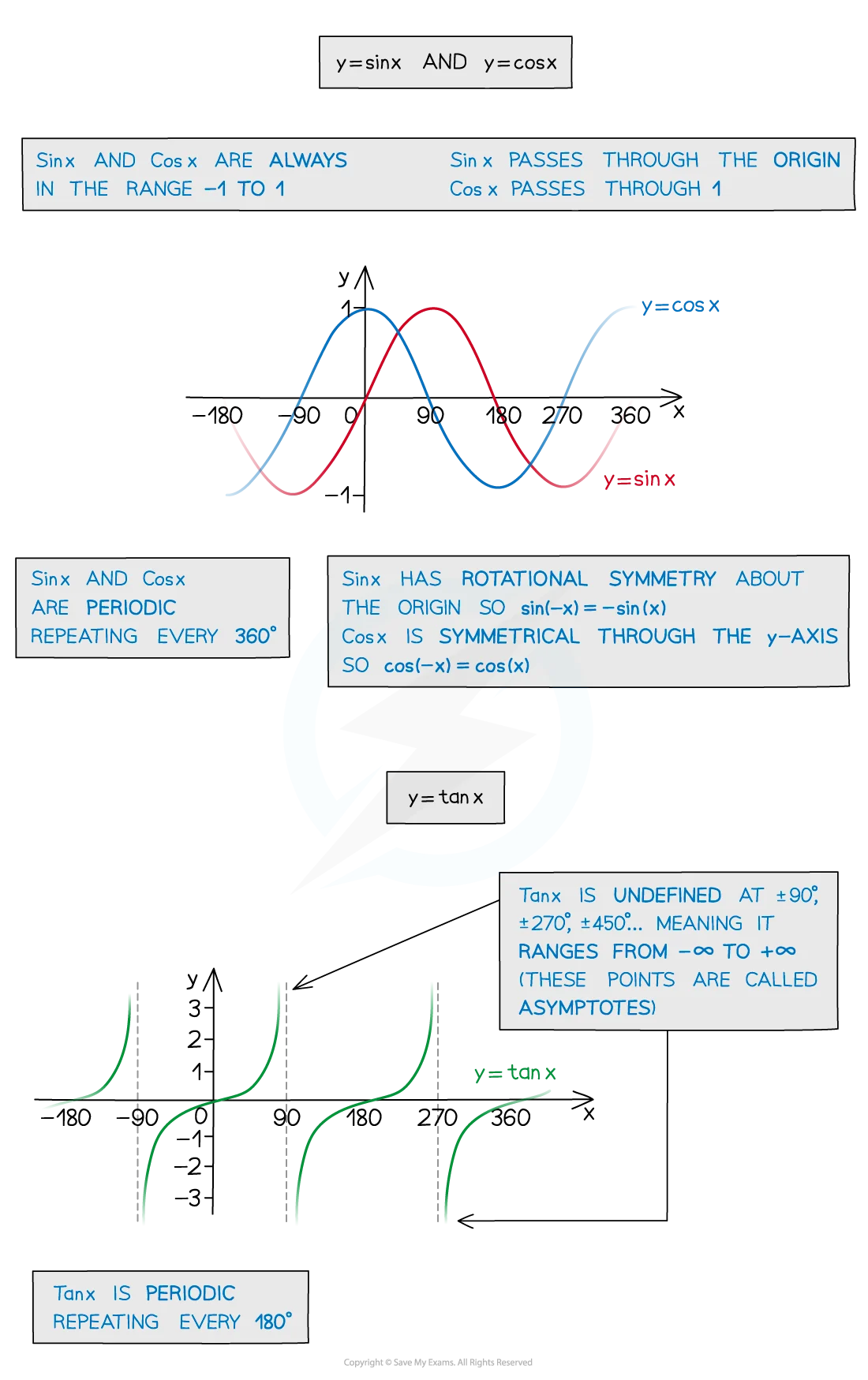
Inverse Values and Multiple Angles Because these functions are periodic, the inverse of a value often leads to more than one possible angle within $0^\circ$ to $360^\circ$.
- The Calculator Limitation: Calculators are programmed to provide only the principal value (the angle closest to $0$). For example, $\sin^{-1}(0.5)$ will always return $30^\circ$.
- Finding the Second Angle:
- For Sine: If the calculator gives $\theta$, the other possibility is $180^\circ - \theta$.
- For Cosine: If the calculator gives $\theta$, the other possibility is $360^\circ - \theta$.
- For Tangent: If the calculator gives $\theta$, the other possibility is $180^\circ + \theta$.
This is why, in a triangle, you must check if an obtuse angle ($> 90^\circ$) is possible based on the given side lengths.
Graphical Explanation:
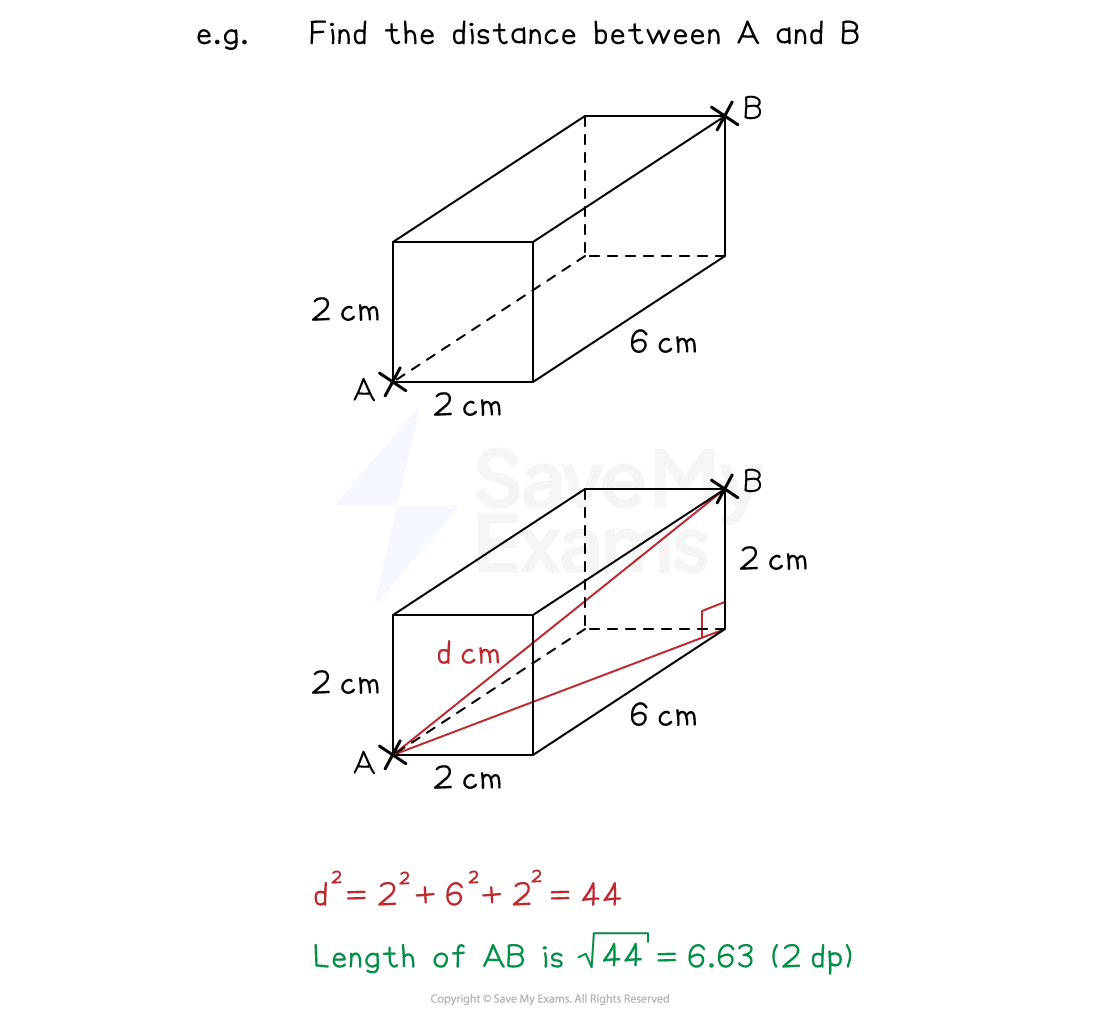
3D Trigonometry
- Definition: Finding lengths, angles, and distances within three-dimensional objects (like pyramids or prisms).
- Strategy:
- Step 1: Visualize and Sketch. Draw the 3D object and highlight the specific 2D triangles you need.
- Step 2: Isolate 2D Triangles. Find a right-angled triangle that connects the known values to the unknown value.
- Step 3: Chain of Calculation. Often, you must solve for an intermediate side length first (e.g., find the diagonal of the base) before you can find the final target value.
- Step 4: Apply SOH CAH TOA or Pythagoras. Use the relevant rules sequentially.