Sequences, Surds, and Sets
1. Sequences
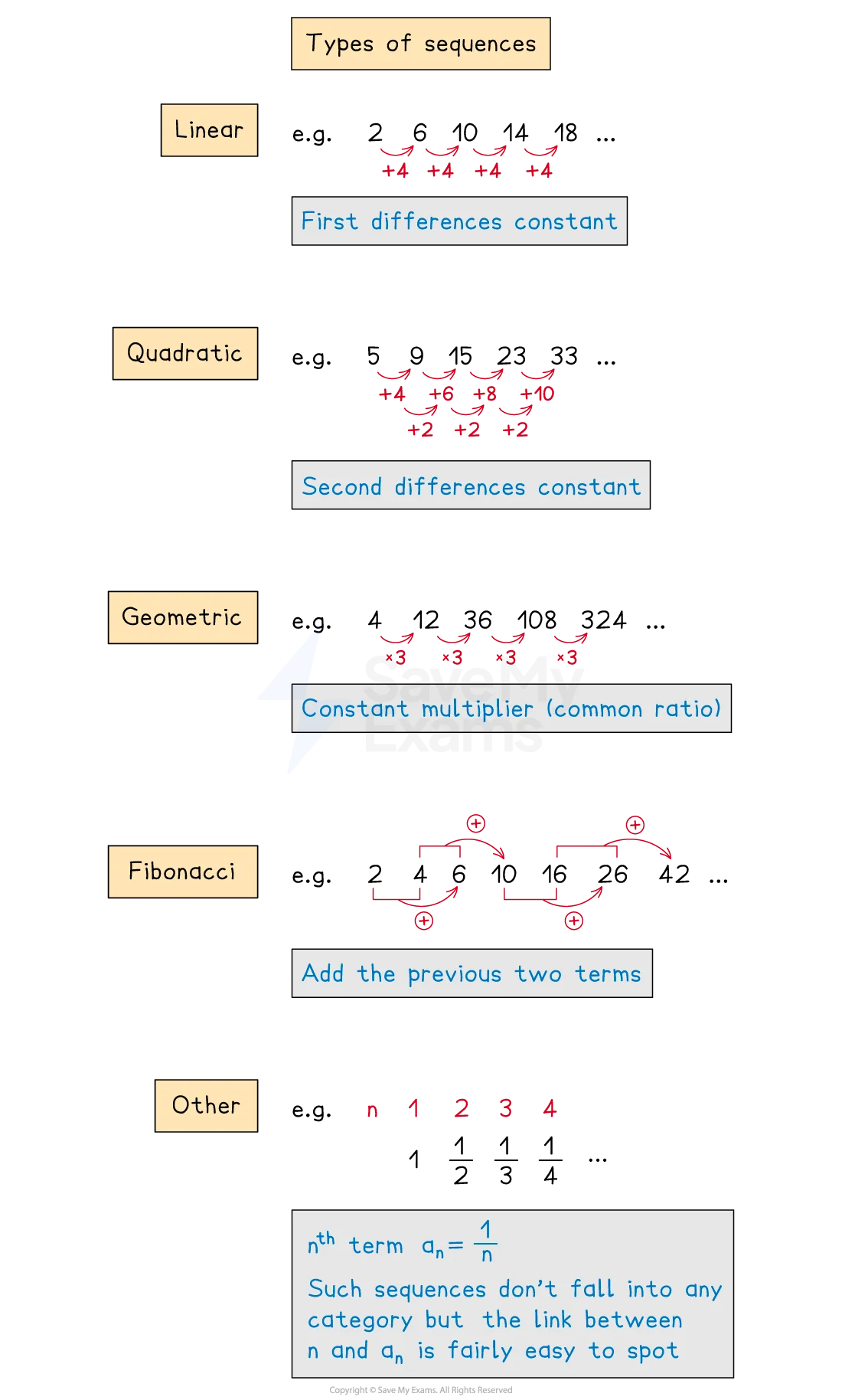
A sequence is an ordered list of numbers following a specific rule.
Term-to-Term Rules
Describes how to get from one term to the next.
- Arithmetic Sequence: Constant difference added or subtracted (e.g., $+3, +3, +3$).
- Geometric Sequence: Constant ratio multiplied or divided (e.g., $\times 2, \times 2, \times 2$).
The $n$-th Term ($u_n$)
The formula to find any term in the sequence based on its position $n$.
Linear Sequences
Formula: $u_n = dn + c$
- $d$: Common difference.
- $c$: The “zero-th” term (term before the first term).
- Example: $5, 8, 11, 14… \rightarrow d=3, c=2 \rightarrow u_n = 3n + 2$.
Quadratic Sequences
Formula: $u_n = an^2 + bn + c$
- The second difference is constant and equals $2a$.
- Example: $2, 6, 12, 20…$ (1st diff: $4, 6, 8$; 2nd diff: $2, 2$). $2a=2 \rightarrow a=1$.
Cubic Sequences
Formula: $u_n = an^3 + bn^2 + cn + d$
- The third difference is constant.
Exponential Sequences
Formula: $u_n = a \cdot r^{(n-1)}$
- $a$: First term.
- $r$: Common ratio.
- Example: $3, 6, 12, 24… \rightarrow u_n = 3 \cdot 2^{n-1}$.
2. Rational and Irrational Numbers
Rational Numbers
Any number that can be expressed as a fraction $\frac{p}{q}$ where $p$ and $q$ are integers and $q \neq 0$.
- Includes integers, finite decimals, and recurring decimals.
- Examples: $5, -2, 0.75, \frac{1}{3}, 0.333…$
Irrational Numbers
Numbers that cannot be written as a simple fraction. Their decimal expansions are non-terminating and non-recurring.
- Examples: $\pi, \sqrt{2}, \sqrt{3}, e$.
3. Surds
A surd is an irrational number expressed as a root (usually square root).
Simplifying Surds
Use the property $\sqrt{ab} = \sqrt{a} \cdot \sqrt{b}$. Look for the largest square factor.
- Example: $\sqrt{50} = \sqrt{25 \cdot 2} = 5\sqrt{2}$.
Rationalising the Denominator
Removing the surd from the bottom of a fraction.
Type 1: Single Surd Multiply numerator and denominator by the surd.
- $\frac{1}{\sqrt{a}} = \frac{1 \cdot \sqrt{a}}{\sqrt{a} \cdot \sqrt{a}} = \frac{\sqrt{a}}{a}$.
Type 2: Binomial Surd Multiply by the conjugate (change the sign).
- $\frac{1}{a + \sqrt{b}} = \frac{1(a - \sqrt{b})}{(a + \sqrt{b})(a - \sqrt{b})} = \frac{a - \sqrt{b}}{a^2 - b}$.
4. Sets
A set is a collection of distinct objects (elements).
Notation
- $x \in A$: Element $x$ is a member of set $A$.
- $x \notin A$: Element $x$ is not a member of set $A$.
- $\emptyset$ or ${ }$: The empty set (contains no elements).
- $A \subseteq B$: Set $A$ is a subset of set $B$ (all elements of $A$ are also in $B$).
- $A \not\subseteq B$: Set $A$ is not a subset of set $B$.
- $\xi$: The universal set (contains all elements under consideration).
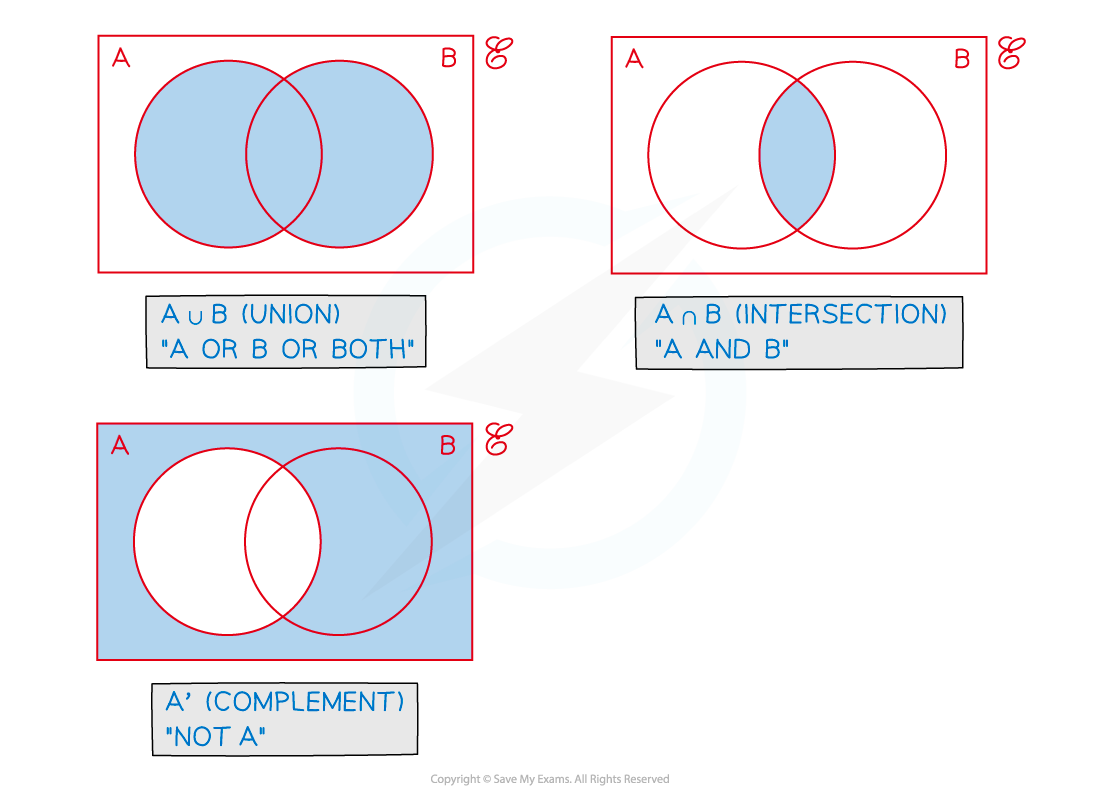
Venn Diagrams
Visual representation of sets.
- Intersection ($A \cap B$): Elements in both $A$ and $B$.
- Union ($A \cup B$): Elements in $A$ or $B$ (or both).
- Complement ($A’$): Elements not in $A$.
3-Set Venn Diagrams: Used to represent relationships between three sets. Ensure the central intersection ($A \cap B \cap C$) is filled first.