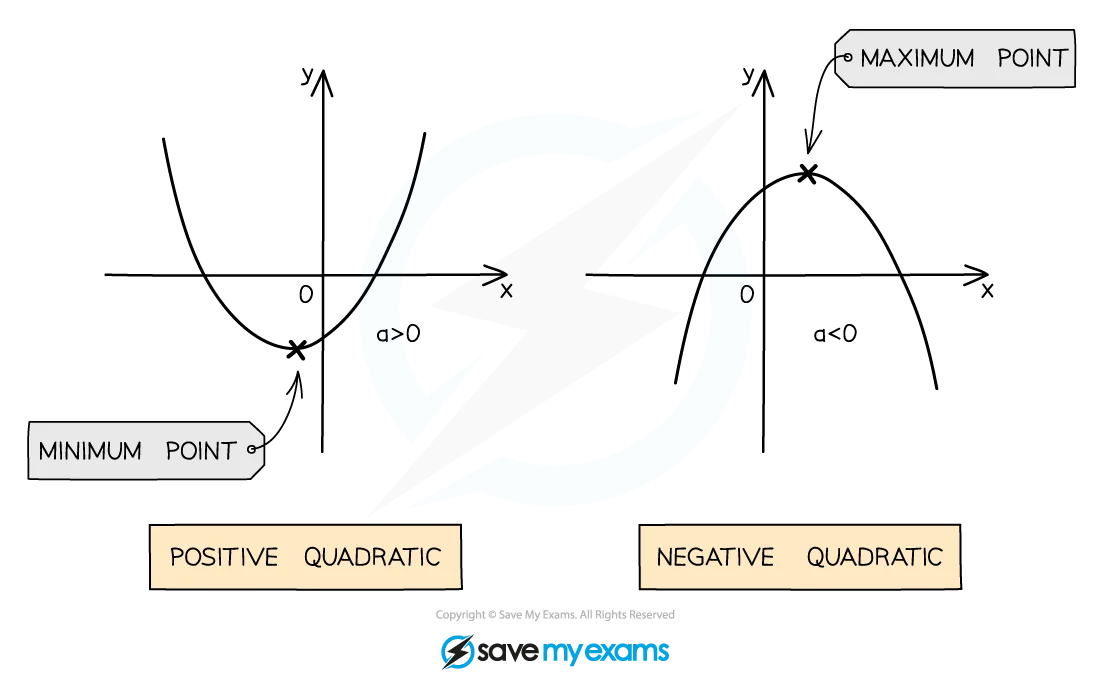
Straight Lines and Quadratic Equations
1. Straight Line Graphs
Represented on a 2D Cartesian coordinate system $(x, y)$.
The Equation of a Line
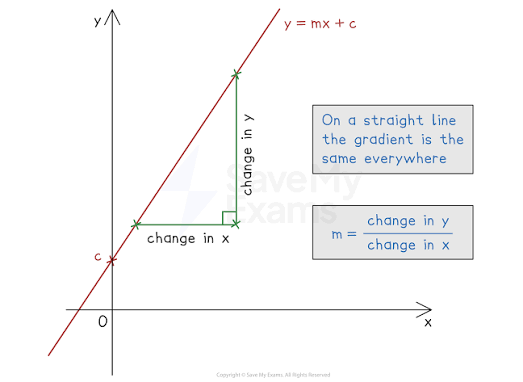
General form: $y = mx + c$
- $m$: Gradient (slope).
- $c$: $y$-intercept (where the line crosses the $y$-axis).
Gradient ($m$)
Gradient measures the steepness: $\text{gradient} = \frac{\text{vertical change}}{\text{horizontal change}} = \frac{\text{rise}}{\text{run}}$.
Calculating Gradient from Two Points: Given $(x_1, y_1)$ and $(x_2, y_2)$: $$m = \frac{y_2 - y_1}{x_2 - x_1}$$
Midpoint
- The midpoint is the point exactly halfway between two points $(x_1, y_1)$ and $(x_2, y_2)$.
$$\text{Midpoint} = \left( \frac{x_1 + x_2}{2}, \frac{y_1 + y_2}{2} \right)$$
Parallel and Perpendicular Lines
- Parallel Lines: Have the same gradient ($m_1 = m_2$).
- Perpendicular Lines: Gradients are negative reciprocals ($m_1 \cdot m_2 = -1$ or $m_2 = -\frac{1}{m_1}$).
2. Quadratic Expressions
Expressions of the form $ax^2 + bx + c$.
Expansion
Using the distributive law (FOIL: First, Outer, Inner, Last).
- $(x + a)(x + b) = x^2 + (a+b)x + ab$.
- Difference of Two Squares: $(a - b)(a + b) = a^2 - b^2$.
Factorisation
The reverse of expansion.
- Common Factors: $3x^2 + 6x = 3x(x + 2)$.
- Simple Trinomials: $x^2 + 5x + 6 = (x + 2)(x + 3)$.
- Harder Trinomials ($ax^2 + bx + c$): Use “splitting the middle term” or trial and error.
- Difference of Two Squares: $x^2 - 16 = (x - 4)(x + 4)$.
3. Quadratic Equations
Solving for $x$ when $ax^2 + bx + c = 0$.
Methods of Solving
-
Factorisation
- Goal: Find the roots by breaking the quadratic expression into two linear factors.
- Use Case: Best used when the expression is easily factorisable (e.g., simple integers for $a, b, c$).
- Step-by-Step:
- Step 1: Rearrange the equation to set it to zero: $ax^2 + bx + c = 0$.
- Step 2: Factorise the quadratic expression into two linear brackets.
- Step 3: Use the Zero Product Property: If $A \cdot B = 0$, then either $A = 0$ or $B = 0$.
- Step 4: Solve the resulting linear equations for $x$.
-
Completing the Square
-
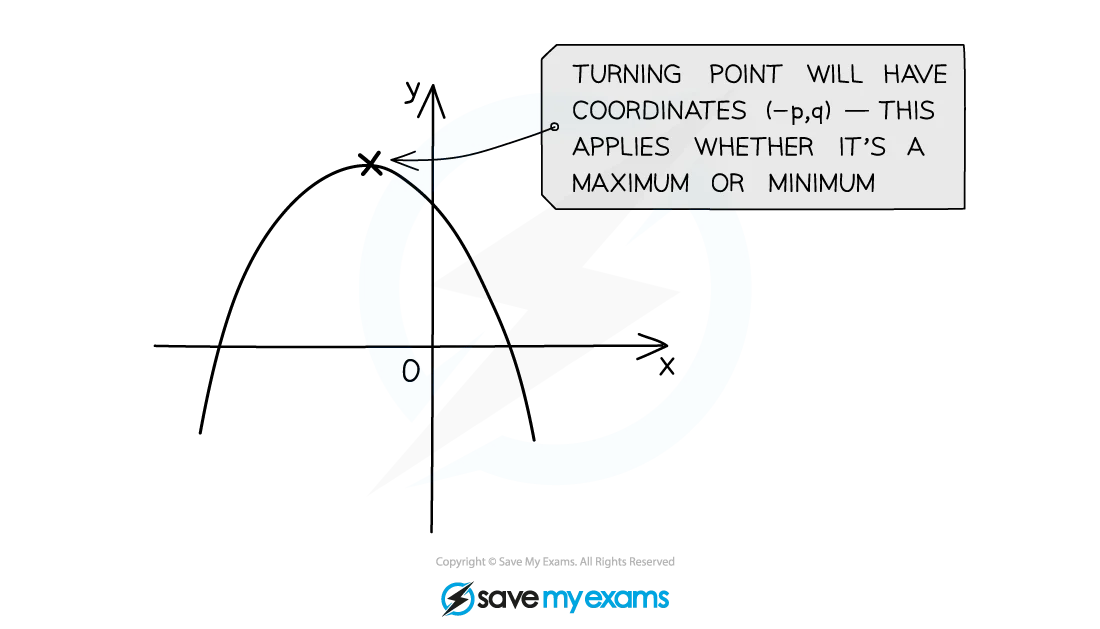
Goal: Transform the quadratic into a “perfect square” form to easily isolate the variable $x$ or find the vertex of the parabola. $$(x + p)^2 + q$$
$p$ represents half the coefficient of $x$ (after $a=1$).
In vertex form $(x + p)^2 + q$, the x-coordinate of the vertex is $-p$.$q$ represents the constant remaining after the square is completed.
In vertex form $(x + p)^2 + q$, the y-coordinate of the vertex is $q$.
-
- Use Case: Used when factorisation is difficult, or when the vertex (turning point) of the parabola is required.
- Explanation found in chapter 14
- Quadratic Formula
- Goal: Directly calculate the roots using the coefficients of the equation.
- Use Case: A universal method that works for any quadratic, especially when roots are irrational or cannot be easily factorised.
- Step-by-Step:
- Step 1: Write the equation in standard form: $ax^2 + bx + c = 0$.
- Step 2: Identify the coefficients $a$, $b$, and $c$.
- Step 3: Substitute these values into the formula: $$x = \frac{-b \pm \sqrt{b^2 - 4ac}}{2a}$$
- Step 4: Simplify the discriminant ($\sqrt{b^2 - 4ac}$) and calculate the two possible values for $x$.
4. Graphical Solutions
The solution to a quadratic equation $ax^2 + bx + c = 0$ corresponds to the x-intercepts (roots) of the graph $y = ax^2 + bx + c$.
- Two Roots: Graph crosses $x$-axis twice ($b^2 - 4ac > 0$).
- One Root: Graph touches $x$-axis once (vertex is on axis, $b^2 - 4ac = 0$).
- No Real Roots: Graph does not touch $x$-axis ($b^2 - 4ac < 0$).