Understanding Measurement
1. Standard Metric Units and Conversions
Metric units follow a base-10 system. Conversion involves multiplying or dividing by powers of 10.
Common Units
- Length: millimeter (mm), centimeter (cm), meter (m), kilometer (km)
- Mass: milligram (mg), gram (g), kilogram (kg), tonne (t)
- Capacity/Volume: milliliter (ml), liter (l), cubic centimeter ($\text{cm}^3$), cubic meter ($\text{m}^3$)
Conversion Factors
- $1\text{ cm} = 10\text{ mm}$
- $1\text{ m} = 100\text{ cm} = 1000\text{ mm}$
- $1\text{ km} = 1000\text{ m}$
- $1\text{ kg} = 1000\text{ g}$
- $1\text{ l} = 1000\text{ ml} = 1000\text{ cm}^3$
Tip: To convert from a larger unit to a smaller unit, multiply. To convert from a smaller unit to a larger unit, divide.
2. Time
Units and Clock Systems
- Units: $1\text{ hour} = 60\text{ minutes}$, $1\text{ minute} = 60\text{ seconds}$.
- 12-hour Clock: Uses AM (Ante Meridiem) and PM (Post Meridiem).
- 24-hour Clock: Uses 00:00 to 23:59. To convert PM times to 24h, add 12 to the hour (e.g., 3:00 PM $\rightarrow$ 15:00), except for 12:00 PM.
Timetables and Time Zones
- Timetables: Read rows (destinations) and columns (times) to find durations. $\text{Duration} = \text{Arrival Time} - \text{Departure Time}$.
- Time Zones: Measured relative to UTC/GMT.
- East: Add hours (+).
- West: Subtract hours (-).
3. Accuracy and Bounds
Rounding introduces error. Bounds define the range within which the true value lies.
Upper and Lower Bounds
If a value $x$ is rounded to the nearest $k$:
- Lower Bound (LB): $x - \frac{k}{2}$
- Upper Bound (UB): $x + \frac{k}{2}$
Example: $70\text{ kg}$ to the nearest $10\text{ kg}$.
- $\text{LB} = 70 - 5 = 65\text{ kg}$
- $\text{UB} = 70 + 5 = 75\text{ kg}$
Bounds in Calculations
To find the bounds of a calculated result:
- Addition: $\text{Max} = \text{UB}_1 + \text{UB}_2$; $\text{Min} = \text{LB}_1 + \text{LB}_2$
- Subtraction: $\text{Max} = \text{UB}_1 - \text{LB}_2$; $\text{Min} = \text{LB}_1 - \text{UB}_2$
- Multiplication: $\text{Max} = \text{UB}_1 \times \text{UB}_2$; $\text{Min} = \text{LB}_1 \times \text{LB}_2$
- Division: $\text{Max} = \text{UB}_1 \div \text{LB}_2$; $\text{Min} = \text{LB}_1 \div \text{UB}_2$
4. Conversion Graphs
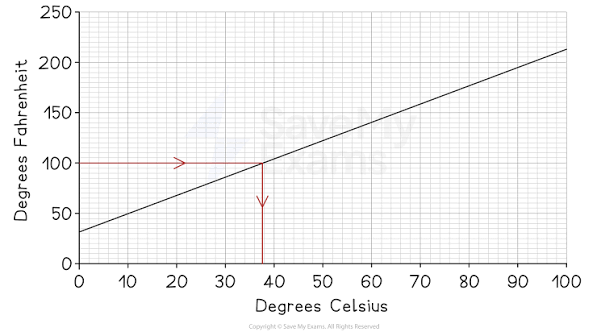
Linear conversion graphs show the relationship between two different units of measurement.
- Drawing: Plot known conversion points (e.g., $0\text{ Celsius} = 32\text{ Fahrenheit}$). Draw a straight line through the points.
- Using: Locate the value on one axis, move vertically/horizontally to the line, and read the corresponding value on the other axis.
5. Currency Exchange
Currency exchange involves converting the value of one currency to another using an exchange rate.
Calculations
- Converting from Base to Foreign: $\text{Foreign Amount} = \text{Base Amount} \times \text{Exchange Rate}$
- Converting from Foreign to Base: $\text{Base Amount} = \text{Foreign Amount} \div \text{Exchange Rate}$
Example: If $1\text{ USD} = 0.92\text{ EUR}$:
- $100\text{ USD} = 100 \times 0.92 = 92\text{ EUR}$
- $100\text{ EUR} = 100 \div 0.92 \approx 108.70\text{ USD}$