Coordination
Coordination allows an organism to detect changes, process information, and produce a suitable response.
- A stimulus is a change in the internal or external environment.
- A receptor detects a stimulus.
- A coordination system processes information.
- An effector produces a response. Effectors are muscles or glands.
Humans coordinate responses using the nervous system and the endocrine system.
Nervous coordination
Electrical impulses travel along neurones. The nervous system consists of:
- Central nervous system (CNS): the brain and spinal cord
- Peripheral nervous system (PNS): nerves outside the brain and spinal cord.
The nervous system coordinates rapid responses by carrying information from receptors to the CNS and impulses from the CNS to effectors.
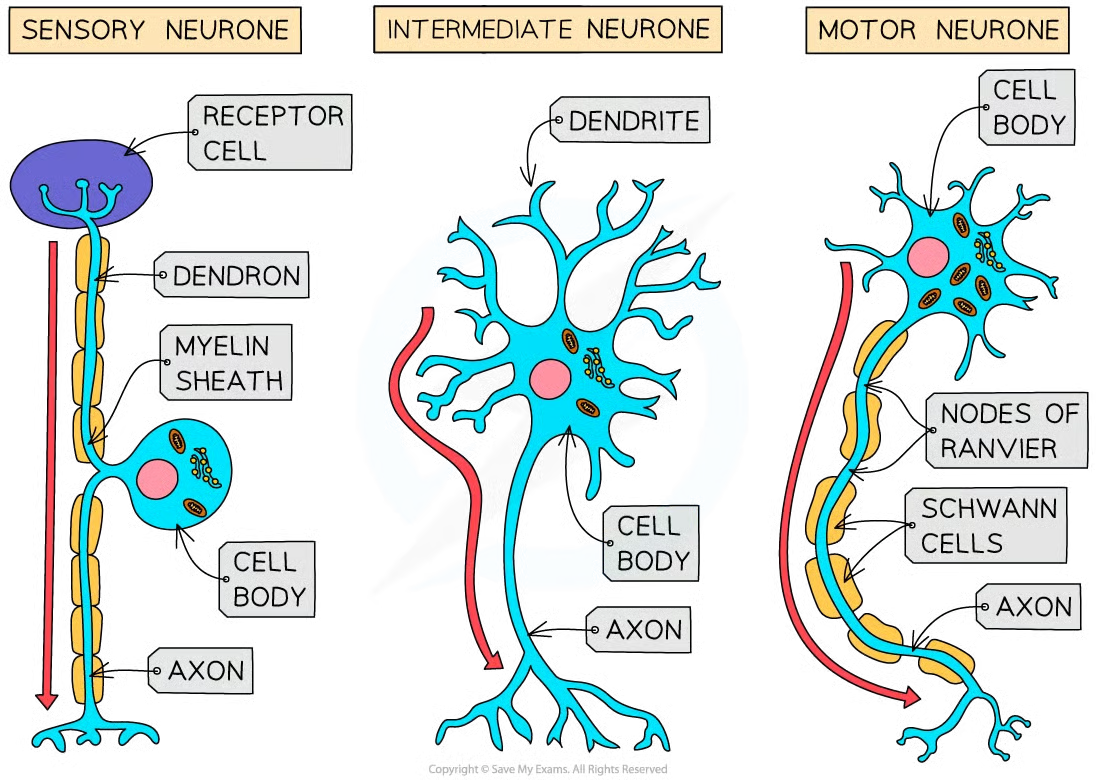
Three neurone types are important:
- Sensory neurone: carries impulses from a receptor to the CNS
- Relay neurone: carries impulses within the CNS, between sensory and motor neurones
- Motor neurone: carries impulses from the CNS to an effector.
Reflex arc and reflex action
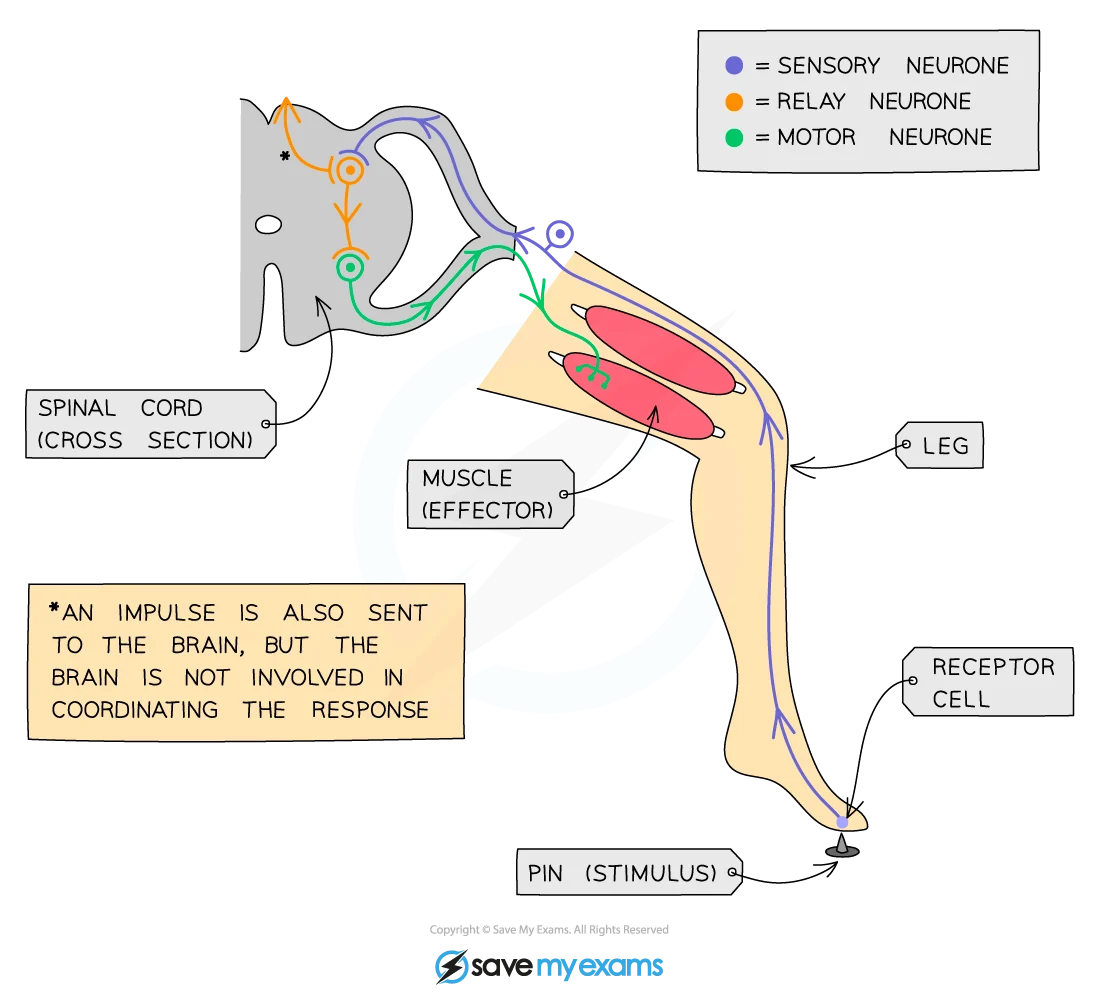
A reflex action is a rapid, automatic response to a stimulus. It protects the body because it does not require a conscious decision before the response begins.
The pathway of a simple reflex arc is:
stimulus → receptor → sensory neurone → relay neurone in CNS
         → motor neurone → effector → response
Synapses
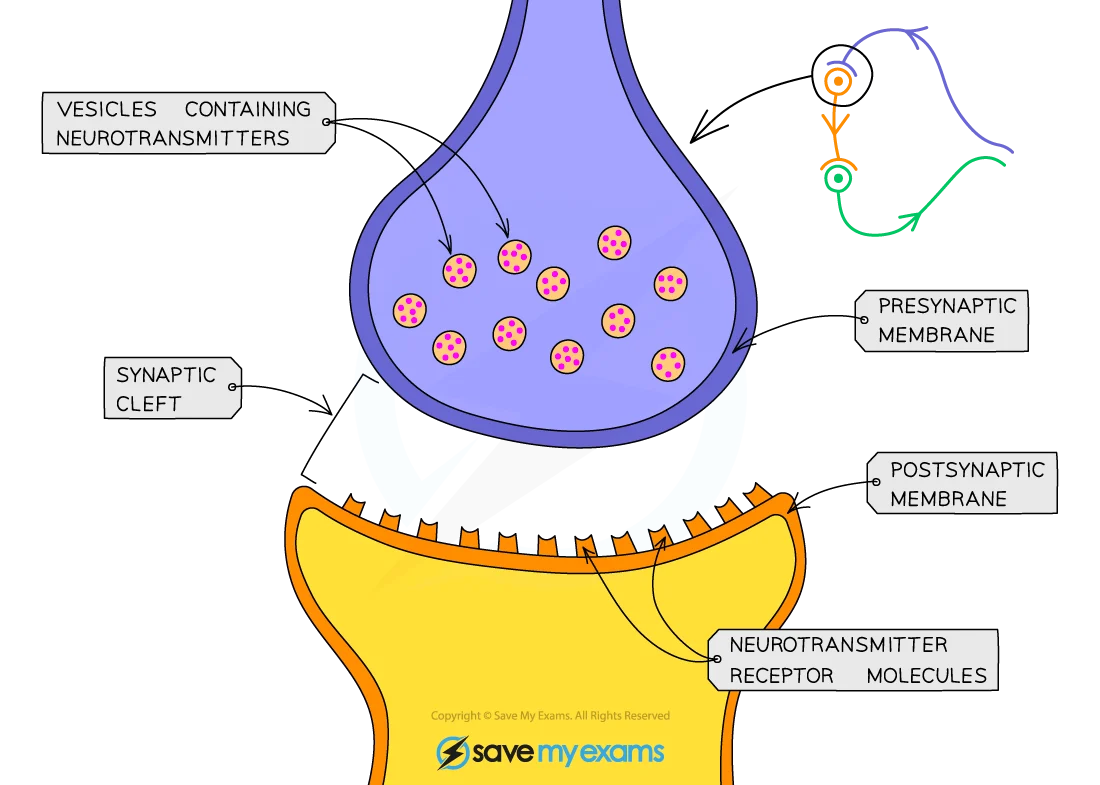
A synapse is a junction between two neurones. It includes:
- vesicles containing neurotransmitter in the ending of the first neurone
- a synaptic gap
- receptor proteins on the membrane of the next neurone.
Transmission across a synapse occurs as follows:
- An electrical impulse reaches the end of the first neurone.
- Vesicles release neurotransmitter into the synaptic gap.
- Neurotransmitter diffuses across the gap.
- It binds to specific receptor proteins on the next neurone.
- This starts a new electrical impulse in the next neurone.
Synapses ensure one-way transmission because neurotransmitter vesicles are at the first neurone and receptor proteins are on the next neurone.
Sense organs and stimuli
| Sense organ | Stimulus detected |
|---|---|
| Eye | Light |
| Ear | Sound |
| Skin | Touch, pressure, and temperature |
| Nose | Chemicals in the air |
| Tongue | Chemicals in food |
The eye
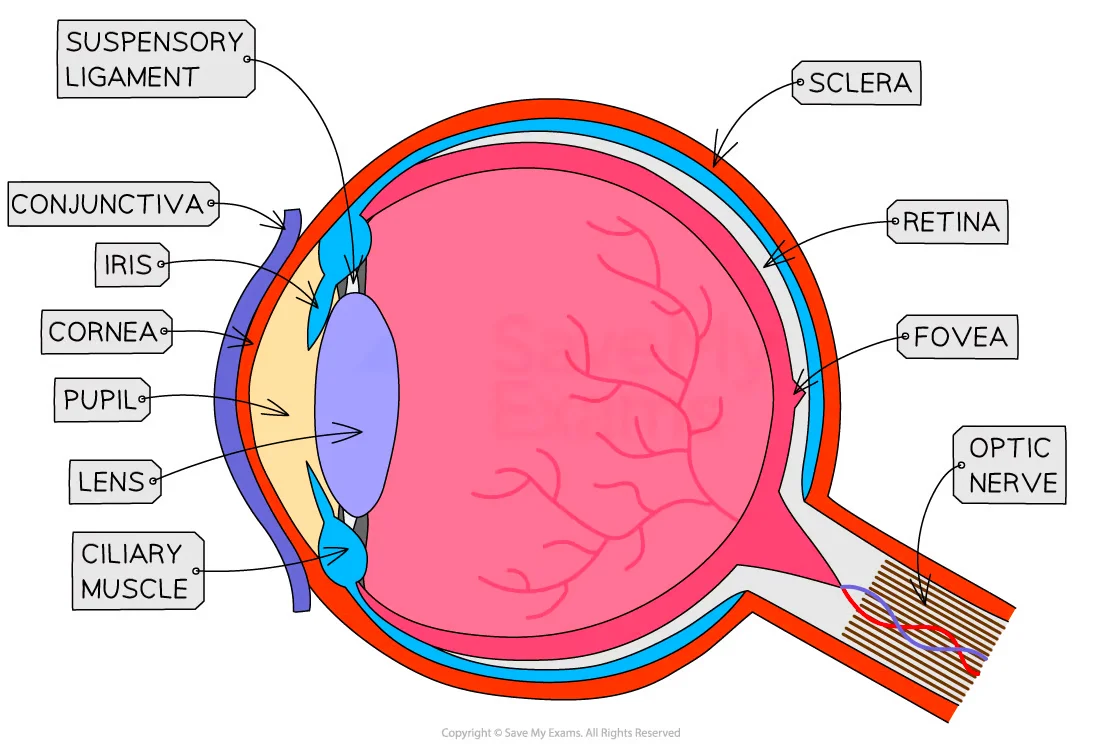
| Structure | Function |
|---|---|
| Cornea | Refracts light entering the eye |
| Iris | Controls the diameter of the pupil |
| Pupil | Opening through which light enters |
| Lens | Refracts light to focus an image on the retina |
| Retina | Contains light receptors, including rods and cones |
| Optic nerve | Carries impulses from the retina to the brain |
| Blind spot | Point where the optic nerve leaves the eye; no rods or cones are present |
| Fovea | Area with many cones; gives the sharpest colour vision |
Rods and cones
- Rods are sensitive in dim light and are more common away from the fovea. They do not detect colour.
- Cones work best in bright light and detect colour. They are concentrated at the fovea.
Pupil reflex
The pupil changes diameter to control the amount of light entering the eye.
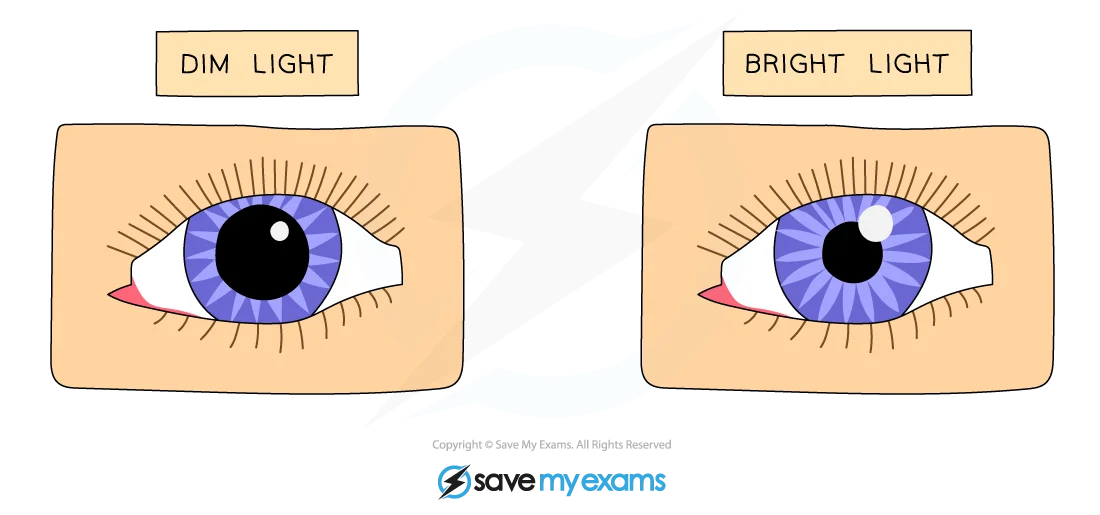
- In bright light, circular iris muscles contract and radial iris muscles relax. The pupil constricts.
- In dim light, circular iris muscles relax and radial iris muscles contract. The pupil dilates.
The circular and radial muscles work antagonistically: when one contracts, the other relaxes.
Accommodation
Accommodation is the change in lens shape that focuses light from objects at different distances.
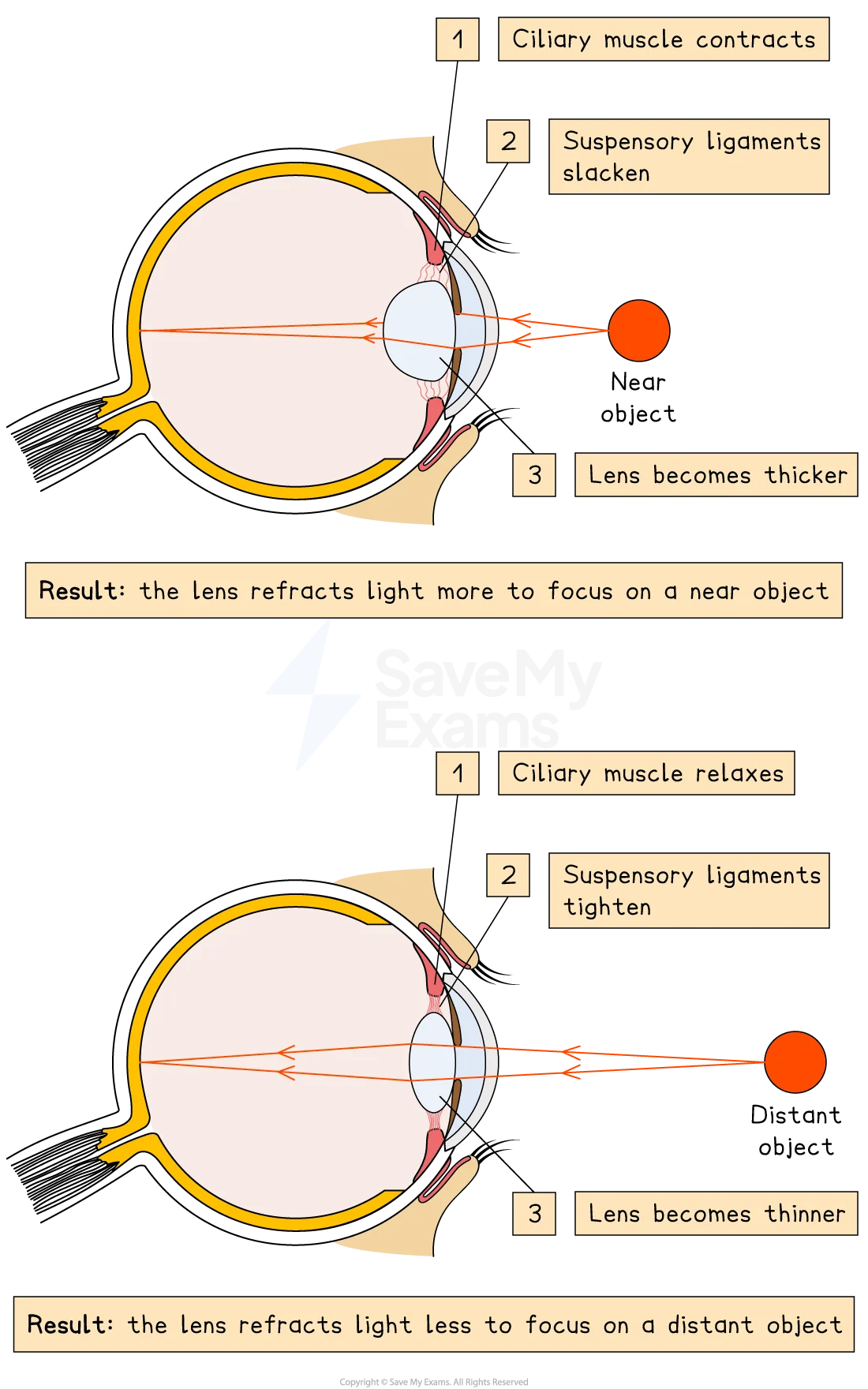
| Object | Ciliary muscles | Suspensory ligaments | Lens | Refraction |
|---|---|---|---|---|
| Near | Contract | Become slack | Thicker and more curved | Increases |
| Distant | Relax | Become tight | Thinner and less curved | Decreases |
Hormonal coordination
A hormone is a chemical messenger produced by an endocrine gland. It is carried in the blood to a target organ, where it causes a response.
| Endocrine gland | Hormone required by this syllabus |
|---|---|
| Adrenal glands | Adrenaline |
| Pancreas | Insulin and glucagon |
| Testes | Testosterone |
| Ovaries | Oestrogen |
Nervous control is usually fast, short-lived, and localised. Hormonal control is usually slower, longer-lasting, and carried in the blood to target organs.
Adrenaline and fight or flight
During danger or stress, the adrenal glands release adrenaline. It prepares the body for rapid activity by:
- increasing heart rate
- increasing breathing rate
- increasing blood glucose concentration
- increasing pupil diameter.
Homeostasis and negative feedback
Homeostasis is the maintenance of a constant internal environment within suitable limits.
A set point is the preferred value or range for an internal condition. Negative feedback occurs when a response reduces a change and brings the condition back towards its set point.
Blood glucose control
After a meal, blood glucose concentration increases:
blood glucose rises → pancreas secretes insulin
→ cells take up glucose and liver converts glucose to glycogen
→ blood glucose falls towards its set point
When blood glucose concentration falls:
blood glucose falls → pancreas secretes glucagon
→ liver converts glycogen to glucose and releases it into blood
→ blood glucose rises towards its set point
Insulin and glucagon have antagonistic effects. In Type 1 diabetes, the pancreas produces little or no insulin. Treatment includes regular insulin injections or an insulin pump, together with monitoring blood glucose concentration.
Temperature regulation
The brain monitors body temperature and coordinates responses. Skin structures involved include hairs, hair erector muscles, sweat glands, temperature receptors, sensory neurones, blood vessels, and fatty tissue.
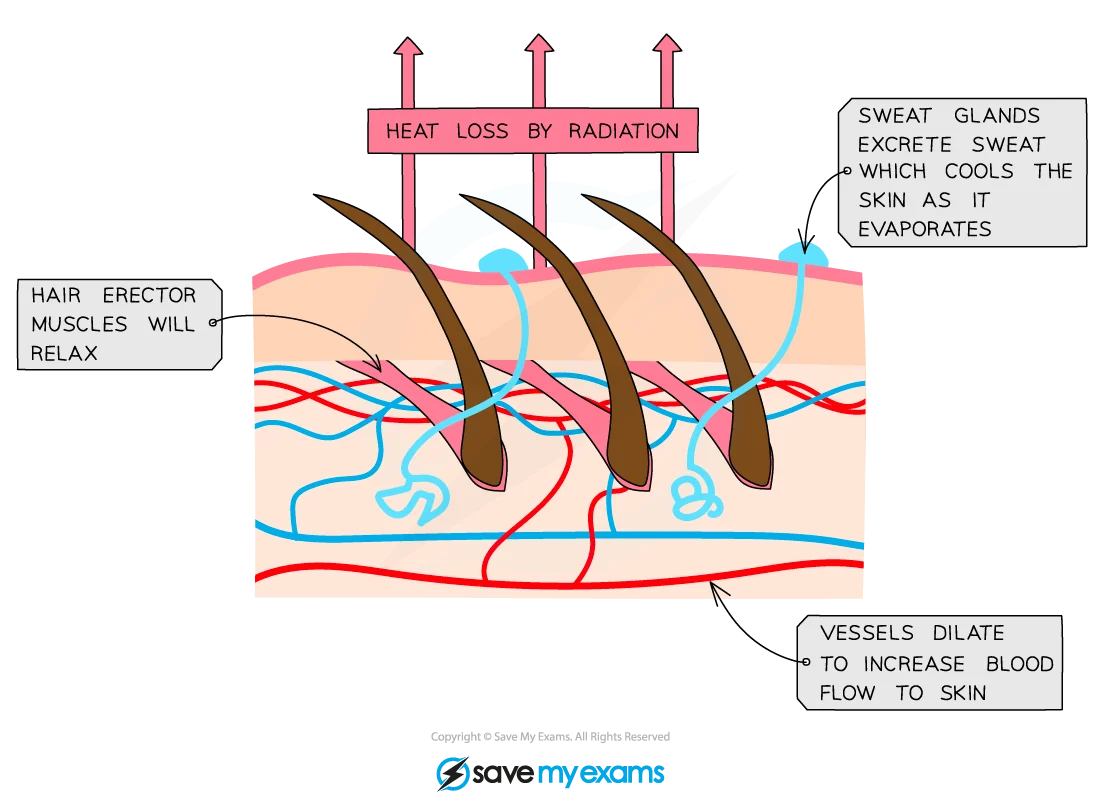 When body temperature is too high:
- blood vessels near the skin dilate, increasing heat loss by radiation
- sweat glands release sweat; evaporation removes heat
- hair erector muscles relax, so less insulating air is trapped.
When body temperature is too low:
- blood vessels near the skin constrict, reducing heat loss
- skeletal muscles contract rapidly during shivering, releasing heat
- hair erector muscles contract and trap an insulating layer of air
- fatty tissue provides insulation.
Tropic responses in plants
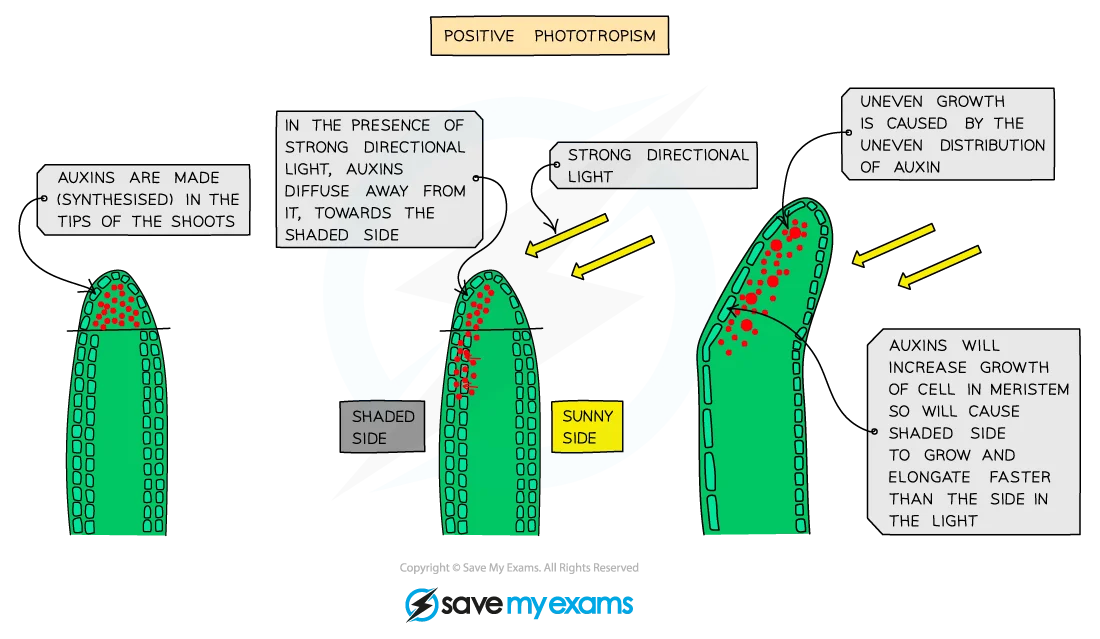
A tropism is a directional growth response to a stimulus.
- Phototropism: growth response to light. Shoots usually grow towards light.
- Gravitropism: growth response to gravity. Roots usually grow towards gravity; shoots usually grow away from gravity.
Auxin is made in the shoot tip and diffuses down the shoot. When light comes from one side, auxin becomes concentrated on the shaded side. In a shoot, auxin stimulates cell elongation. Cells on the shaded side elongate more, so the shoot bends towards the light.
Investigating tropisms
To investigate phototropism, grow similar seedlings with light from one side and compare them with seedlings receiving light evenly from above. Keep water, temperature, soil, and seedling age the same. Record the direction and amount of growth over time.
To investigate gravitropism, place germinating seeds horizontally and observe the direction of root and shoot growth. Repeat with suitable controls and keep other conditions constant.
Exam summary
- Receptors detect stimuli; effectors produce responses.
- The CNS is the brain and spinal cord; the PNS contains nerves outside them.
- A simple reflex arc is receptor → sensory neurone → relay neurone → motor neurone → effector.
- Synapses transmit impulses one way using neurotransmitters.
- The eye detects light; rods detect dim light and cones detect colour.
- Circular and radial iris muscles control pupil diameter antagonistically.
- Hormones are chemical messengers transported in blood.
- Insulin lowers blood glucose; glucagon raises it.
- Homeostasis maintains internal conditions using negative feedback.
- Sweating, vasodilation, shivering, and vasoconstriction regulate temperature.
- Auxin causes unequal growth in shoots during phototropism.