Inheritance is the transmission of genetic information from one generation to the next. Genetic information is carried by DNA in chromosomes.
DNA, chromosomes, genes, and alleles
- A chromosome is a long molecule of DNA containing many genes.
- A gene is a length of DNA that codes for a protein.
- An allele is an alternative form of a gene. For example, a gene for a characteristic may have different alleles that code for different versions of that characteristic.
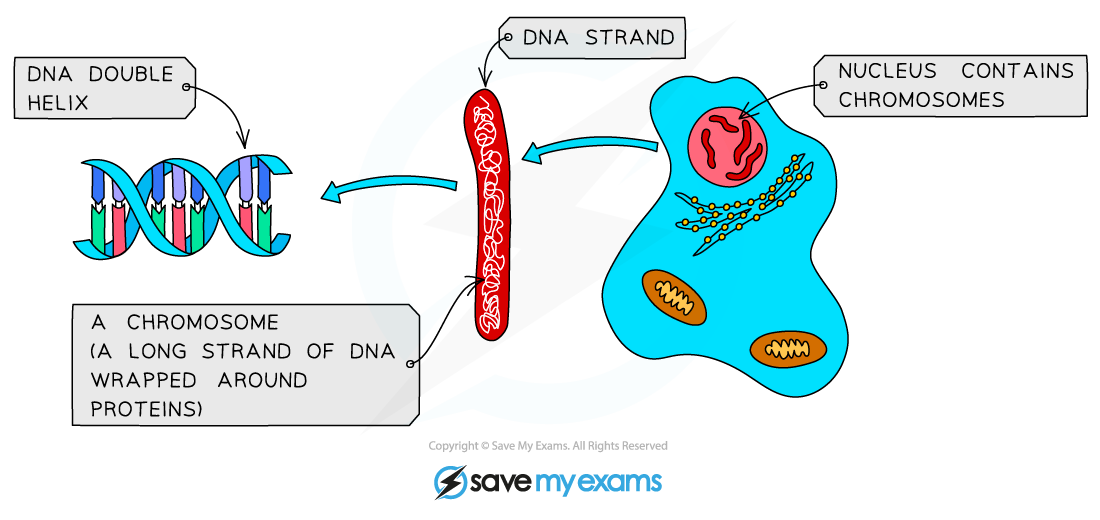
The sequence of bases in a gene determines the sequence of amino acids in its protein. Different amino acid sequences produce proteins with different shapes. Protein shape determines how a protein works. For example, proteins may act as enzymes, carriers, or receptors.
Protein synthesis and gene expression
- A gene in the nucleus provides the base sequence for a protein.
- An mRNA copy of the gene is made in the nucleus.
- The mRNA moves into the cytoplasm and attaches to a ribosome.
- The ribosome assembles amino acids in the order specified by the mRNA base sequence.
- The amino-acid chain folds into a protein with a particular shape and function.
All body cells usually contain the same genes, but different genes are expressed in different cell types. Therefore, cells produce different proteins and become specialised. For example, a muscle cell and a nerve cell contain the same genetic information but express different genes.
Genetic terms
| Term | Meaning |
|---|---|
| Genotype | The genetic make-up of an organism: the alleles it has. |
| Phenotype | The observable features of an organism. It results from its genotype and, for some features, environmental effects. |
| Homozygous | Having two identical alleles for a gene, such as $TT$ or $tt$. |
| Heterozygous | Having two different alleles for a gene, such as $Tt$. |
| Dominant allele | An allele expressed in the phenotype when present, including in a heterozygote. |
| Recessive allele | An allele expressed only when no dominant allele is present. |
| Pure-breeding | Describes an organism that is homozygous and produces offspring with the same form of a characteristic when bred with another organism of the same pure-breeding type. |
A dominant allele is not necessarily more common, stronger, or better than a recessive allele. Dominant and recessive describe expression in a heterozygote.
Sex inheritance in humans
Human body cells have sex chromosomes. Typical female cells have $XX$ and typical male cells have $XY$. An egg cell always carries $X$. A sperm cell carries either $X$ or $Y$.
| Sperm chromosome | Egg chromosome | Zygote |
|---|---|---|
| $X$ | $X$ | $XX$ |
| $Y$ | $X$ | $XY$ |
There is an approximately $1:1$ chance of an $XX$ or $XY$ zygote in this simplified model. The sperm determines which sex chromosome is contributed.
Mitosis
Mitosis is nuclear division that produces two genetically identical nuclei, producing two genetically identical cells. It is used for growth, repair, cell replacement, and asexual reproduction.
Sequence:
- Chromosomes replicate, so each chromosome consists of two identical copies.
- The copies separate during nuclear division.
- Each new nucleus receives one copy of every chromosome.
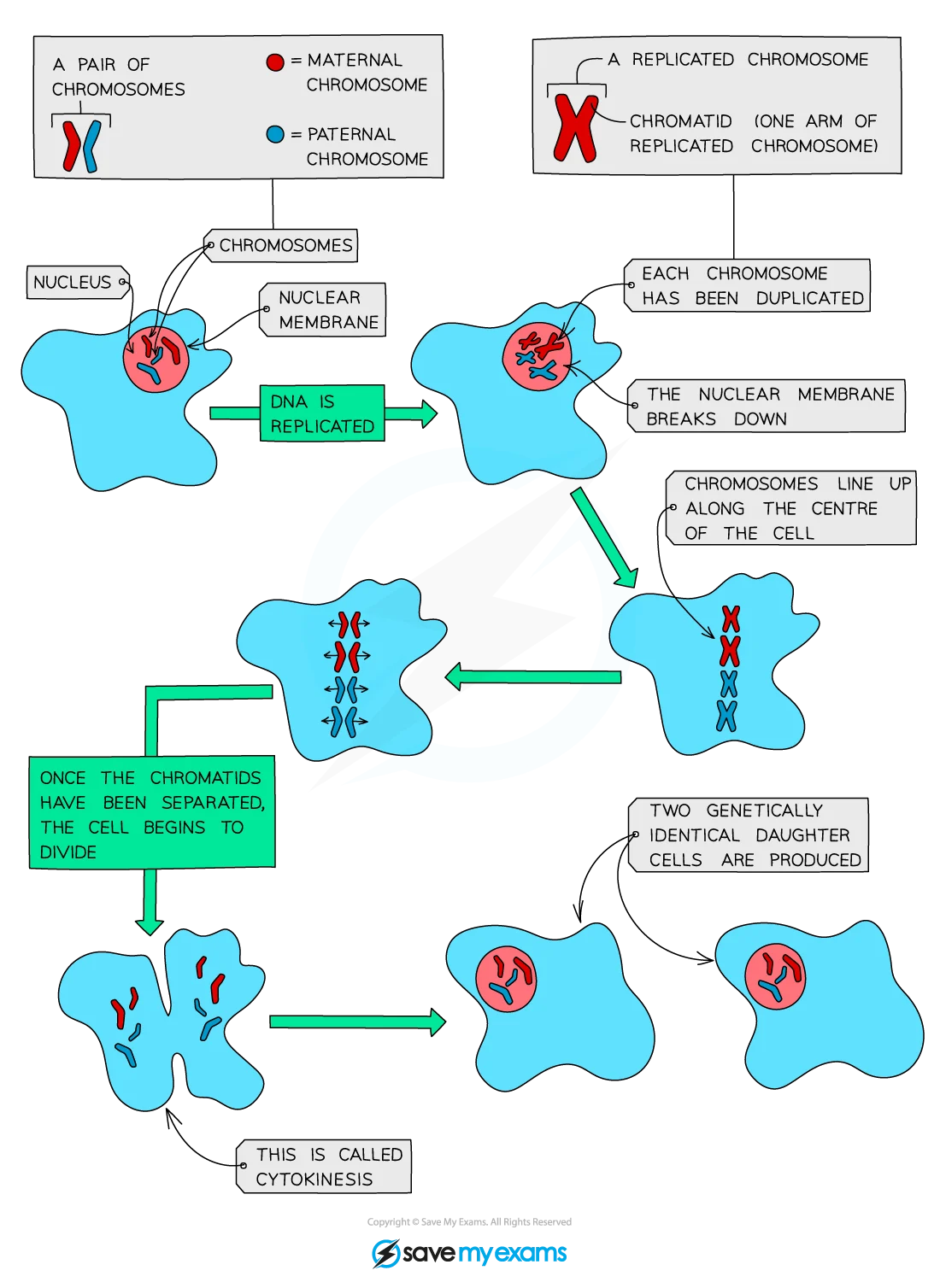
The chromosome number is maintained. In humans, mitosis produces diploid nuclei with $46$ chromosomes, arranged as $23$ pairs, when starting from a normal diploid cell.
Haploid, diploid, and meiosis
- A diploid nucleus has two sets of chromosomes. Human body cells have $23$ pairs, or $46$ chromosomes.
- A haploid nucleus has one set of chromosomes. Human gametes have $23$ chromosomes.
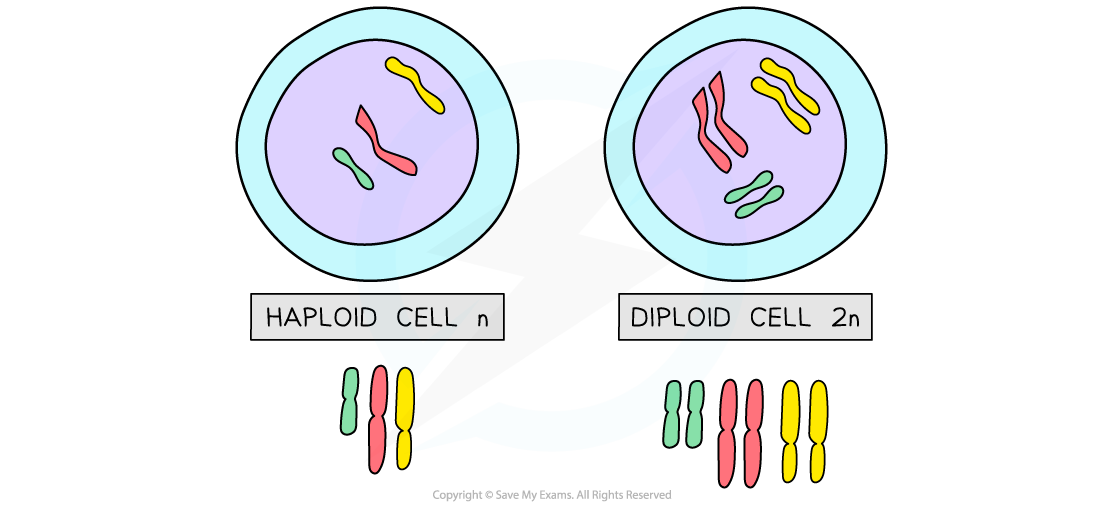
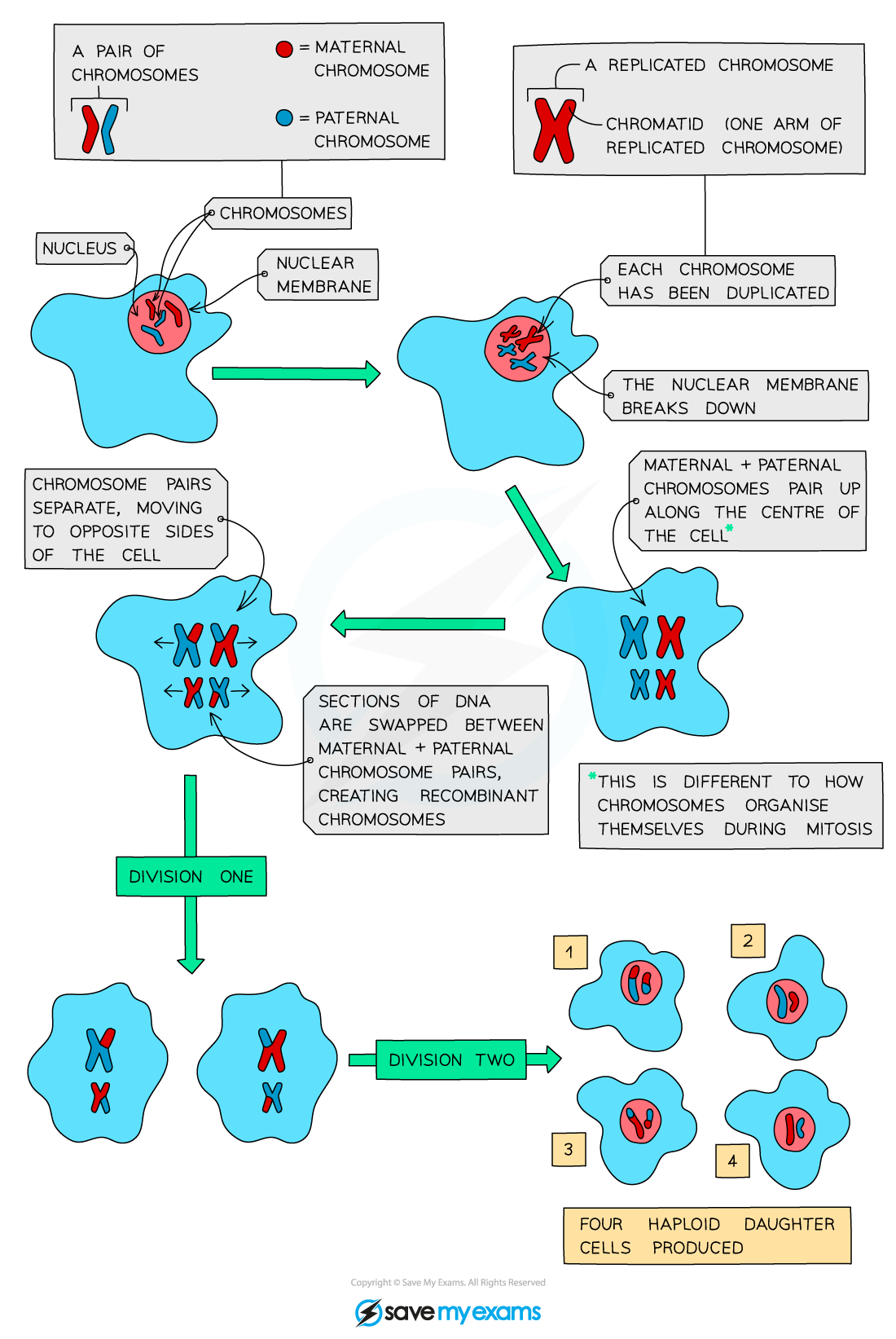
Meiosis is a reduction division used to produce gametes. It changes a diploid cell into haploid cells. The gametes are genetically different because chromosome pairs and alleles are separated into different combinations.
Mitosis and meiosis must not be confused:
| Feature | Mitosis | Meiosis |
|---|---|---|
| Main role | Growth, repair, replacement, asexual reproduction | Production of gametes |
| Starting nucleus | Usually diploid | Diploid |
| Nuclei produced | Two | Four gametes |
| Chromosome number | Maintained | Halved |
| Genetic similarity | Genetically identical | Genetically different |
Stem cells are unspecialised cells. They divide by mitosis and can develop into specialised cell types. This allows growth and the replacement or repair of specialised cells.
Monohybrid inheritance
A genetic diagram predicts inheritance of one characteristic. Use a letter pair for the alleles, list the gametes, and combine one allele from each parent.
Example: a dominant phenotype
Let $T$ be the dominant allele for tall plants and $t$ the recessive allele for short plants. Cross two heterozygous plants: $Tt \times Tt$.
| $T$ | $t$ | |
|---|---|---|
| $T$ | $TT$ | $Tt$ |
| $t$ | $Tt$ | $tt$ |
Genotype ratio: $1,TT : 2,Tt : 1,tt$.
Phenotype ratio: $3$ tall to $1$ short, or $3:1$, because $TT$ and $Tt$ are tall while only $tt$ is short.
A cross between a homozygous dominant organism and a homozygous recessive organism, $TT \times tt$, produces all $Tt$ offspring. All have the dominant phenotype but are heterozygous.
A cross between a heterozygous organism and a homozygous recessive organism, $Tt \times tt$, produces a $1:1$ genotype and phenotype ratio: half $Tt$ with the dominant phenotype and half $tt$ with the recessive phenotype.
Test crosses
A test cross identifies an organism’s unknown genotype when it has a dominant phenotype. Cross it with a homozygous recessive organism.
- If all offspring have the dominant phenotype, the unknown may be homozygous dominant.
- If any offspring have the recessive phenotype, the unknown must be heterozygous.
With a finite sample, all offspring having the dominant phenotype does not prove that the unknown is homozygous dominant.
A large number of offspring gives more reliable evidence than a small number because chance affects observed ratios.
Pedigree diagrams
Pedigrees show how a characteristic passes through a family.
- A square usually represents a male.
- A circle usually represents a female.
- A horizontal line joins parents.
- A vertical line connects parents to offspring.
- A shaded symbol represents an individual with the characteristic being studied.
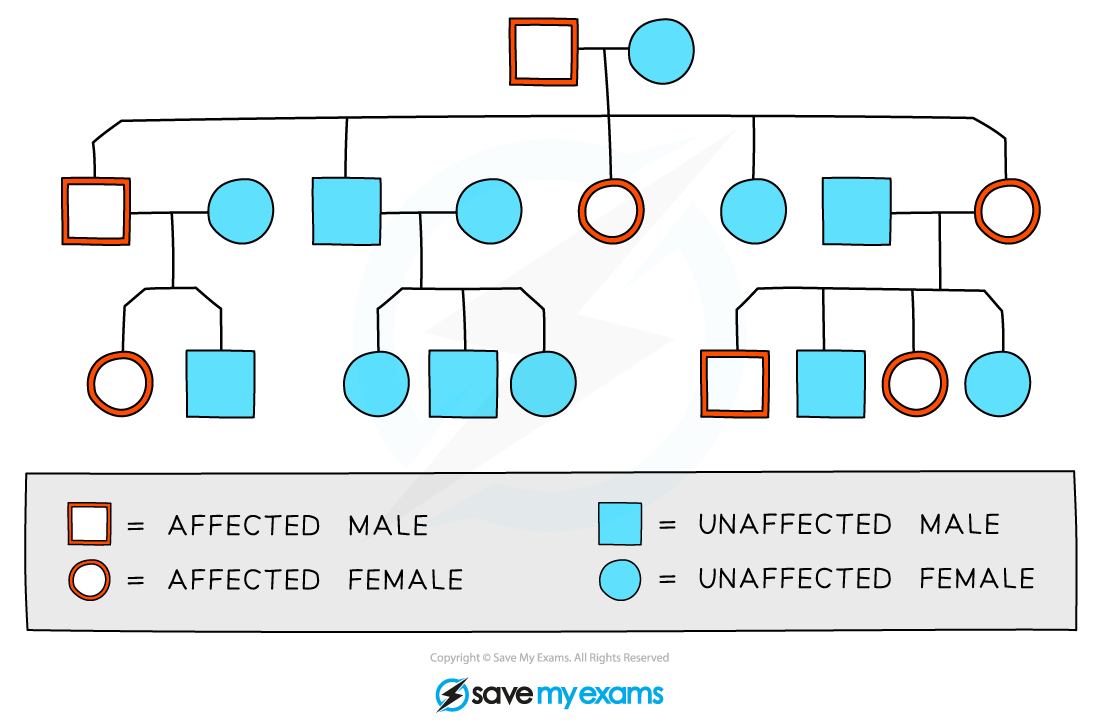
To interpret a pedigree, identify affected and unaffected individuals, follow the lines between generations, and use possible genotypes to test inheritance patterns.
If two unaffected parents have an affected child, the characteristic is likely recessive, because both parents may carry the recessive allele. Pedigree evidence must be used with the stated information; not every pedigree proves one inheritance pattern uniquely.
Codominance and ABO blood groups
In codominance, both alleles contribute to the phenotype in a heterozygote. Neither allele masks the other. For example, the genotype $I^A I^B$ produces blood-group phenotype AB: both $I^A$ and $I^B$ are expressed.
ABO blood groups are controlled by three alleles: $I^A$, $I^B$, and $I^o$. $I^A$ and $I^B$ are codominant with each other. Both are dominant to $I^o$.
| Genotype | Blood-group phenotype |
|---|---|
| $I^A I^A$ or $I^A I^o$ | A |
| $I^B I^B$ or $I^B I^o$ | B |
| $I^A I^B$ | AB |
| $I^o I^o$ | O |
For example, a parent with genotype $I^A I^o$ can produce $I^A$ or $I^o$ gametes. A parent with genotype $I^B I^o$ can produce $I^B$ or $I^o$ gametes. Their possible children have genotypes $I^A I^B$, $I^A I^o$, $I^B I^o$, and $I^o I^o$, giving phenotypes AB, A, B, and O.
The Punnett square is:
| $I^B$ | $I^o$ | |
|---|---|---|
| $I^A$ | $I^A I^B$ (AB) | $I^A I^o$ (A) |
| $I^o$ | $I^B I^o$ (B) | $I^o I^o$ (O) |
Phenotype O has genotype $I^o I^o$; O is not an allele symbol by itself.
Sex-linked characteristics
A sex-linked characteristic is controlled by a gene on a sex chromosome, usually the X chromosome. In a typical male, a recessive allele on the X chromosome is expressed because the Y chromosome does not carry a corresponding allele for that gene. Therefore, X-linked recessive characteristics can be more common in males. Red-green colour blindness is an example.
Use superscripts to show X-linked alleles. Let $X^N$ be the normal allele and $X^n$ be the recessive colour-blindness allele. A carrier female $X^N X^n$ and an unaffected male $X^N Y$ have this Punnett square:
| $X^N$ | $Y$ | |
|---|---|---|
| $X^N$ | $X^N X^N$: unaffected daughter | $X^N Y$: unaffected son |
| $X^n$ | $X^N X^n$: carrier daughter | $X^n Y$: colour-blind son |
In this cross, half of the sons are expected to have the characteristic, while none of the daughters are expected to have it. Always identify the sex chromosome and allele received from each parent before interpreting a sex-linked cross.
Exam checklist
- Distinguish gene, allele, genotype, and phenotype.
- State whether a genotype is homozygous or heterozygous.
- Explain that dominant does not mean common or stronger.
- Use $23$ pairs and $46$ chromosomes for a human diploid cell, and $23$ chromosomes for a human gamete.
- Link DNA base sequence to amino acid sequence, protein shape, and protein function.
- Distinguish genetically identical diploid cells from genetically different haploid gametes.
- Show genetic diagrams clearly and give both genotype and phenotype ratios.
- For codominance, show both alleles in the phenotype.
- For sex linkage, include the sex chromosomes in every genotype.
Syllabus traceability
- 17 Core: chromosomes and genes; alleles; inheritance; genotype and phenotype; homozygous, pure-breeding, heterozygous, dominant, and recessive alleles; human sex inheritance; mitosis and its roles.
- 17 Supplement (Extended): DNA and protein synthesis; gene expression and cell specialisation; haploid and diploid nuclei; human chromosome numbers; stem cells; meiosis; pedigrees; monohybrid crosses and test crosses; codominance; ABO blood groups; sex-linked characteristics and crosses.