Apparatus and measurements
Choose apparatus that measures the quantity needed with suitable precision.
| Quantity | Apparatus | Use and limitation |
|---|---|---|
| Time | Stopwatch | Measures elapsed time; reaction start and stop can be judged inconsistently. |
| Temperature | Thermometer | Measures temperature; read at eye level and allow the reading to stabilise. |
| Mass | Balance | Measures mass; zero it before use and avoid drafts or spills. |
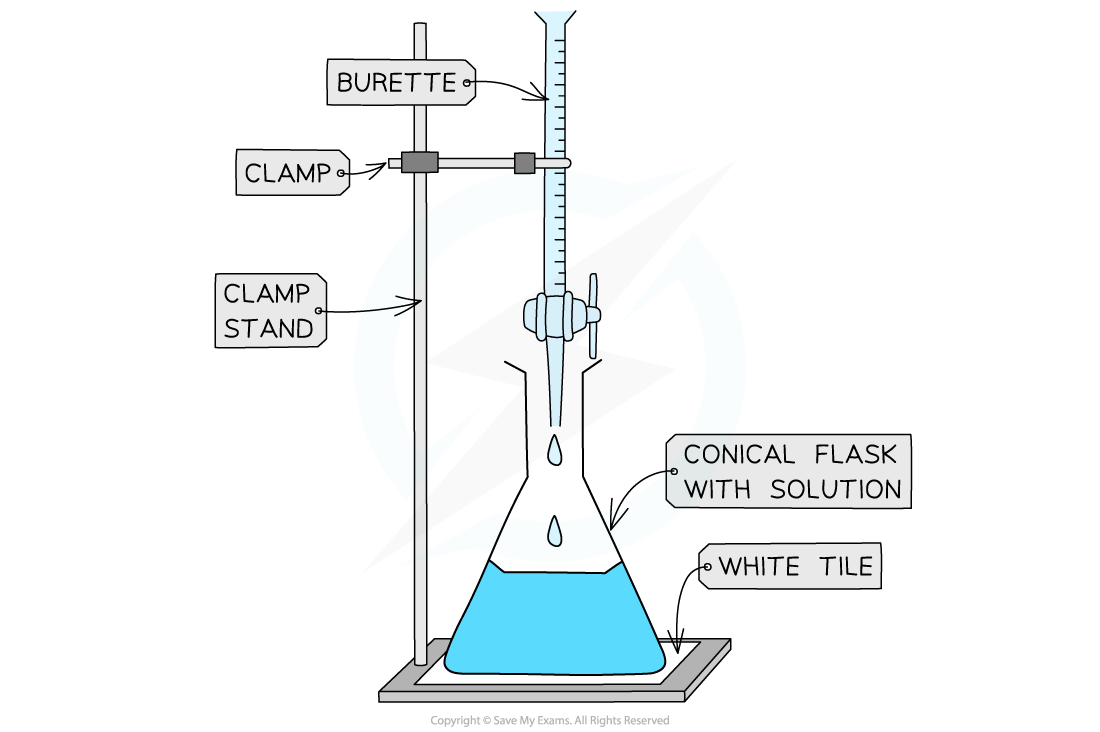
| Liquid volume | Burette | Delivers variable, accurately measured volumes, especially in titrations. |
| Liquid volume | Volumetric pipette | Transfers one fixed, accurate volume. |
| Liquid volume | Measuring cylinder | Measures a range of volumes quickly, but less precisely than a pipette or burette. |
| Gas volume | Gas syringe | Collects and measures gas directly; check connections for leaks. |
A measuring cylinder is convenient for approximate volumes. Use a pipette and burette when accurate solution volumes matter. Read liquid levels at eye level, using the bottom of the meniscus for colourless liquids.
Solutions and filtration
A solute dissolves in a solvent. The resulting mixture is a solution. A saturated solution contains as much dissolved solute as possible at that temperature. In filtration, the insoluble solid left on the filter paper is the residue; the liquid passing through is the filtrate.
Filtration separates an insoluble solid from a liquid, for example sand from water. It does not separate a dissolved solute from its solution.
Acid–base titration
A titration measures the volume of one solution needed to react with a known volume of another.
- Rinse the burette with the solution it will contain; fill it and record the initial reading.
- Rinse a volumetric pipette with the other solution. Transfer a fixed volume into a conical flask.
- Add a few drops of a suitable indicator.
- Add solution from the burette while swirling. Near the end-point, add it drop-wise until the indicator just changes colour permanently.
- Record the final burette reading. The titre is final reading minus initial reading.
- Repeat until titres are close (concordant); use their mean, excluding a rough trial if appropriate.
The indicator changes colour over a narrow pH range. The end-point is the observed indicator colour change. Choose an indicator so this change occurs close to the equivalence point, where reactants have reacted in stoichiometric proportions; the two points are related but not identical. Swirling mixes reactants; rinsing flask walls with distilled water does not change the amount of reactant delivered by the pipette.
Paper chromatography
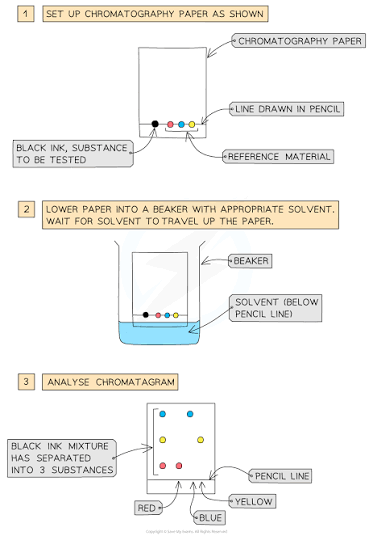
Paper chromatography separates soluble substances in a mixture, such as dyes in ink.
- Draw a pencil baseline near the bottom of the paper. Pencil does not dissolve in the solvent.
- Place a small spot of sample on the line and let it dry. Add more small spots if needed.
- Stand the paper in a little solvent, with solvent level below the baseline.
- Let the solvent rise. Remove the paper before the solvent reaches the top and immediately mark the solvent front in pencil.
Different substances travel different distances because they have different solubilities in the solvent and attractions to the paper. A pure substance usually produces one spot; a mixture produces more than one. Identify an unknown by comparing spot positions with known samples under the same conditions. A match supports identification but does not prove identity on its own. Colourless spots can be made visible using a locating agent.
The retention factor is:
$$R_f=\frac{\text{distance travelled by substance}}{\text{distance travelled by solvent}}$$
Measure both distances from the baseline. For example, if a spot travels $3.0,\mathrm{cm}$ and the solvent front travels $5.0,\mathrm{cm}$:
$$R_f=\frac{3.0}{5.0}=0.60$$
An $R_f$ value has no unit and is less than or equal to $1$. Compare values only when chromatography conditions are the same.
Separation and purification
Choose a method based on whether components are dissolved, their boiling points, and whether the mixture contains solids or liquids.
| Method | What it separates | Key idea | Advantage and limitation |
|---|---|---|---|
| Solvent extraction | A substance that dissolves in a chosen solvent | Select a solvent that dissolves the wanted substance; separate the solution from insoluble material by filtration, then evaporate some solvent and crystallise the wanted substance. | Selective when the wanted substance dissolves well; solvent removal takes time. |
| Filtration | Insoluble solid from liquid | Solid stays as residue; liquid passes through as filtrate. | Quick and simple; dissolved substances pass through with the liquid. |
| Crystallisation | Dissolved solid from solution | Evaporate some solvent, then cool a concentrated solution so crystals form. Filter and dry crystals. | Produces purified solid; some solute remains in the solution. |
| Simple distillation | Solvent from a solution, or liquids with widely different boiling points | Evaporate the lower-boiling component and condense its vapour. | Can recover solvent; does not separate liquids with similar boiling points effectively. |
| Fractional distillation | Miscible liquids with closer boiling points | A fractionating column allows repeated evaporation and condensation; lower-boiling liquid is collected first. | Separates liquids with closer boiling points; takes longer than simple distillation. |
To purify a soluble solid, dissolve it in a suitable hot solvent, remove insoluble impurities by filtration, concentrate the filtrate, cool to crystallise, then filter and dry the crystals. Do not evaporate to dryness if this may decompose the substance or leave soluble impurities mixed with product.
Examples: filter sand from water; crystallise salt from salt solution; distil pure water from salt solution; use fractional distillation to separate miscible liquids with similar boiling points; use chromatography to separate dyes.
Testing purity
A pure solid has a sharp, characteristic melting point. Impurities usually lower and broaden its melting range. A pure liquid has a characteristic boiling point at a stated pressure; impurities can change the observed boiling range. Compare measured values with reliable data under the same conditions to identify a substance and assess purity.
Tests for anions
Acidify samples when specified; this removes interfering ions in some tests. Use separate portions of the sample for different tests.
| Ion | Test | Positive result |
|---|---|---|
| Carbonate, $\mathrm{CO_3^{2-}}$ | Add dilute acid; test the gas with limewater. | Effervescence; carbon dioxide turns limewater milky. |
| Chloride, $\mathrm{Cl^-}$ | Add dilute nitric acid, then aqueous silver nitrate. | White precipitate of silver chloride. |
| Bromide, $\mathrm{Br^-}$ | Add dilute nitric acid, then aqueous silver nitrate. | Cream precipitate of silver bromide. |
| Iodide, $\mathrm{I^-}$ | Add dilute nitric acid, then aqueous silver nitrate. | Yellow precipitate of silver iodide. |
| Nitrate, $\mathrm{NO_3^-}$ | Add aqueous sodium hydroxide and aluminium foil; warm gently. | Ammonia is produced; it turns damp red litmus paper blue. |
| Sulfate, $\mathrm{SO_4^{2-}}$ | Add dilute nitric acid, then aqueous barium nitrate. | White precipitate of barium sulfate. |
| Sulfite, $\mathrm{SO_3^{2-}}$ | Add acidified potassium manganate(VII). | Purple solution decolourises. |
Tests for cations
Add aqueous sodium hydroxide or aqueous ammonia to a fresh sample, first dropwise and then in excess where indicated. A precipitate is an insoluble solid formed in solution.
| Ion | With aqueous sodium hydroxide | With aqueous ammonia |
|---|---|---|
| Aluminium, $\mathrm{Al^{3+}}$ | White precipitate, soluble in excess. | White precipitate, insoluble in excess. |
| Ammonium, $\mathrm{NH_4^+}$ | On warming, ammonia is released; it turns damp red litmus paper blue. | — |
| Calcium, $\mathrm{Ca^{2+}}$ | White precipitate, insoluble in excess. | No precipitate. |
| Chromium(III), $\mathrm{Cr^{3+}}$ | Green precipitate, soluble in excess. | Green precipitate, insoluble in excess. |
| Copper(II), $\mathrm{Cu^{2+}}$ | Light blue precipitate, insoluble in excess. | Light blue precipitate; dissolves in excess to form a dark blue solution. |
| Iron(II), $\mathrm{Fe^{2+}}$ | Green precipitate, insoluble in excess. | Green precipitate, insoluble in excess. |
| Iron(III), $\mathrm{Fe^{3+}}$ | Red-brown precipitate, insoluble in excess. | Red-brown precipitate, insoluble in excess. |
| Zinc, $\mathrm{Zn^{2+}}$ | White precipitate, soluble in excess. | White precipitate, soluble in excess. |
Tests for gases
| Gas | Test | Positive result |
|---|---|---|
| Ammonia, $\mathrm{NH_3}$ | Hold damp red litmus paper in the gas. | Paper turns blue. |
| Carbon dioxide, $\mathrm{CO_2}$ | Bubble through limewater. | Limewater turns milky. |
| Chlorine, $\mathrm{Cl_2}$ | Hold damp litmus paper in the gas. | Paper is bleached. |
| Hydrogen, $\mathrm{H_2}$ | Apply a lighted splint. | Squeaky pop. |
| Oxygen, $\mathrm{O_2}$ | Insert a glowing splint. | Splint relights. |
| Sulfur dioxide, $\mathrm{SO_2}$ | Bubble the gas through acidified potassium manganate(VII) solution. | Purple solution decolourises. |
Flame tests
Clean a nichrome or platinum wire loop, dip it in the sample, then hold it in a non-luminous flame. Identify the metal ion from the flame colour.
| Ion | Flame colour |
|---|---|
| Lithium, $\mathrm{Li^+}$ | Red |
| Sodium, $\mathrm{Na^+}$ | Yellow |
| Potassium, $\mathrm{K^+}$ | Lilac |
| Calcium, $\mathrm{Ca^{2+}}$ | Orange-red |
| Barium, $\mathrm{Ba^{2+}}$ | Light green |
| Copper(II), $\mathrm{Cu^{2+}}$ | Blue-green |
Sodium’s intense yellow can mask other flame colours, so clean apparatus between samples and treat flame tests as one piece of evidence rather than a complete analysis.