Physical and chemical changes
A physical change does not produce a new substance; changes of state are physical changes.
A chemical change produces one or more new substances. Reversibility, colour change, gas formation, temperature change, or a precipitate may provide evidence, but none alone is a complete definition.
Rates of reaction
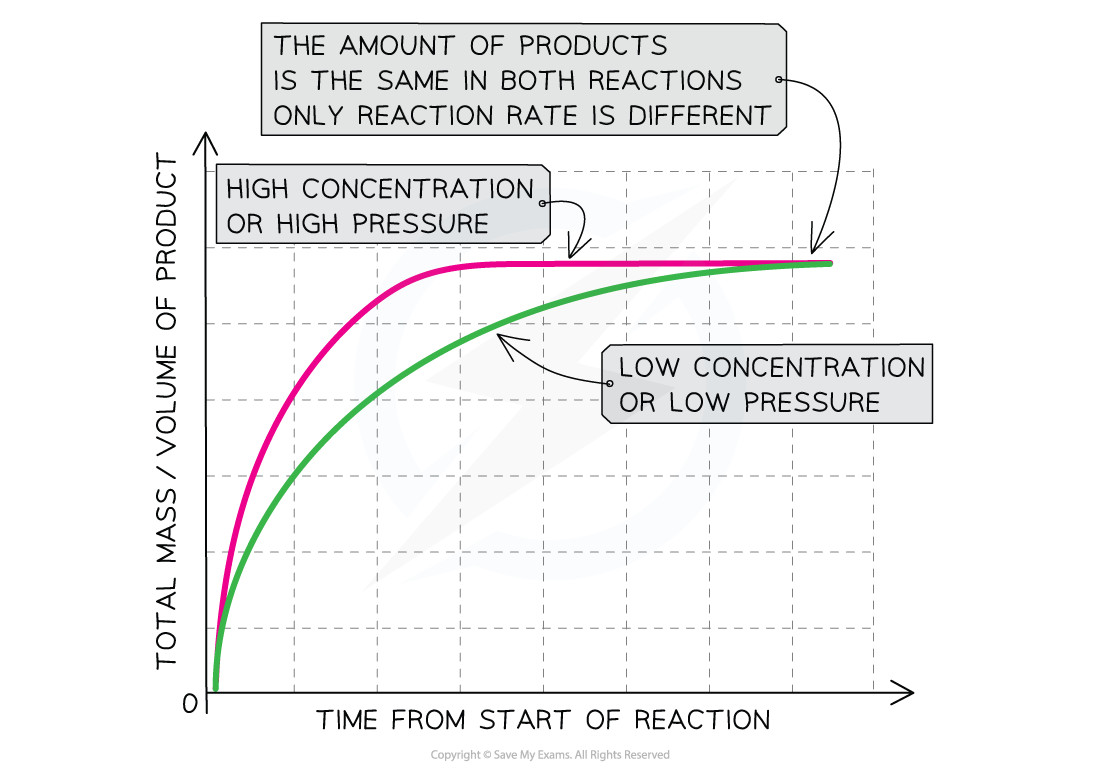
The rate of reaction is how quickly reactants are used or products are formed. It can be measured by mass loss, gas volume, colour change, or precipitate formation over time.
Factors that increase rate:
- Concentration: more particles per unit volume cause more frequent collisions.
- Pressure of gases: particles are closer together, so collision frequency increases.
- Surface area: smaller solid pieces expose more particles for collision.
- Temperature: particles move faster, collide more often, and a larger proportion have energy at least equal to $E_a$.
- Catalyst: provides an alternative pathway with lower $E_a$; it is chemically unchanged at the end. Enzymes are biological catalysts.
Collision Theory
Collision theory requires particles to collide with sufficient energy and suitable orientation. A fair investigation should control quantities such as temperature, concentration, surface area, and apparatus, repeat measurements, and compare a rate measurement such as $\frac{\text{change}}{\text{time}}$.
Gas-syringe investigation:
- Measure acid into a flask
- Add a weighed carbonate
- Fit a bung connected to a gas syringe
- Start the timer immediately.
- Record gas volume at regular intervals.
- Repeat and calculate the initial rate from the initial gradient of a volume–time graph.
Keep acid volume, carbonate mass, temperature, and apparatus constant. Check for leaks and allow the apparatus to return to the same temperature before repeating.
A mass-loss method uses a balance while gas escapes; it is simple but can be affected by draughts and delayed readings. A colour-change or precipitate method can compare times, but the endpoint may be judged subjectively.
A final plateau on a volume–time or mass–time graph means the reaction has stopped because a reactant has been used up.
Reversible reactions and equilibrium
A reversible reaction can proceed in both directions and is shown with $\rightleftharpoons$.
Hydrated copper(II) sulfate is blue and anhydrous copper(II) sulfate is white:
$$\mathrm{CuSO_4\cdot5H_2O \rightleftharpoons CuSO_4+5H_2O}$$
Hydrated cobalt(II) chloride is pink and anhydrous cobalt(II) chloride is blue:
$$\mathrm{CoCl_2\cdot6H_2O \rightleftharpoons CoCl_2+6H_2O}$$
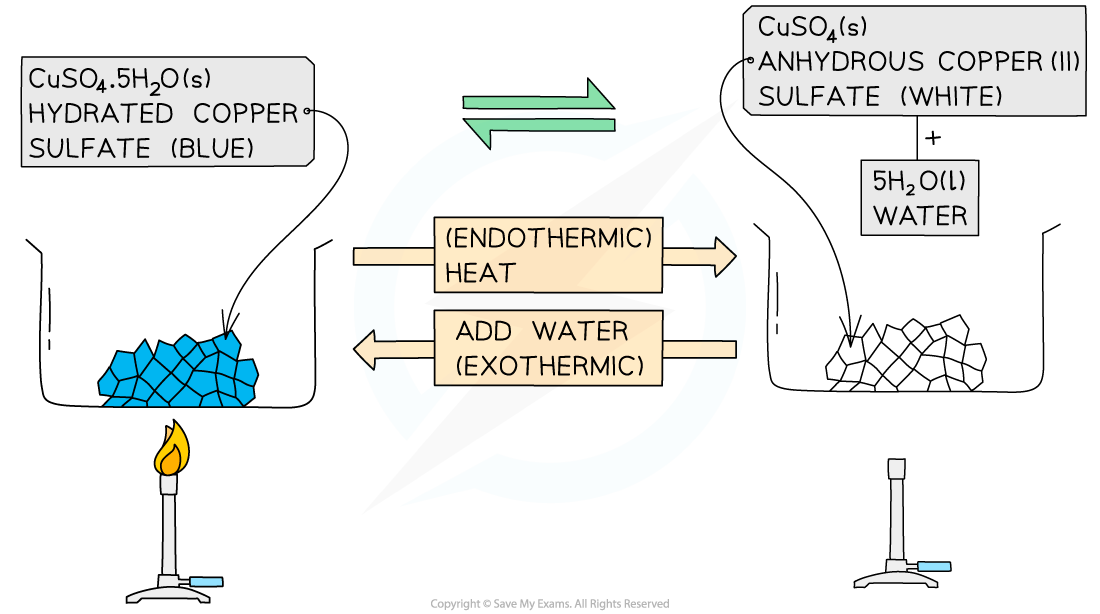
Dynamic equilibrium occurs in a closed system when the forward and reverse reaction rates are equal. Concentrations remain constant, but both reactions continue.
- Increasing temperature shifts equilibrium in the endothermic direction.
- Increasing pressure shifts equilibrium towards the side with fewer gas molecules.
- Increasing the concentration of a reactant shifts equilibrium towards products; removing a species shifts equilibrium to replace it.
Haber process
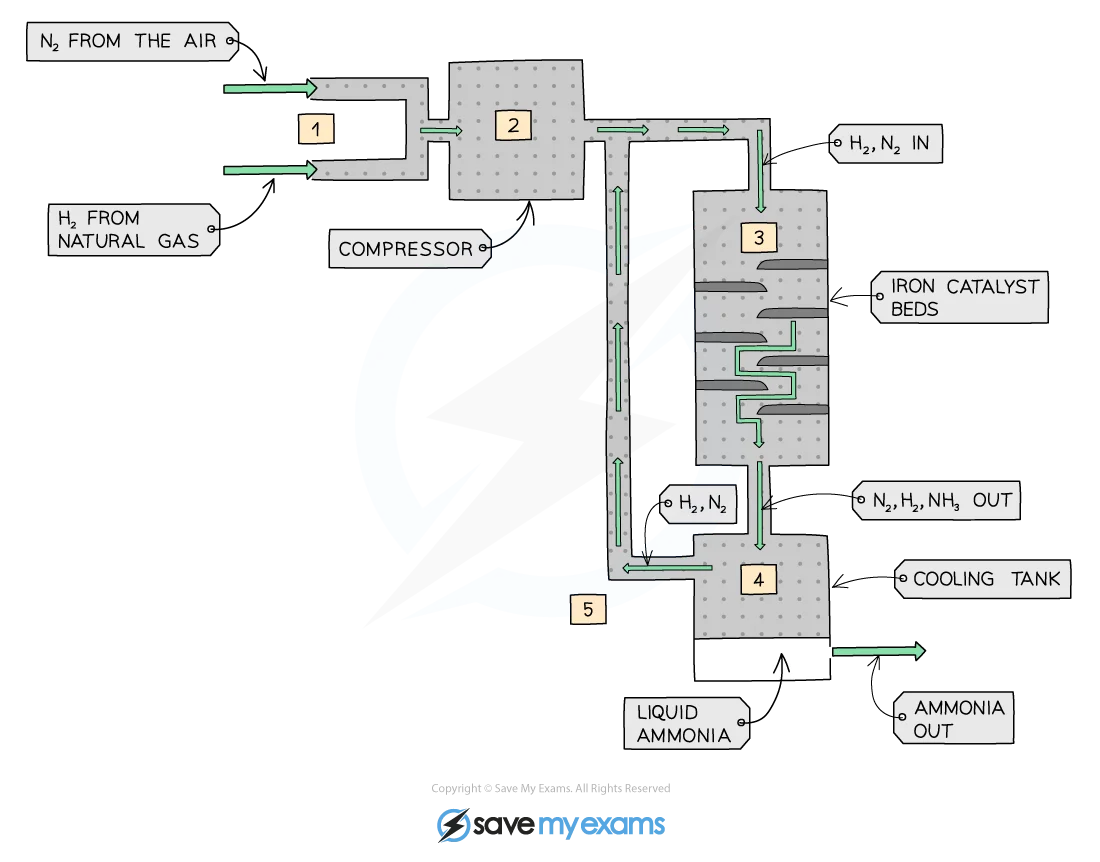
The Haber process is an industrial method for manufacturing ammonia, $\mathrm{NH_3}$, from nitrogen and hydrogen. Ammonia is used to make fertilisers and other nitrogen-containing chemicals.
$$\mathrm{N_2(g)+3H_2(g) \rightleftharpoons 2NH_3(g)}$$
Nitrogen comes from air and hydrogen is obtained from methane. The gases are purified and mixed in a $1:3$ ratio of nitrogen to hydrogen. The mixture is compressed to $20,000\ \mathrm{kPa}$, heated to $450\ ^\circ\mathrm{C}$, and passed over an iron catalyst:
$$\mathrm{N_2(g)+3H_2(g) \rightleftharpoons 2NH_3(g)}$$
The gas mixture is cooled so ammonia liquefies and can be separated. Unreacted nitrogen and hydrogen are recycled.
The reaction is exothermic, so lower temperature gives a higher ammonia yield but a slower rate. Higher pressure favours ammonia because four gas molecules form two, but very high pressure costs more and creates safety risks.
The iron catalyst increases rate by lowering activation energy without changing equilibrium yield. These conditions balance rate, yield, cost, and safety.
Contact process
The Contact process is an industrial method for manufacturing sulfuric acid. Its key reaction makes sulfur trioxide, $\mathrm{SO_3}$, which is then used to produce sulfuric acid.
$$\mathrm{2SO_2(g)+O_2(g) \rightleftharpoons 2SO_3(g)}$$
Sulfur dioxide comes from burning sulfur or roasting sulfide ores; oxygen comes from air. Sulfur can be burned directly:
$$\mathrm{S(s)+O_2(g) \rightarrow SO_2(g)}$$
The sulfur dioxide is purified and dried, then mixed with oxygen and passed over vanadium(V) oxide at $450\ ^\circ\mathrm{C}$ and $200\ \mathrm{kPa}$:
$$\mathrm{2SO_2(g)+O_2(g) \rightleftharpoons 2SO_3(g)}$$
The sulfur trioxide is absorbed in concentrated sulfuric acid to form oleum, rather than being added directly to water. Oleum is then diluted carefully with water to produce sulfuric acid:
$$\mathrm{SO_3+H_2SO_4 \rightarrow H_2S_2O_7}$$
$$\mathrm{H_2S_2O_7+H_2O \rightarrow 2H_2SO_4}$$
The Contact reaction is exothermic, so $450\ ^\circ\mathrm{C}$ is a compromise between a useful rate and acceptable equilibrium yield. A pressure of $200\ \mathrm{kPa}$ gives little extra yield because the pressure increase would be expensive.
Vanadium(V) oxide increases rate by lowering activation energy but does not change equilibrium position.
Redox
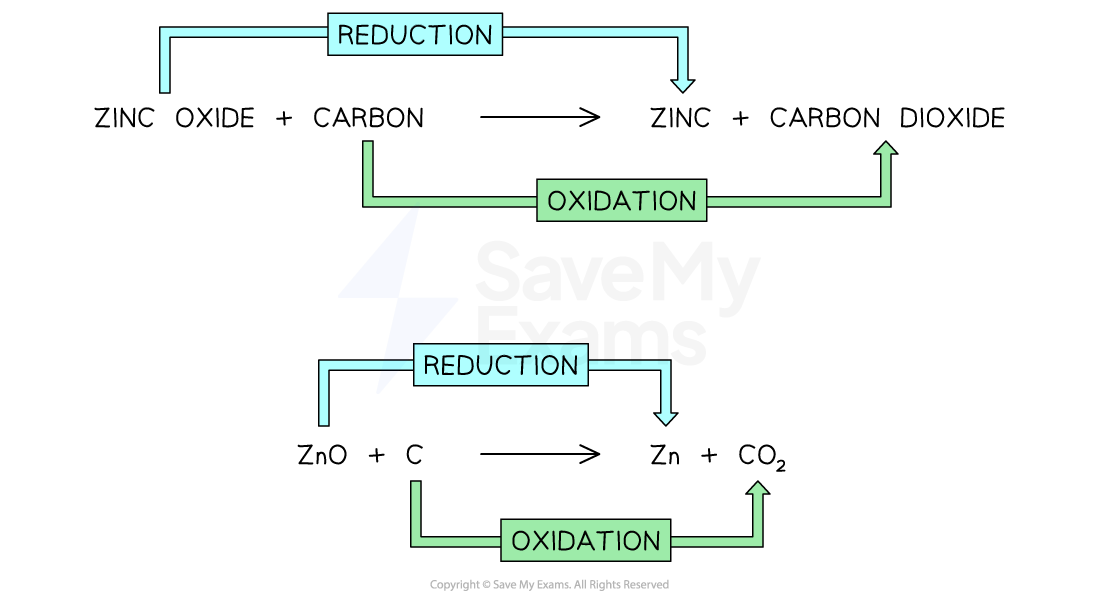
Redox means oxidation and reduction occur together.
- Oxidation is gain of oxygen, loss of electrons, or increase in oxidation number.
- Reduction is loss of oxygen, gain of electrons, or decrease in oxidation number.
- An oxidising agent oxidises another substance and is itself reduced.
- A reducing agent reduces another substance and is itself oxidised.
Use Roman numerals for oxidation numbers, for example iron(II), $\mathrm{Fe(II)}$, and iron(III), $\mathrm{Fe(III)}$.
For example:
$$\mathrm{CuO+H_2 \rightarrow Cu+H_2O}$$
Copper(II) oxide loses oxygen and is reduced. Hydrogen gains oxygen and is oxidised, so $\mathrm{CuO}$ is the oxidising agent and $\mathrm{H_2}$ is the reducing agent.
A colour change can identify redox: acidified potassium manganate(VII) changes from purple to colourless when it is reduced, while aqueous potassium iodide can be oxidised to brown iodine.