Exothermic and endothermic reactions
An exothermic reaction transfers heat to the surroundings. The surroundings warm and the enthalpy change is negative, so $\Delta H < 0$.
An endothermic reaction takes in heat from the surroundings. The surroundings cool and the enthalpy change is positive, so $\Delta H > 0$.
Examples include combustion and neutralisation for exothermic reactions, and thermal decomposition and photosynthesis for endothermic reactions.
Reaction pathway diagrams
A reaction pathway diagram plots energy vertically and reaction progress horizontally.
- Reactants are shown at the start and products at the end.
- $E_a$ is the vertical energy difference from reactants to the peak.
- $\Delta H$ is the vertical energy difference from reactants to products.
- Products below reactants indicate an exothermic reaction.
- Products above reactants indicate an endothermic reaction.
A catalyst lowers $E_a$ by providing an alternative pathway. It does not change the energies of reactants or products and does not change $\Delta H$.
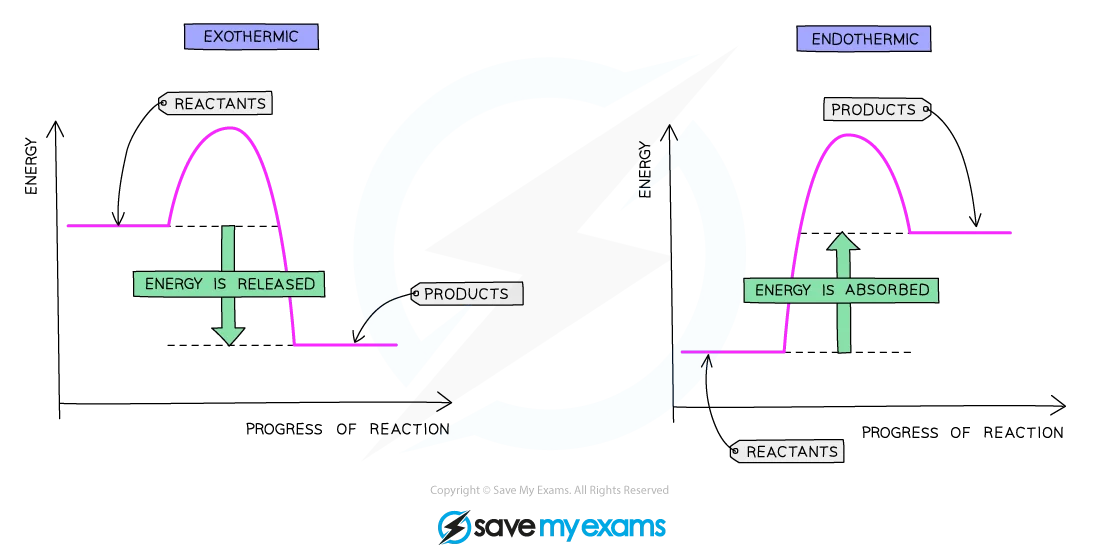
Enthalpy change and activation energy
Enthalpy change is the energy change transferred during a reaction. Activation energy is the minimum energy colliding particles must have for a reaction to occur.
For an exothermic reaction, energy released when new bonds form is greater than energy absorbed when old bonds break. For an endothermic reaction, the reverse is true.
Bond energies
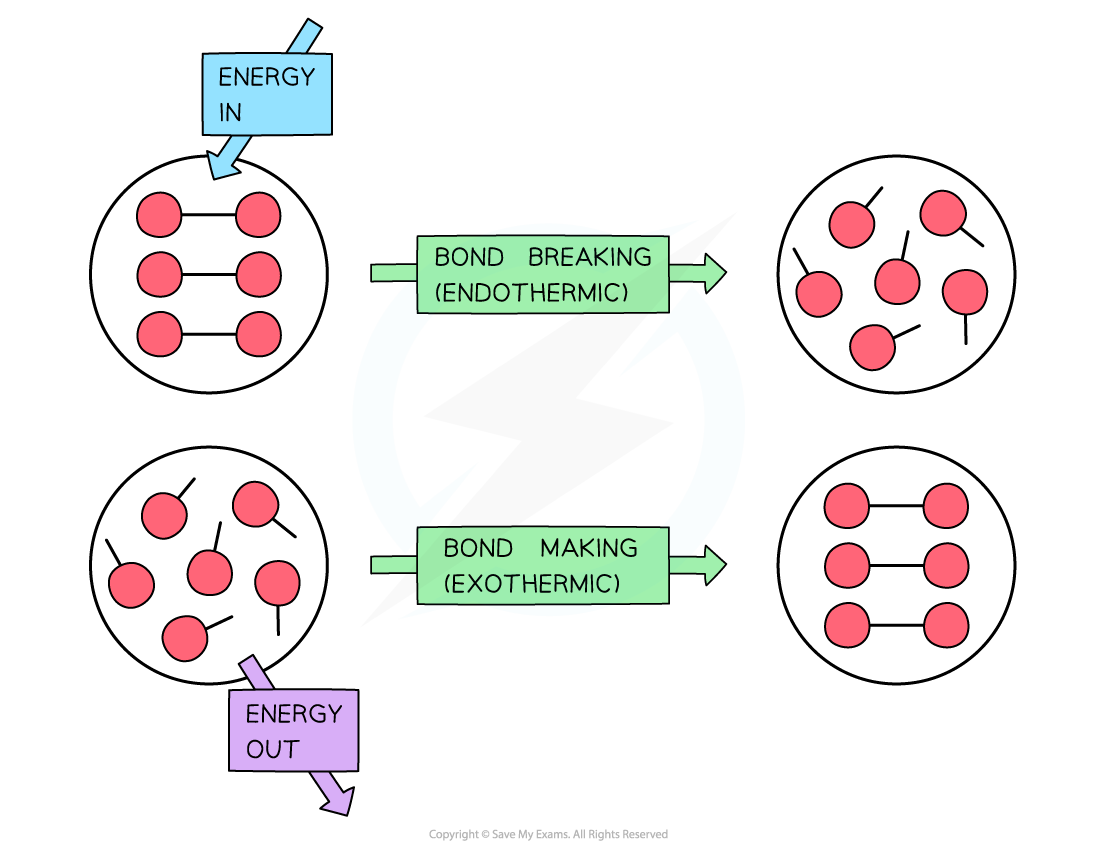 Breaking covalent bonds requires energy. Making covalent bonds releases energy.
$$\Delta H=\sum E(\text{bonds broken})-\sum E(\text{bonds formed})$$
Worked example. For:
$$\mathrm{H_2+Cl_2 \rightarrow 2HCl}$$
Use bond energies $E(\mathrm{H-H})=436\ \mathrm{kJ,mol^{-1}}$, $E(\mathrm{Cl-Cl})=243\ \mathrm{kJ,mol^{-1}}$, and $E(\mathrm{H-Cl})=431\ \mathrm{kJ,mol^{-1}}$.
Energy absorbed:
$$436+243=679\ \mathrm{kJ,mol^{-1}}$$
Energy released:
$$2 \times 431=862\ \mathrm{kJ,mol^{-1}}$$
Therefore:
$$\Delta H=679-862=-183\ \mathrm{kJ,mol^{-1}}$$
The negative value confirms that the reaction is exothermic.
Diagram exam check:
For an exothermic diagram, draw products below reactants and label $\Delta H$ downward.
For an endothermic diagram, draw products above reactants and label $\Delta H$ upward.
In both diagrams, measure $E_a$ from reactants to the peak.