Physical properties and metallic bonding
Metals generally conduct heat and electricity, have high melting and boiling points, and are malleable and ductile. Metallic bonding consists of positive ions in a lattice attracted to delocalised electrons. Mobile electrons explain conductivity; layers of ions can move, explaining malleability and ductility.
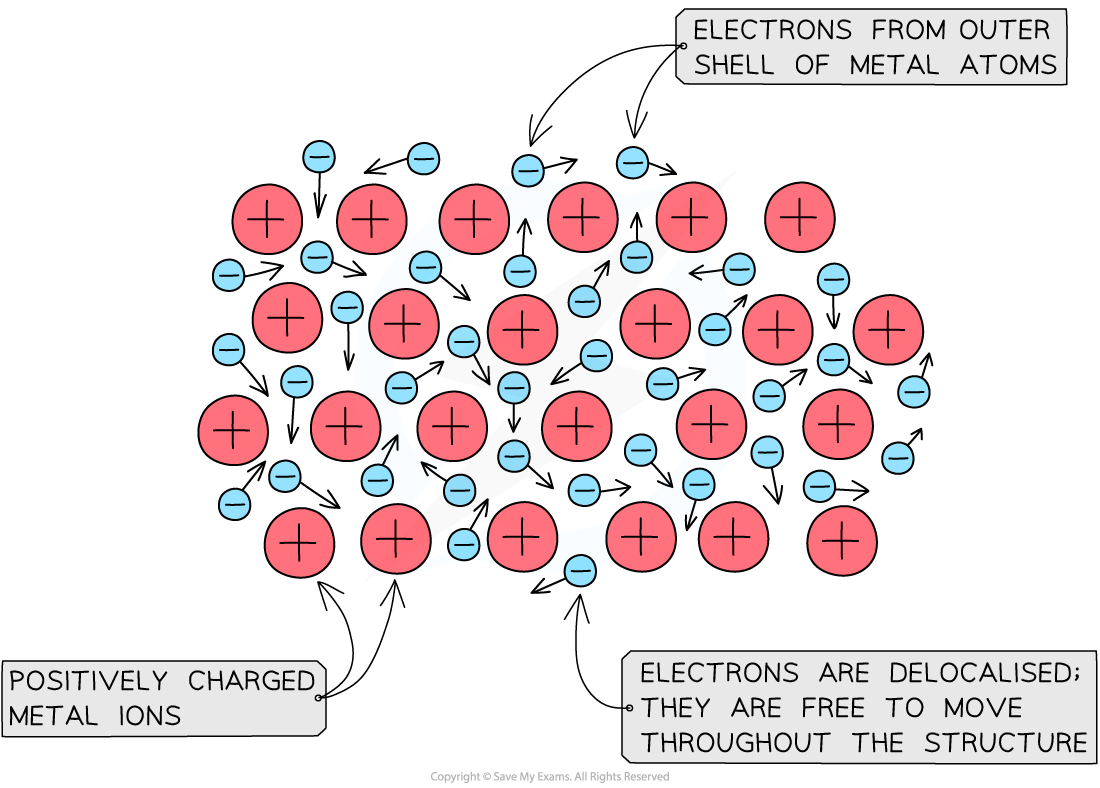
Non-metals generally have lower melting points and are poor conductors, although graphite is an important exception.
Chemical properties and uses
Metals tend to lose electrons and form positive ions.
They react with oxygen to form metal oxides. Aluminium rapidly forms a thin, tough, impermeable layer of aluminium oxide, $\mathrm{Al_2O_3}$. This layer stops oxygen and water reaching fresh aluminium, so aluminium appears less reactive than it is.
Aluminium is used in aircraft because it has low density, in cables because it has low density and conducts electricity, and in containers because its oxide layer resists corrosion. Copper is used in wiring because it conducts electricity and is ductile.
Reactivity series
From most reactive to least reactive:
$$\mathrm{K,\ Na,\ Ca,\ Mg,\ Al,\ C,\ Zn,\ Fe,\ H,\ Cu,\ Ag,\ Au}$$
A more reactive metal displaces a less reactive metal from its compound. For example:
$$\mathrm{Zn(s)+CuSO_4(aq) \rightarrow ZnSO_4(aq)+Cu(s)}$$
The solution loses its blue colour and copper is deposited. The result shows that zinc is more reactive than copper.
Use several results to order metals. For example:
| Metal added to solution | Observation | Conclusion |
|---|---|---|
| Magnesium + copper(II) ions | Copper forms | Magnesium is more reactive than copper |
| Zinc + copper(II) ions | Copper forms | Zinc is more reactive than copper |
| Iron + copper(II) ions | Copper forms slowly | Iron is more reactive than copper |
| Copper + silver ions | Silver forms | Copper is more reactive than silver |
| Silver + copper(II) ions | No reaction | Silver is less reactive than copper |
Reactions with water and acids
- Potassium, sodium, and calcium react with cold water to form the metal hydroxide and hydrogen.
- Magnesium reacts with steam to form magnesium oxide and hydrogen.
- Magnesium, zinc, and iron react with dilute hydrochloric acid to form a chloride and hydrogen.
- Copper, silver, and gold do not react with dilute hydrochloric acid.
Examples:
$$\mathrm{2Na(s)+2H_2O(l) \rightarrow 2NaOH(aq)+H_2(g)}$$
$$\mathrm{Mg(s)+H_2O(g) \rightarrow MgO(s)+H_2(g)}$$
$$\mathrm{Mg(s)+2HCl(aq) \rightarrow MgCl_2(aq)+H_2(g)}$$
Hydrogen gives a squeaky pop with a lighted splint. Use observations and displacement results to deduce a reactivity order.
Alloys
An alloy is a mixture of a metal with other elements. Different-sized atoms distort the regular layers and prevent them sliding, so alloys are harder and stronger than pure metals.
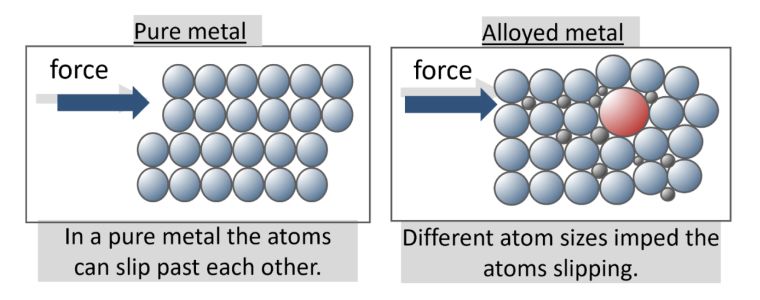
Brass contains copper and zinc. Stainless steel contains iron with chromium and other elements such as nickel and carbon. Stainless steel is hard and resists rusting, so it is used for cutlery.
Rusting and protection
Iron or steel rusts when both oxygen and water are present. Rust is hydrated iron(III) oxide. Barrier methods such as painting, greasing, and plastic coating prevent oxygen and water reaching the iron.
Galvanising coats iron with zinc. Zinc provides a barrier and, because it is more reactive than iron, gives sacrificial protection. If the coating is scratched, zinc is oxidised first. A more reactive metal such as magnesium or zinc can also be attached directly to iron for sacrificial protection.
Extraction of iron
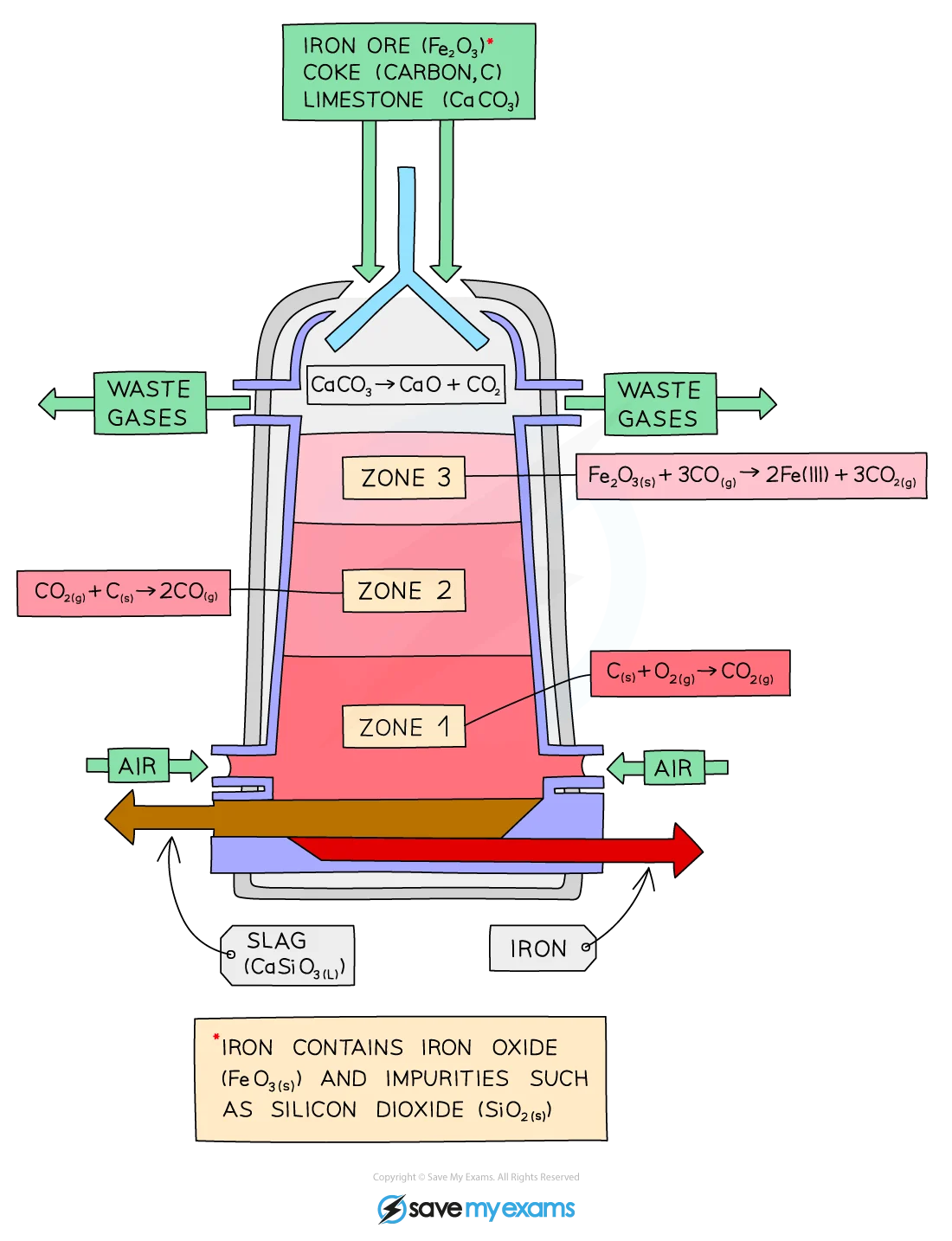
Hematite contains iron(III) oxide. In a blast furnace:
- Coke burns:
$$\mathrm{C+O_2 \rightarrow CO_2}$$
- Carbon dioxide reacts with more coke:
$$\mathrm{CO_2+C \rightarrow 2CO}$$
- Carbon monoxide reduces iron(III) oxide:
$$\mathrm{Fe_2O_3+3CO \rightarrow 2Fe+3CO_2}$$
- Limestone decomposes:
$$\mathrm{CaCO_3 \rightarrow CaO+CO_2}$$
- Calcium oxide reacts with silica impurity to form slag:
$$\mathrm{CaO+SiO_2 \rightarrow CaSiO_3}$$
Extraction of aluminium
Aluminium is extracted by electrolysis because it is above carbon in the reactivity series. Purified aluminium oxide is dissolved in molten cryolite, which lowers the operating temperature and energy cost.
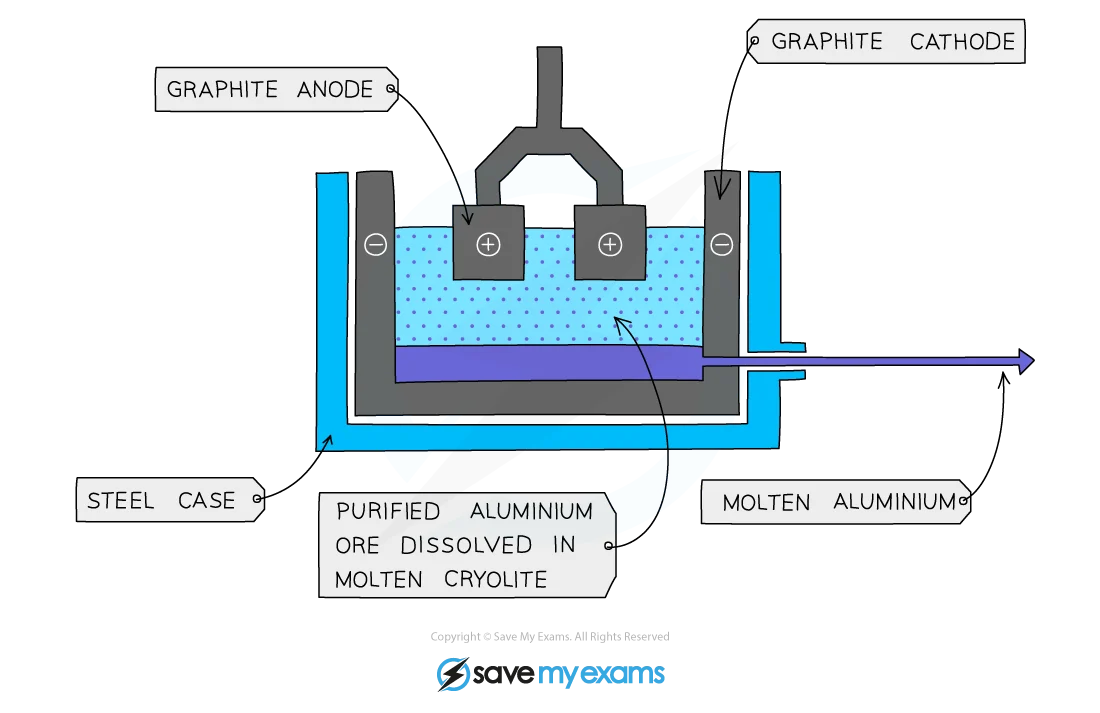
At the cathode:
$$\mathrm{Al^{3+}+3e^- \rightarrow Al}$$
At the carbon anode:
$$\mathrm{2O^{2-} \rightarrow O_2+4e^-}$$
The oxygen reacts with carbon, for example:
$$\mathrm{C+O_2 \rightarrow CO_2}$$
Carbon anodes are therefore consumed and must be replaced. Cryolite is not the ore; bauxite is the aluminium ore.