Elements, compounds and mixtures
- An element contains only one type of atom.
- A compound contains atoms of two or more elements chemically bonded in fixed proportions.
- A mixture contains two or more substances that are not chemically bonded. Its components can be separated by physical methods.
Atomic structure
| Particle | Relative charge | Relative mass | Location |
|---|---|---|---|
| Proton | $+1$ | $1$ | Nucleus |
| Neutron | $0$ | $1$ | Nucleus |
| Electron | $-1$ | $\frac{1}{1840}$ | Shells around nucleus |
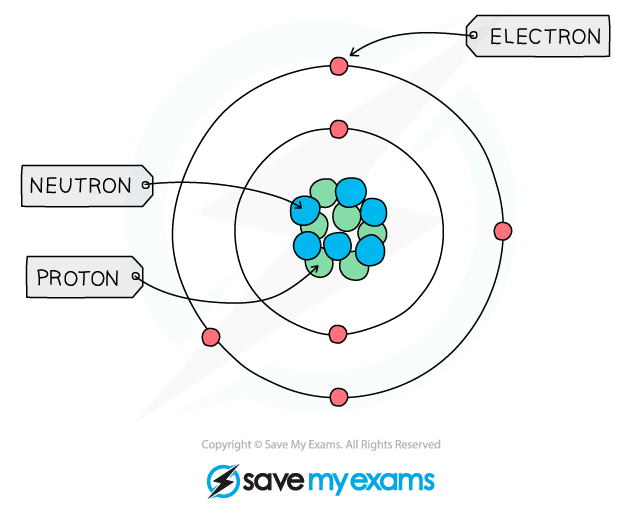
The proton number, or atomic number, is the number of protons. The mass number, or nucleon number, is the total number of protons and neutrons. In a neutral atom, number of electrons equals number of protons.
For example:
- $^{14}_6\mathrm{C}$ has 6 protons, 8 neutrons, and 6 electrons.
- $^{23}_{11}\mathrm{Na^+}$ has 11 protons, 12 neutrons, and 10 electrons.
Electronic configuration for proton numbers 1–20
Electrons fill shells with capacities used at this level: the first shell holds 2, the second 8, and the third 8 before the fourth shell begins.
| Proton number | Element | Electronic configuration |
|---|---|---|
| 1 | H | $1$ |
| 2 | He | $2$ |
| 3 | Li | $2,1$ |
| 4 | Be | $2,2$ |
| 5 | B | $2,3$ |
| 6 | C | $2,4$ |
| 7 | N | $2,5$ |
| 8 | O | $2,6$ |
| 9 | F | $2,7$ |
| 10 | Ne | $2,8$ |
| 11 | Na | $2,8,1$ |
| 12 | Mg | $2,8,2$ |
| 13 | Al | $2,8,3$ |
| 14 | Si | $2,8,4$ |
| 15 | P | $2,8,5$ |
| 16 | S | $2,8,6$ |
| 17 | Cl | $2,8,7$ |
| 18 | Ar | $2,8,8$ |
| 19 | K | $2,8,8,1$ |
| 20 | Ca | $2,8,8,2$ |
Examples: magnesium, proton number 12, has configuration $2,8,2$; chlorine, proton number 17, has configuration $2,8,7$.
For Groups I–VII, the number of outer-shell electrons equals the group number. The period number equals the number of occupied shells. Group VIII noble gases have full outer shells.
Isotopes and relative atomic mass
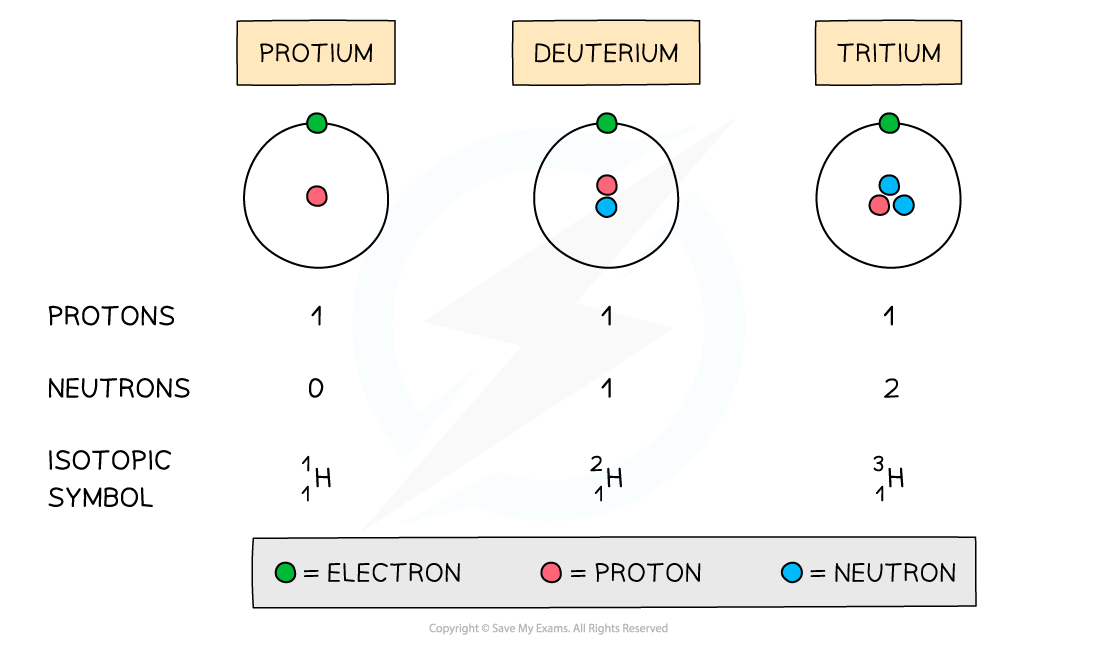
Isotopes are atoms of the same element with the same number of protons but different numbers of neutrons. They have the same electron configuration and therefore similar chemical properties.
Relative atomic mass is a weighted mean:
$$A_r = \frac{(m_1 \times a_1) + (m_2 \times a_2) + \cdots}{a_1+a_2+\cdots}$$
Worked example. An element contains 75% isotope X-35 and 25% isotope X-37:
$$A_r = \frac{(35 \times 75)+(37 \times 25)}{100}=35.5$$
Ions and ionic bonding
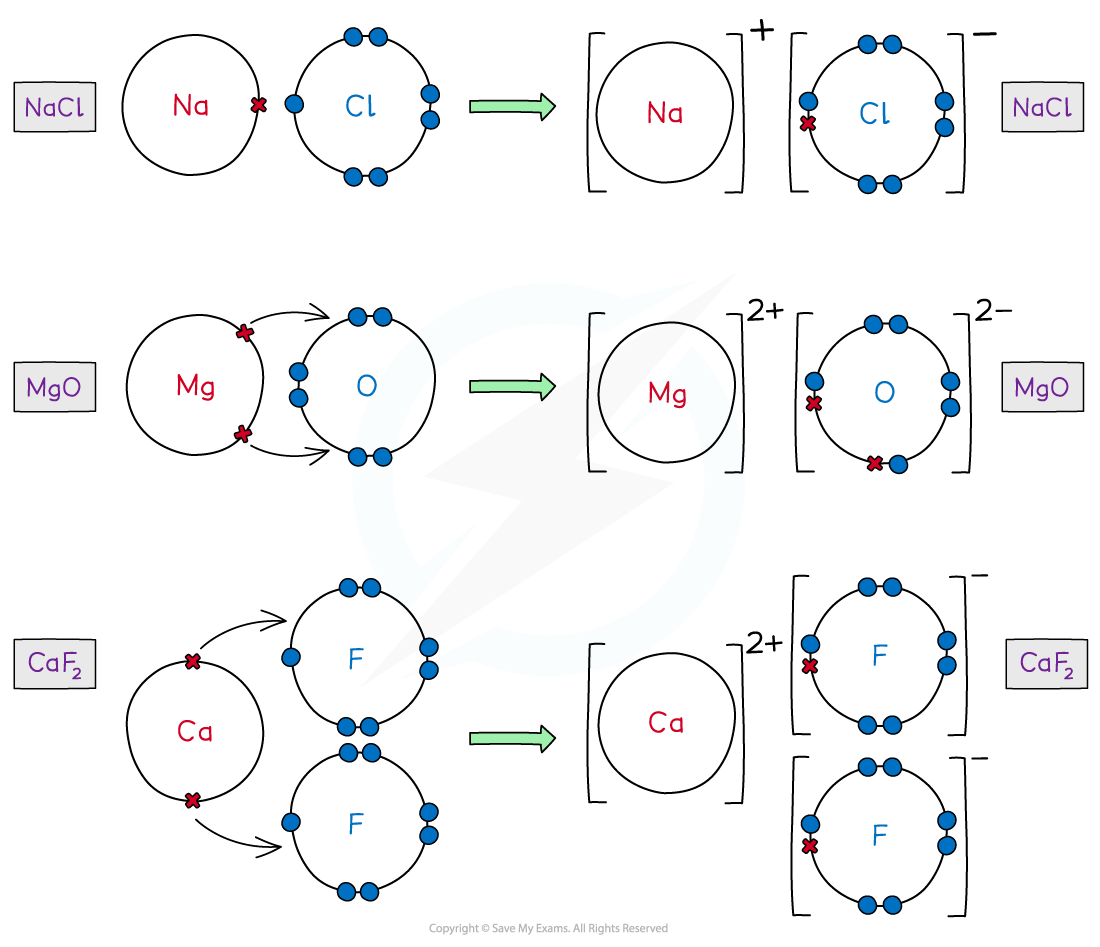
A cation forms when an atom loses electrons. An anion forms when an atom gains electrons. For example:
$$\mathrm{Na} \rightarrow \mathrm{Na^+}+e^-$$
$$\mathrm{Cl}+e^- \rightarrow \mathrm{Cl^-}$$
An ionic bond is the strong electrostatic attraction between oppositely charged ions. Ionic compounds form giant ionic lattices. They have high melting and boiling points. They conduct electricity when molten or aqueous because ions can move, but not when solid because ions are fixed.
For sodium chloride, sodium transfers one outer electron to chlorine. Sodium becomes $\mathrm{Na^+}$ with configuration $2,8$; chlorine becomes $\mathrm{Cl^-}$ with configuration $2,8,8$.
In a dot-and-cross diagram:
- Show chlorine’s seven original outer electrons as dots, the transferred sodium electron as a cross.
- Square brackets around each ion
- The charges $+1$ and $-1$ outside the brackets.
Covalent bonding
A covalent bond is a shared pair of electrons. For dot-and-cross diagrams, use dots for electrons from one atom and crosses for electrons from the other atom. For a covalent dot-and-cross diagram, show each shared pair between the atoms and all required lone pairs.
| Molecule | Bonds and lone pairs to show |
|---|---|
| $\mathrm{H_2}$ | One shared pair between the two hydrogen atoms |
| $\mathrm{Cl_2}$ | One shared pair and three lone pairs around each chlorine atom |
| $\mathrm{H_2O}$ | Two $\mathrm{O-H}$ shared pairs and two lone pairs on oxygen |
| $\mathrm{CH_4}$ | Four $\mathrm{C-H}$ shared pairs around carbon |
| $\mathrm{NH_3}$ | Three $\mathrm{N-H}$ shared pairs and one lone pair on nitrogen |
| $\mathrm{HCl}$ | One $\mathrm{H-Cl}$ shared pair and three lone pairs on chlorine |
Supplement examples include $\mathrm{CH_3OH}$, $\mathrm{C_2H_4}$, $\mathrm{O_2}$, $\mathrm{CO_2}$, and $\mathrm{N_2}$. For double or triple bonds, show two or three shared electron pairs respectively. Dot-and-cross diagrams must show each shared pair and all required lone pairs.
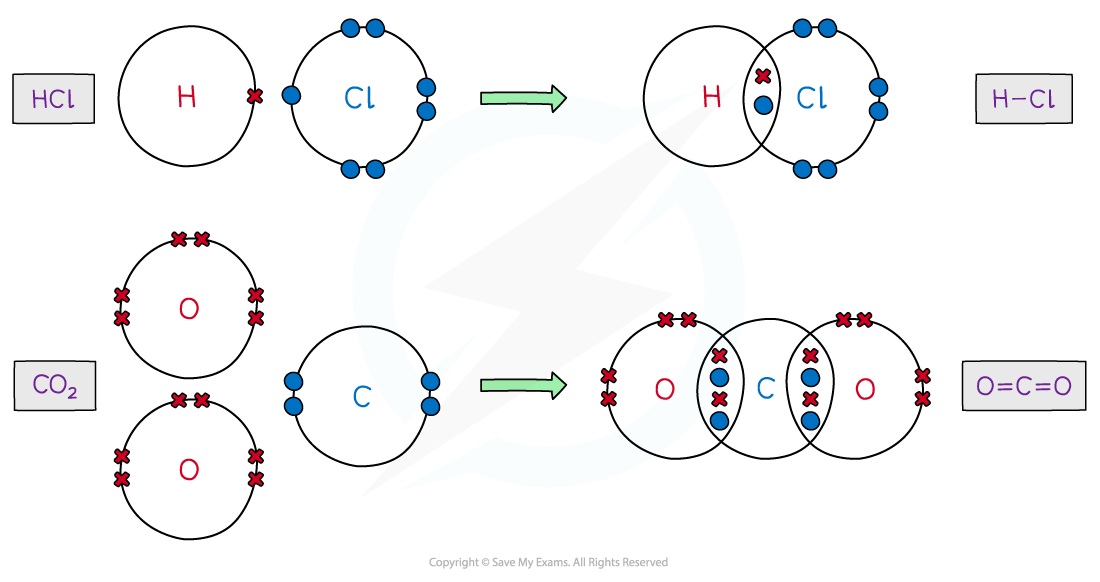
Simple molecular substances usually have low melting and boiling points because weak intermolecular forces act between molecules. Their covalent bonds are strong, but they have no mobile ions or electrons and therefore do not conduct electricity.
Giant covalent structures
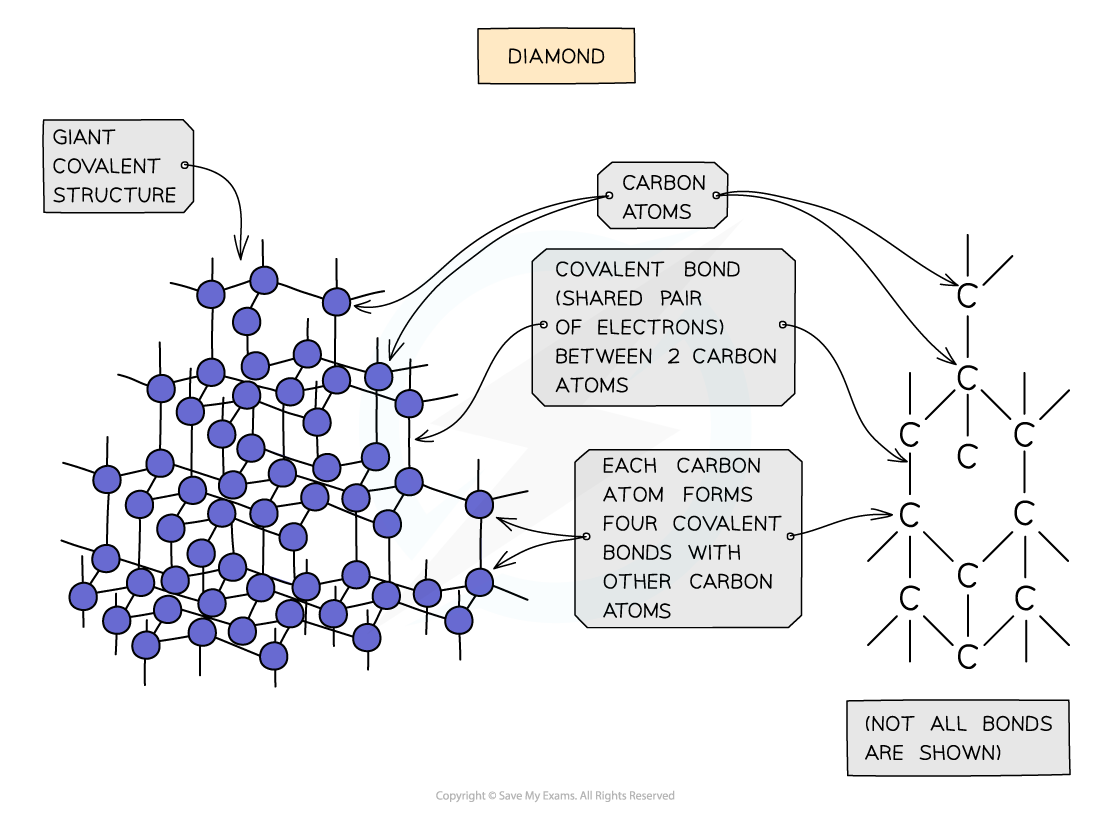
- Diamond: each carbon bonds to four other carbon atoms. It is hard and is used in cutting tools.
- Graphite: each carbon bonds to three other carbon atoms in layers. Layers slide, so graphite is a lubricant. One electron per carbon is delocalised, so graphite conducts electricity and can be used as an electrode.
- Silicon(IV) oxide, $\mathrm{SiO_2}$: each silicon bonds to four oxygen atoms and each oxygen bonds to two silicon atoms in a giant covalent network. It is hard and has a high melting point, like diamond.
Metallic bonding
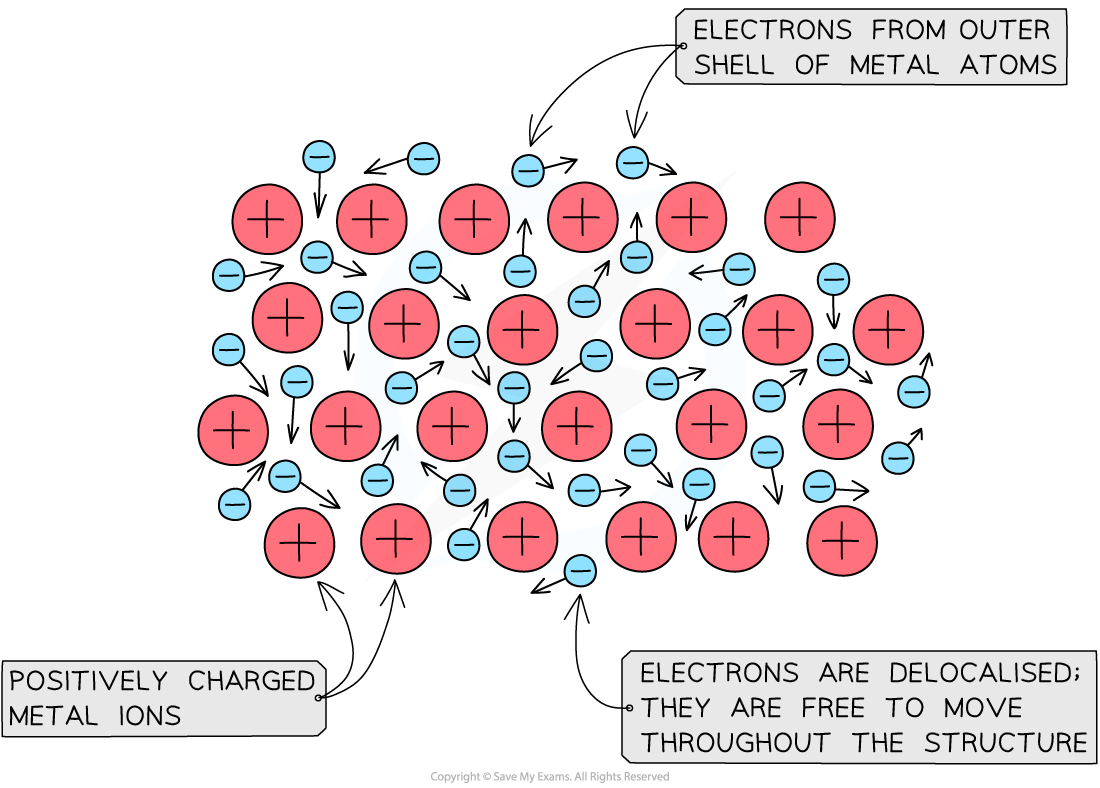
A metal contains positive ions in a lattice surrounded by delocalised electrons. Electrostatic attraction between the ions and electrons holds the lattice together. Delocalised electrons explain electrical and thermal conductivity. Layers can move while attraction remains, explaining malleability and ductility.