Symmetry
1. Key vocabulary
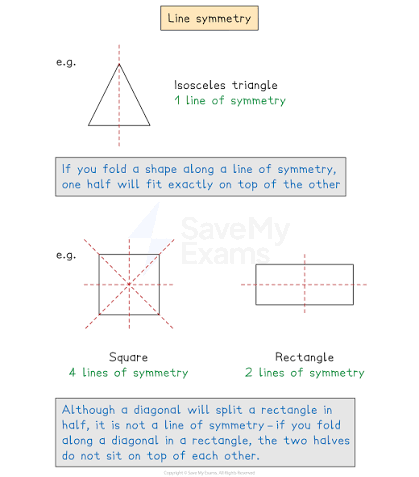
- Line of symmetry: A line that divides a shape into two matching mirror-image halves.
- Rotational symmetry: A shape matches its original position after a rotation of less than one complete turn.
- Order of rotational symmetry: The number of times a shape matches itself during one complete turn of $360^\circ$.
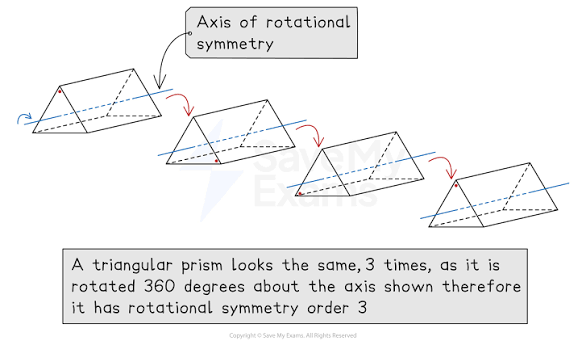
- Axis of rotational symmetry: A line about which a shape or solid can be rotated and remain unchanged.
- Plane of symmetry: A flat plane that divides a solid into matching mirror-image halves.
A shape can have line symmetry, rotational symmetry, both, or neither.
2. Line symmetry in two-dimensional shapes
To test line symmetry, imagine folding the shape along a possible line. Both halves must coincide exactly. A line of symmetry must divide corresponding points into mirror images; it is not enough for the two parts to have equal area.
Important examples:
| Shape | Lines of symmetry | Order of rotational symmetry |
|---|---|---|
| Equilateral triangle | $3$ | $3$ |
| Isosceles triangle | $1$ | $1$ |
| Scalene triangle | $0$ | $1$ |
| Square | $4$ | $4$ |
| Rectangle (not square) | $2$ | $2$ |
| Rhombus (not square) | $2$ | $2$ |
| Parallelogram (not rectangle) | $0$ | $2$ |
| Non-rhombus kite | $1$ | $1$ |
| Regular pentagon | $5$ | $5$ |
The exact symmetry of a trapezium depends on its type. An isosceles trapezium has one line of symmetry; a general trapezium may have none.
Application example: A point $P$ is $3\text{ cm}$ from a rectangle’s vertical line of symmetry. Its mirror image is also $3\text{ cm}$ from that line.
3. Rotational symmetry in two-dimensional shapes
Rotate a shape about its centre. Count every position in which it matches its starting position, including the starting position at $0^\circ$.
For a regular polygon with $n$ equal sides:
$$\text{order of rotational symmetry}=n$$
For order greater than $1$, the smallest angle of rotation is:
$$\text{smallest angle}=\frac{360^\circ}{\text{order}}$$
A shape with order $1$ has no non-trivial rotational symmetry, so it has no smallest matching rotation less than $360^\circ$.
Worked example: A regular hexagon has order $6$.
$$\text{smallest angle}=\frac{360^\circ}{6}=60^\circ$$
It matches after rotations of $60^\circ$, $120^\circ$, $180^\circ$, $240^\circ$, and $300^\circ$.
A shape with order $1$ has no non-trivial rotational symmetry. Do not confuse the number of sides with the number of lines of symmetry for an irregular shape.
4. Symmetry of triangles and quadrilaterals
Triangles
- An equilateral triangle has $3$ lines of symmetry. Each line passes through a vertex and the midpoint of the opposite side. Its rotational order is $3$.
- An isosceles triangle has $1$ line of symmetry, passing from the unequal vertex to the midpoint of the base. Its rotational order is $1$.
- A scalene triangle has no line symmetry and rotational order $1$.
- A general right-angled triangle has no symmetry. A special isosceles right-angled triangle has $1$ line of symmetry.
Symmetry can show that corresponding sides or angles are equal. For example, the two base angles of an isosceles triangle are equal because reflection in its symmetry line maps one base angle to the other.
Quadrilaterals
- A square has $4$ lines of symmetry and rotational order $4$.
- A rectangle has $2$ lines of symmetry through the midpoints of opposite sides and rotational order $2$.
- A rhombus has $2$ lines of symmetry along its diagonals and rotational order $2$.
- A parallelogram has rotational order $2$ but usually no line symmetry.
- A kite normally has $1$ line of symmetry through the vertices between its equal adjacent sides. A square, if treated as a special kite, has $4$ lines of symmetry.
- An isosceles trapezium has $1$ line of symmetry and rotational order $1$.
Use these properties to find equal lengths, equal angles, and unknown angles. Symmetry does not automatically mean that every diagonal or every angle is equal; use only properties guaranteed by the particular shape.
Application example: If one base angle of an isosceles triangle is $52^\circ$, reflection in its line of symmetry gives the other base angle:
$$52^\circ$$
5. Circle terms
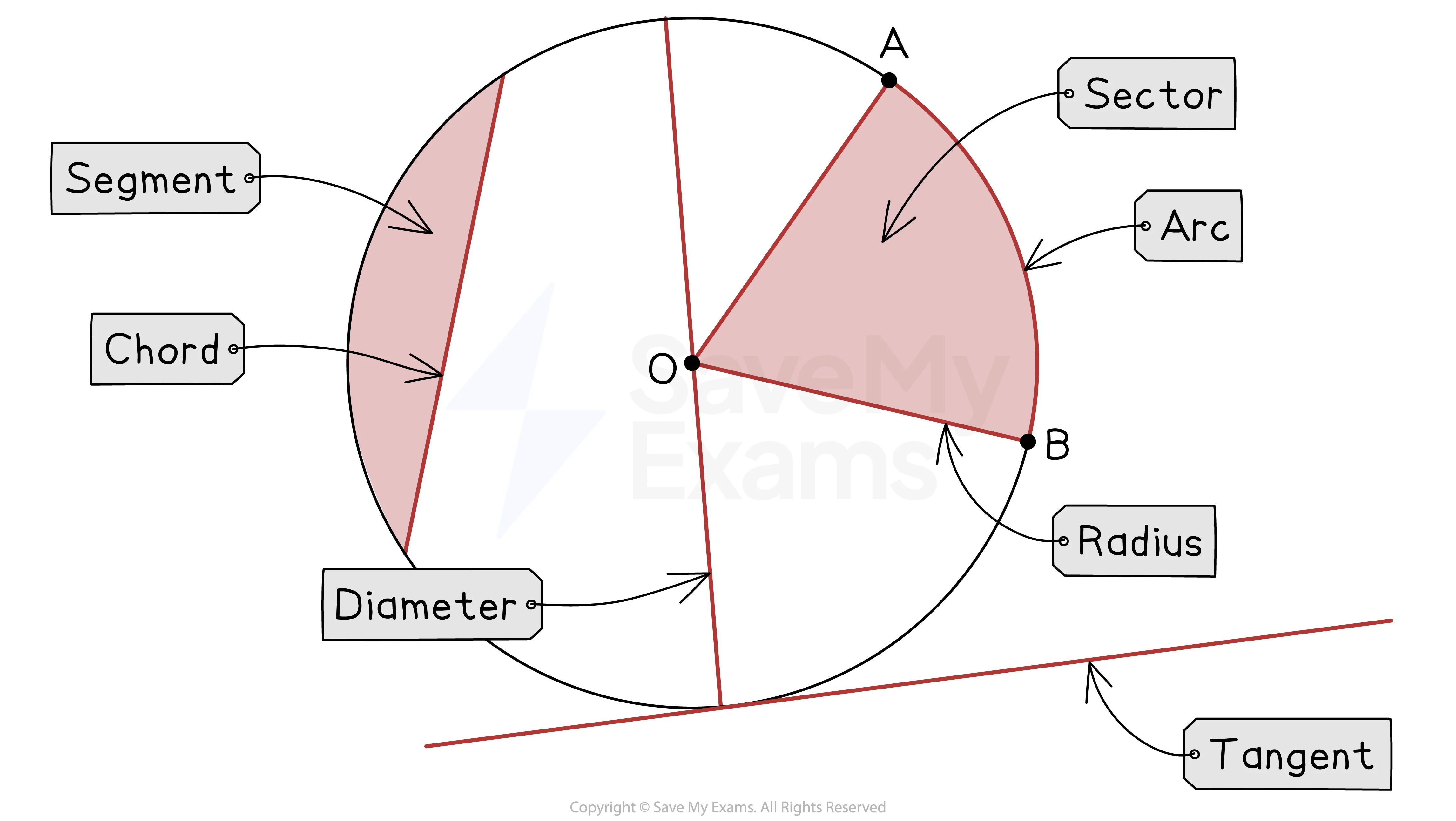
Use the following vocabulary before studying circle symmetry or circle theorems:
- A diameter passes through the centre.
- A chord joins two points on the circumference.
- A tangent touches the circle at one point.
- An arc is part of the circumference.
- A sector is the region bounded by two radii and an arc.
- A segment is the region bounded by a chord and an arc.
- An angle at the centre has its vertex at the centre.
- An angle at the circumference has its vertex on the circle.
6. Symmetry of circles
A circle has infinitely many lines of symmetry: every line through its centre is a line of symmetry. It also matches itself after rotation through any angle. A circle therefore has infinitely many possible rotational matches, so its order is not normally written as a finite number.
Circle symmetry gives these results:
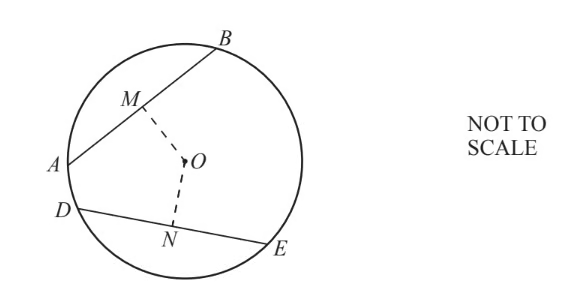
- Equal chords are the same distance from the centre.
- The perpendicular bisector of a chord passes through the centre.
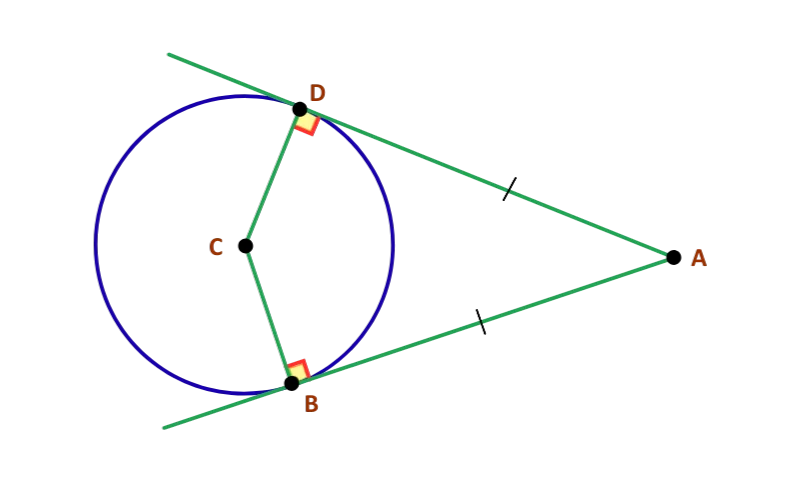
- Two tangents drawn from the same external point to the circle have equal lengths.
Worked example: Two chords are equal. One chord is $7\text{ cm}$ from the centre. By circle symmetry, the other chord is also $7\text{ cm}$ from the centre.
7. Circle theorems
1. Angle in a semicircle
The angle subtended by a diameter at the circumference is $90^\circ$.

Worked example: $AB$ is a diameter and $C$ lies on the circumference. Therefore, $\angle ACB=90^\circ$. If $\angle CAB=34^\circ$, the triangle angle sum gives:
$$\angle CBA=180^\circ-90^\circ-34^\circ=56^\circ$$
2. Radius and tangent
The radius drawn to the point of contact is perpendicular to the tangent, so the angle between them is $90^\circ$.
Worked example: A tangent touches a circle at $A$. Let $T$ be a point on the tangent line at $A$, and let $O$ be the centre. Since $OA$ is a radius:
$$\angle OAT=90^\circ$$
Suppose ray $AB$ lies inside angle $OAT$, and the angle between chord $AB$ and tangent $AT$ is $38^\circ$. The remaining angle between radius $OA$ and chord $AB$ is:
$$\angle OAB=90^\circ-38^\circ=52^\circ$$

3. Angle at the centre
The angle at the centre standing on an arc is twice the angle at the circumference standing on the same arc.
$$\text{angle at centre}=2\times\text{angle at circumference}$$
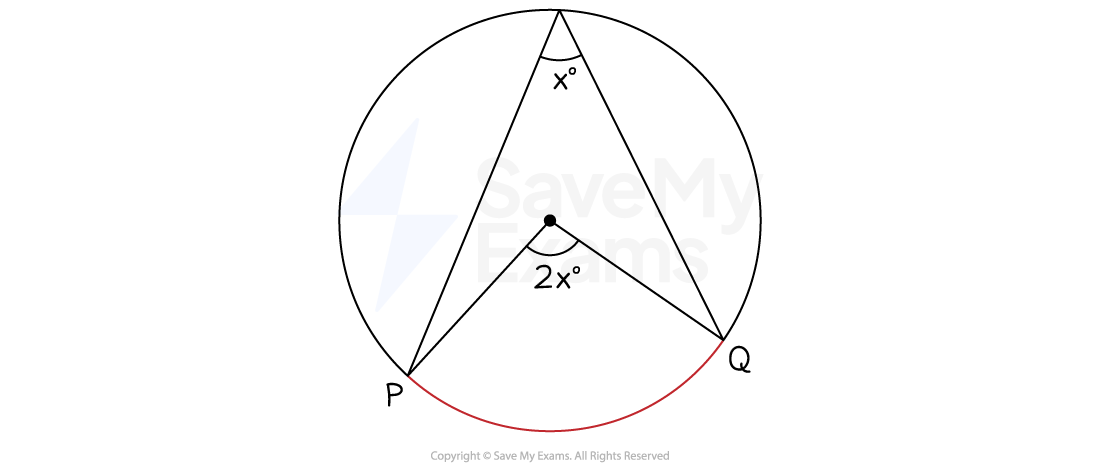
Worked example: An angle at the circumference is $38^\circ$. The angle at the centre standing on the same arc is:
$$2\times38^\circ=76^\circ$$
4. Angles in the same segment
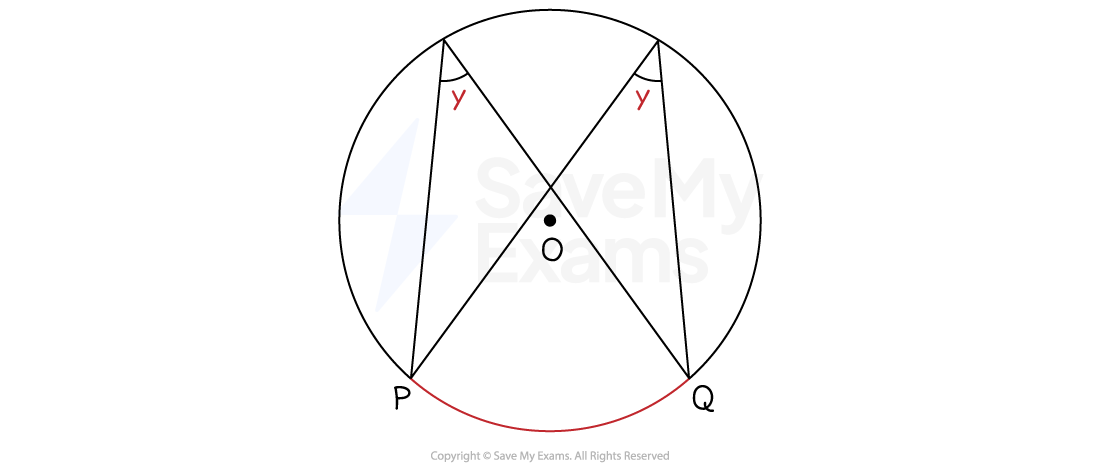
Angles at the circumference standing on the same chord or arc are equal when their vertices lie in the same segment, on the same side of the chord. In simpler terms, both angles touch the same two points on the circumference and their vertices are on the same side of the chord.
Worked example: Points $P$ and $Q$ lie on the same side of chord $AB$. If $\angle APB$ and $\angle AQB$ stand on chord $AB$ and $\angle APB=47^\circ$, then:
$$\angle AQB=47^\circ$$
5. Cyclic quadrilateral
Opposite angles in a quadrilateral whose four vertices lie on a circle sum to $180^\circ$.
Worked example: One angle of a cyclic quadrilateral is $112^\circ$. Its opposite angle is:
$$180^\circ-112^\circ=68^\circ$$

6. Alternate segment theorem
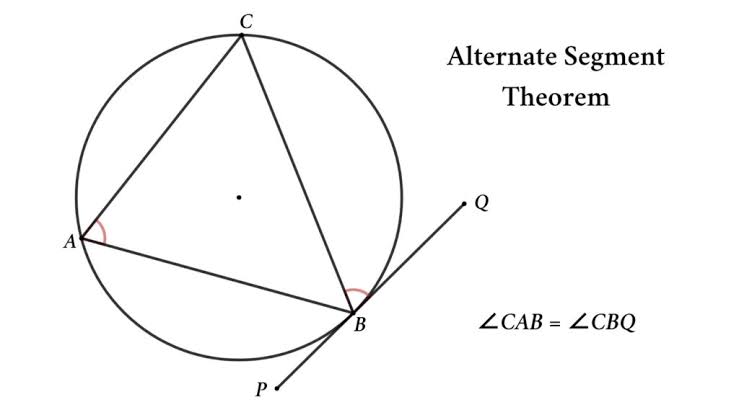
The angle between a tangent and a chord equals the angle in the part of the circle on the opposite side of the chord (called the alternate segment).
Worked example: A tangent touches a circle at $A$ and chord $AB$ makes an angle of $52^\circ$ with the tangent. If $C$ lies on the opposite segment, then:
$$\angle ACB=52^\circ$$
The reason is that $\angle ACB$ stands on chord $AB$ in the alternate segment.
These theorems depend on identifying the same chord, arc, diameter, or tangent. Mark the relevant points before choosing a theorem.
8. Using circle theorems to solve angle facts
Before selecting a theorem, identify the centre, diameter, chord, tangent, arc, sector, and segment in the diagram. Then use this method:
- Mark known radii, diameters, equal chords, tangents, or symmetry lines.
- Look for a right angle from a diameter or a radius and tangent.
- Identify angles standing on the same chord or arc.
- Check whether four points form a cyclic quadrilateral.
- Apply the relevant circle theorem.
- Finish with familiar angle facts: angles in a triangle sum to $180^\circ$, angles in a quadrilateral sum to $360^\circ$, angles on a straight line sum to $180^\circ$, and angles around a point sum to $360^\circ$.
- State a reason for each important step.
Worked example: In a cyclic quadrilateral, one pair of opposite angles is $83^\circ$ and $x^\circ$. Therefore:
$$x+83^\circ=180^\circ$$
$$x=97^\circ$$
For an unfamiliar diagram, do not assume that a line is a diameter or that points are equally spaced. Use only information shown or a theorem that proves the result.
9. Symmetry of prisms and pyramids
A plane of symmetry divides a solid into two matching halves. An axis of rotational symmetry is a line about which a solid can be rotated and remain unchanged.
Prisms
A prism has two congruent, parallel bases. Its planes and axes of symmetry depend on the symmetry of its base.
Example: A right prism with an isosceles triangular base has a longitudinal plane of symmetry. This plane runs along the prism’s length and passes through the line of symmetry of its triangular base.
Pyramids
A pyramid has a base and triangular faces that meet at an apex. Its planes and axes of symmetry depend on the symmetry of its base and the position of its apex.
Example: A regular square-based pyramid has an axis from its apex to the centre of its square base. It also has vertical planes of symmetry through the apex and each line of symmetry of the square.
A cube has several planes of symmetry and axes of rotational symmetry. A prism or pyramid with an irregular base generally has fewer symmetries.
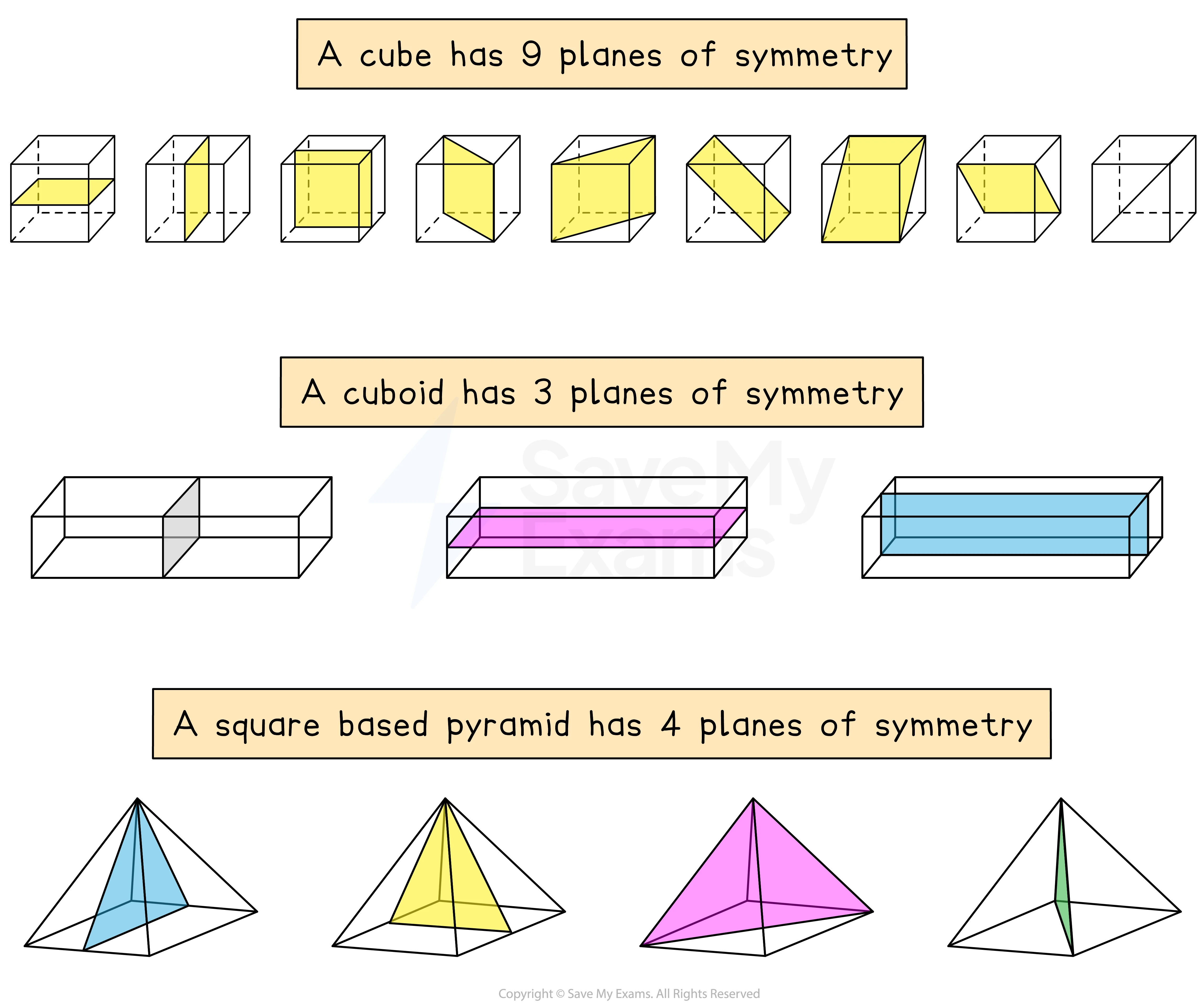
How to identify solid symmetry
- Inspect the base and identify its lines of symmetry.
- Check whether a plane through the solid creates two matching halves.
- Check whether a line through the solid is an axis of rotational symmetry.
- Count a symmetry of the base only when it remains a symmetry of the complete solid.