Organic chemistry
Formulae, functional groups and naming
A displayed formula shows every atom and covalent bond. A structural formula is an unambiguous shortened description. For example, $\mathrm{CH_3CH_2OH}$ is a structural formula, while a displayed formula shows every $\mathrm{C-H}$, $\mathrm{C-C}$, $\mathrm{C-O}$, and $\mathrm{O-H}$ bond separately.
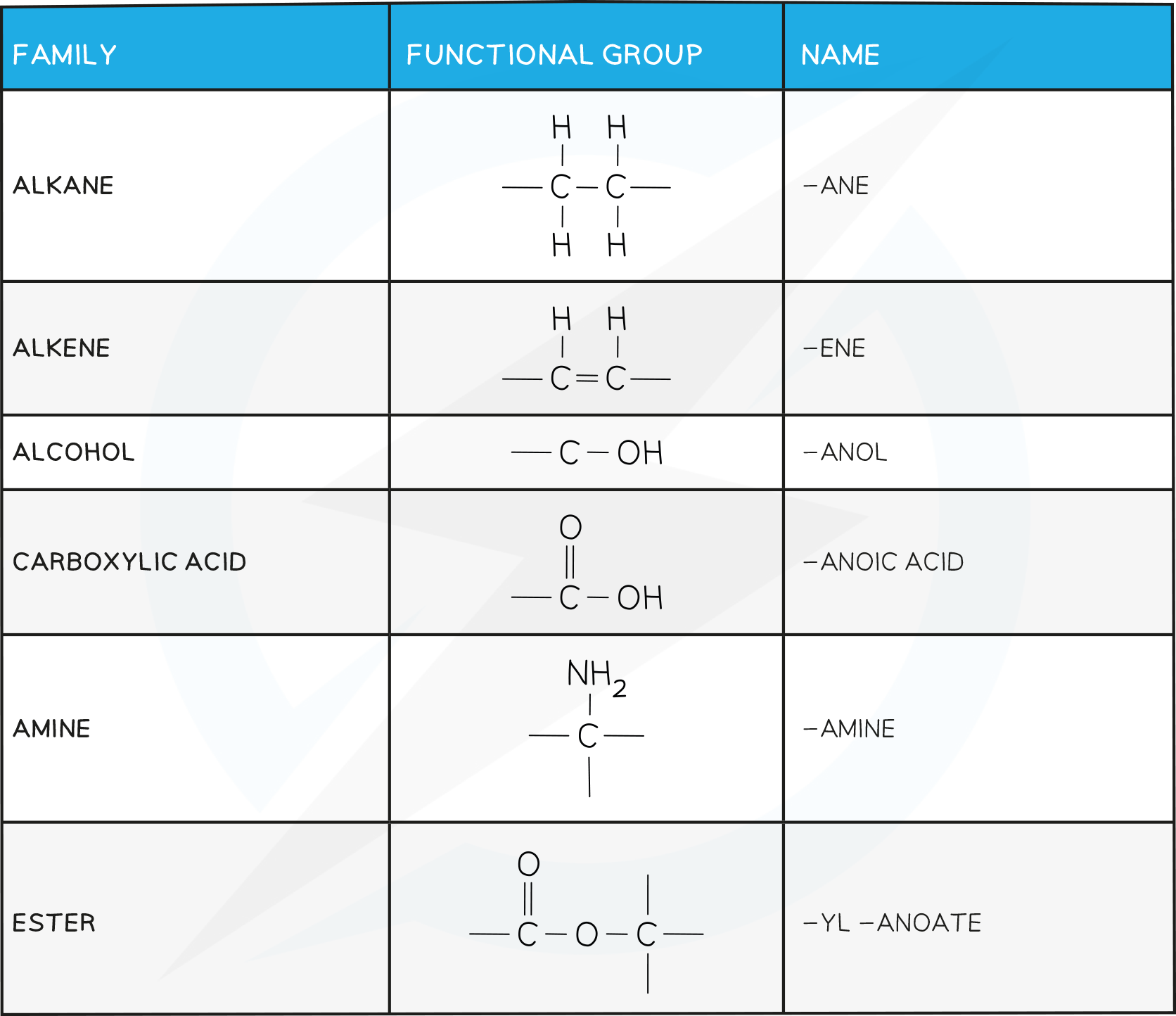
A functional group controls characteristic reactions. Before drawing, count carbon atoms, identify the functional group or multiple bond, and add hydrogen atoms until each carbon forms four bonds.
A structural formula example is $\mathrm{CH_2{=}CH_2}$.
| Homologous series | Functional group or bond | General formula | Example |
|---|---|---|---|
| Alkane | Single carbon–carbon bonds | $\mathrm{C_nH_{2n+2}}$ | Ethane, $\mathrm{C_2H_6}$ |
| Alkene | $\mathrm{C{=}C}$ | $\mathrm{C_nH_{2n}}$ | Ethene, $\mathrm{C_2H_4}$ |
| Alcohol | $\mathrm{-OH}$ | $\mathrm{C_nH_{2n+1}OH}$ | Ethanol, $\mathrm{C_2H_5OH}$ |
| Carboxylic acid | $\mathrm{-COOH}$ | $\mathrm{C_nH_{2n+1}COOH}$ | Ethanoic acid, $\mathrm{CH_3COOH}$ |
Saturated compounds contain only $\mathrm{C{-}C}$ bonds. Unsaturated compounds contain at least one $\mathrm{C{=}C}$ bond.
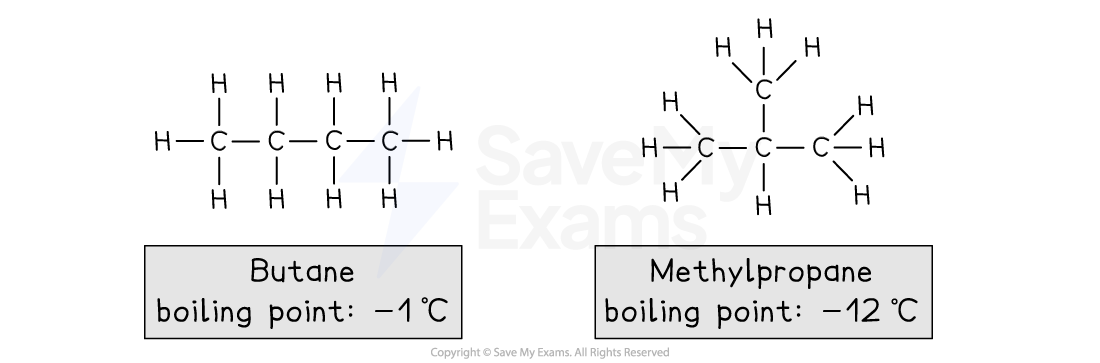
A structural isomer has the same molecular formula but a different structural formula. Members of a homologous series have the same functional group and general formula, successive members differ by $\mathrm{-CH_2-}$, and they show similar chemical properties and gradual physical-property trends.
For example, $\mathrm{C_4H_{10}}$ has two structural isomers:
$$\mathrm{CH_3CH_2CH_2CH_3}\qquad\text{and}\qquad\mathrm{CH_3CH(CH_3)CH_3}$$
Use a carbon-chain prefix and a family ending:
| Carbon atoms | Prefix | Alkane | Alkene | Alcohol | Carboxylic acid |
|---|---|---|---|---|---|
| 1 | meth- | methane | — | — | — |
| 2 | eth- | ethane | ethene | ethanol | ethanoic acid |
| 3 | prop- | propane | propene | propanol | propanoic acid |
| 4 | but- | butane | butene | butanol | butanoic acid |
Name endings are $\mathrm{-ane}$, $\mathrm{-ene}$, $\mathrm{-ol}$, and $\mathrm{-oic\ acid}$. To name a compound, count the carbon atoms, identify the functional group or $\mathrm{C=C}$ bond, then combine the prefix and ending.
Fossil fuels and petroleum
Coal, natural gas, and petroleum are fossil fuels. Methane, $\mathrm{CH_4}$, is the main component of natural gas. Petroleum is a mixture of hydrocarbons, which contain carbon and hydrogen only.
In fractional distillation, petroleum is heated and vaporised. Vapours rise through a column that is hotter at the bottom and cooler at the top. Fractions condense at different heights because their hydrocarbons have different boiling points.
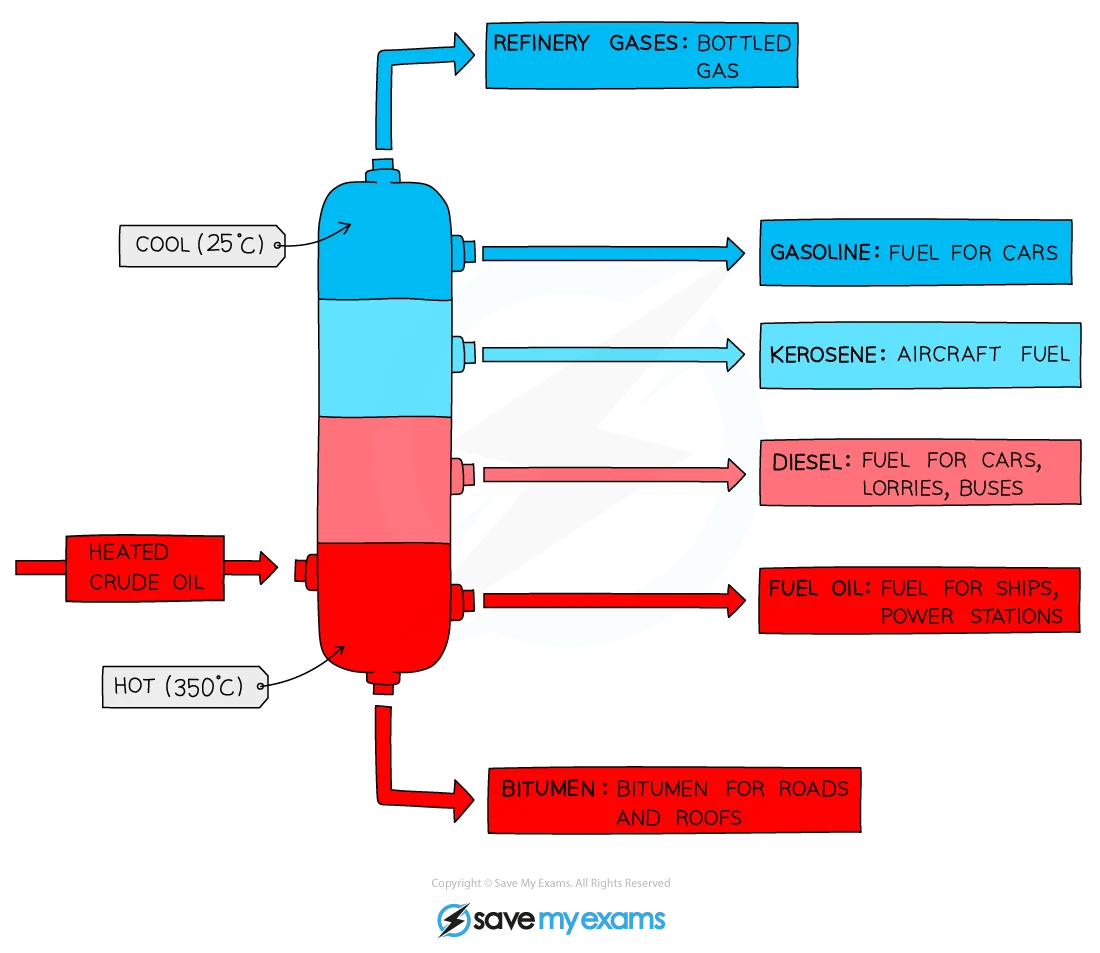
From bottom to top, chain length, boiling point, and viscosity decrease while volatility increases.
| Fraction | Use |
|---|---|
| Refinery gas | Heating and cooking |
| Gasoline | Car fuel |
| Naphtha | Chemical feedstock |
| Kerosene | Jet fuel |
| Diesel oil | Diesel engines |
| Fuel oil | Ships and home heating |
| Lubricating oil | Lubricants, waxes, and polishes |
| Bitumen | Road surfacing |
Alkanes and alkenes
Alkanes contain only single carbon–carbon bonds and are saturated. Alkenes contain a carbon–carbon double bond and are unsaturated.
Catalytic Cracking
Cracking breaks long-chain alkanes into shorter alkanes and alkenes using high temperature and a catalyst. It supplies more useful short-chain fuels and alkenes for polymer manufacture.
$$\mathrm{C_{10}H_{22} \rightarrow C_8H_{18}+C_2H_4}$$
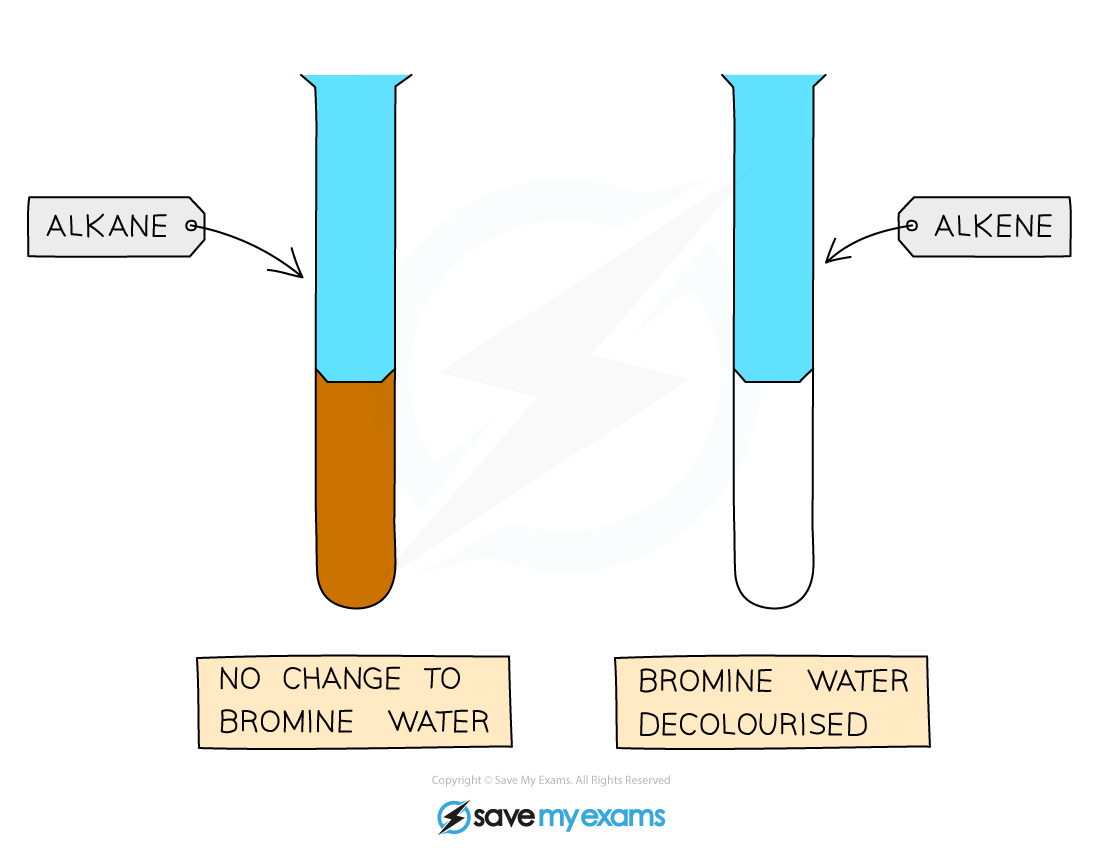
Bromination (unsaturation test)
Aqueous bromine tests for unsaturation. An alkene decolourises orange-brown bromine; an alkane does not under these conditions.
Alkane monosubstitution
Alkanes undergo substitution with chlorine in ultraviolet light. In monosubstitution:
$$\mathrm{CH_4+Cl_2 \xrightarrow{UV} CH_3Cl+HCl}$$
Alkene addition
Alkenes undergo addition. Only one product forms because atoms add across the double bond:
$$\mathrm{CH_2{=}CH_2+Br_2 \rightarrow CH_2BrCH_2Br}$$
$$\mathrm{CH_2{=}CH_2+H_2 \xrightarrow{Ni} CH_3CH_3}$$
$$\mathrm{CH_2{=}CH_2+H_2O \xrightarrow{\text{acid catalyst}} CH_3CH_2OH}$$
Ethanol
Fermentation uses yeast, glucose solution, $25$–$35\ ^\circ\mathrm{C}$, and no oxygen:
$$\mathrm{C_6H_{12}O_6 \rightarrow 2C_2H_5OH+2CO_2}$$
It uses renewable plant material but is slow and produces dilute ethanol requiring fractional distillation. Catalytic addition of steam to ethene is fast and continuous and produces a more concentrated product, but uses finite petroleum feedstock and high temperature and pressure:
$$\mathrm{C_2H_4+H_2O \rightleftharpoons C_2H_5OH}$$
Conditions are $300\ ^\circ\mathrm{C}$, $6000\ \mathrm{kPa}$, and an acid catalyst. Ethanol is used as a solvent and fuel. Complete combustion is:
$$\mathrm{C_2H_5OH+3O_2 \rightarrow 2CO_2+3H_2O}$$
Ethanoic acid
Ethanol is oxidised to ethanoic acid by bacteria in vinegar production or by acidified potassium manganate(VII).
Ethanoic acid reacts with metals, bases, and carbonates:
$$\mathrm{2CH_3COOH+Mg \rightarrow (CH_3COO)_2Mg+H_2}$$
The salt is magnesium ethanoate.
$$\mathrm{CH_3COOH+NaOH \rightarrow CH_3COONa+H_2O}$$
The salt is sodium ethanoate.
$$\mathrm{2CH_3COOH+Na_2CO_3 \rightarrow 2CH_3COONa+H_2O+CO_2}$$
The salt is sodium ethanoate; carbon dioxide and water are also formed.
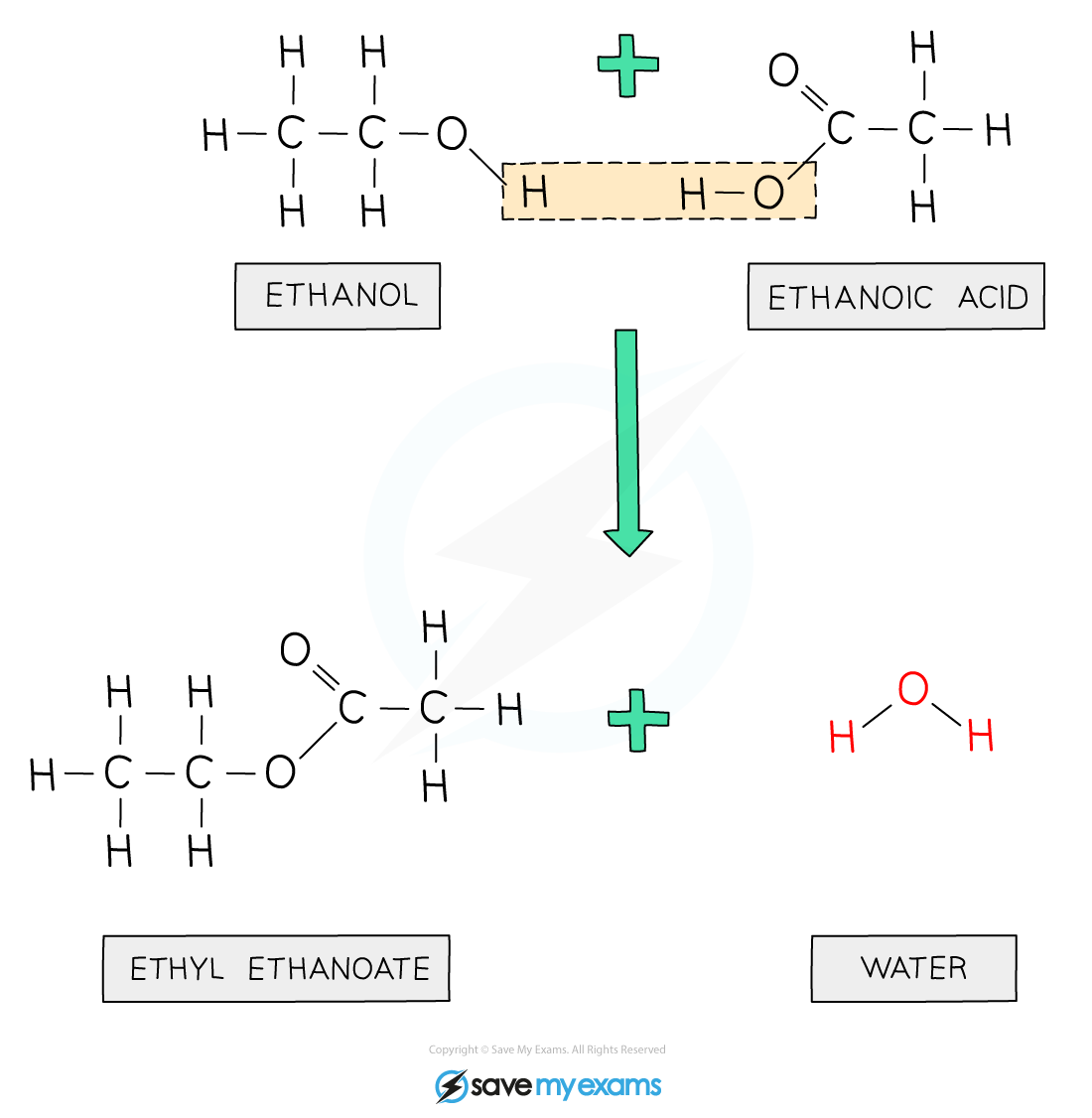
A carboxylic acid and an alcohol form an ester and water in the presence of an acid catalyst:
Polymers and plastics
A polymer is a large molecule made from many monomers.
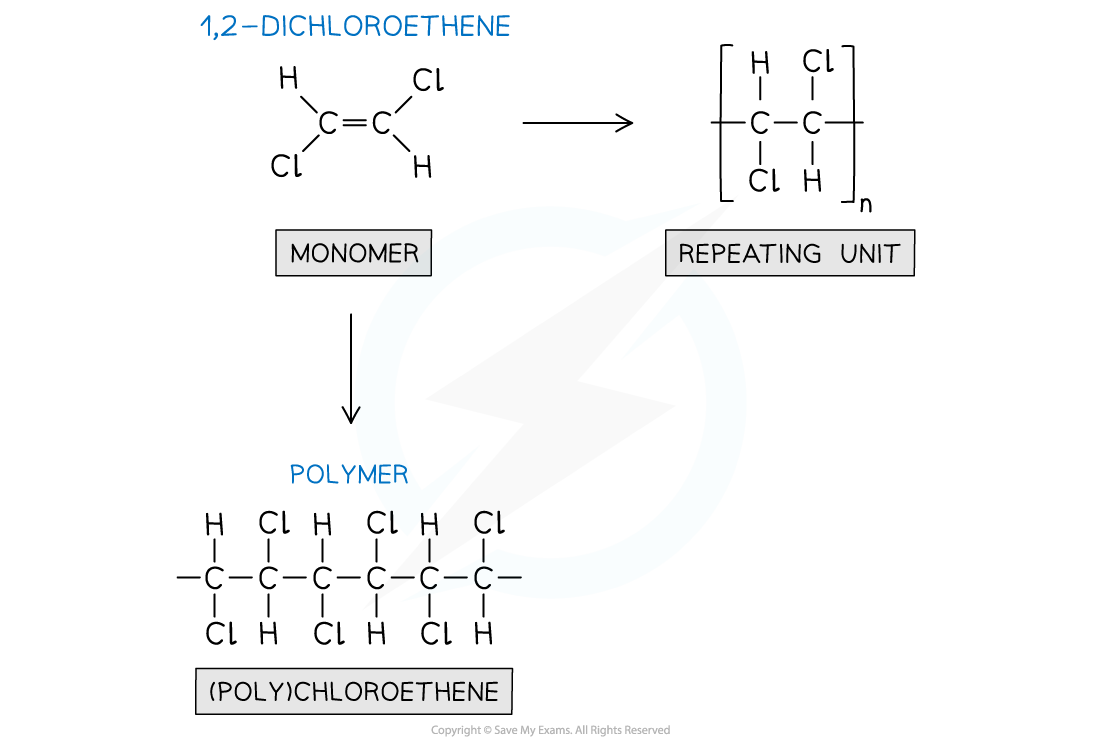
Addition polymerisation uses an unsaturated monomer and forms no small molecule:
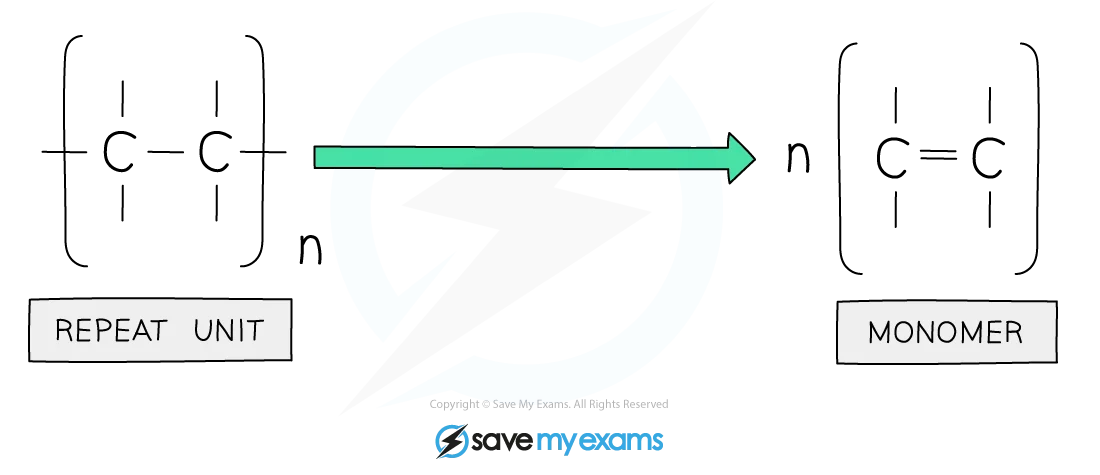 $$\mathrm{[-CH_2-CH_2-]_n \rightarrow nCH_2{=}CH_2 }$$
To deduce an addition-polymer repeat unit, open the alkene double bond, draw single bonds to neighbouring units, and place brackets with subscript $n$. To deduce the alkene monomer, remove the bonds joining adjacent repeat units and restore a C=C bond.
Condensation polymerisation
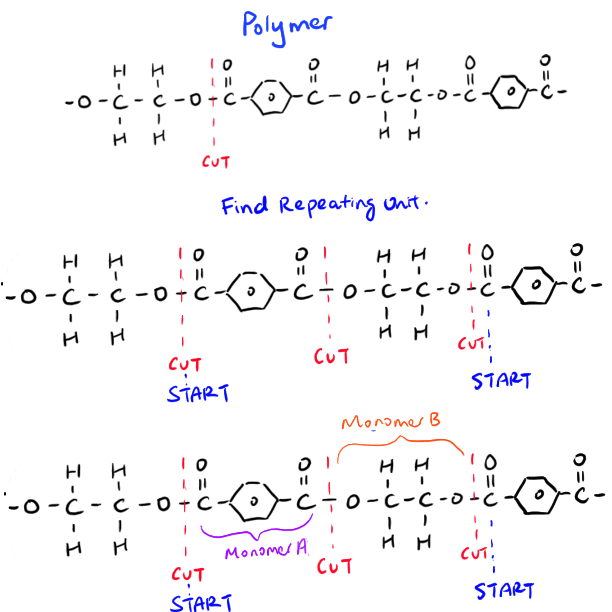
Condensation polymerisation uses monomers with two functional groups and releases a small molecule, usually water.
- Dicarboxylic acids with diamines form polyamides containing $\mathrm{-CO-NH-}$ linkages.
- Dicarboxylic acids with diols form polyesters containing $\mathrm{-CO-O-}$ linkages.
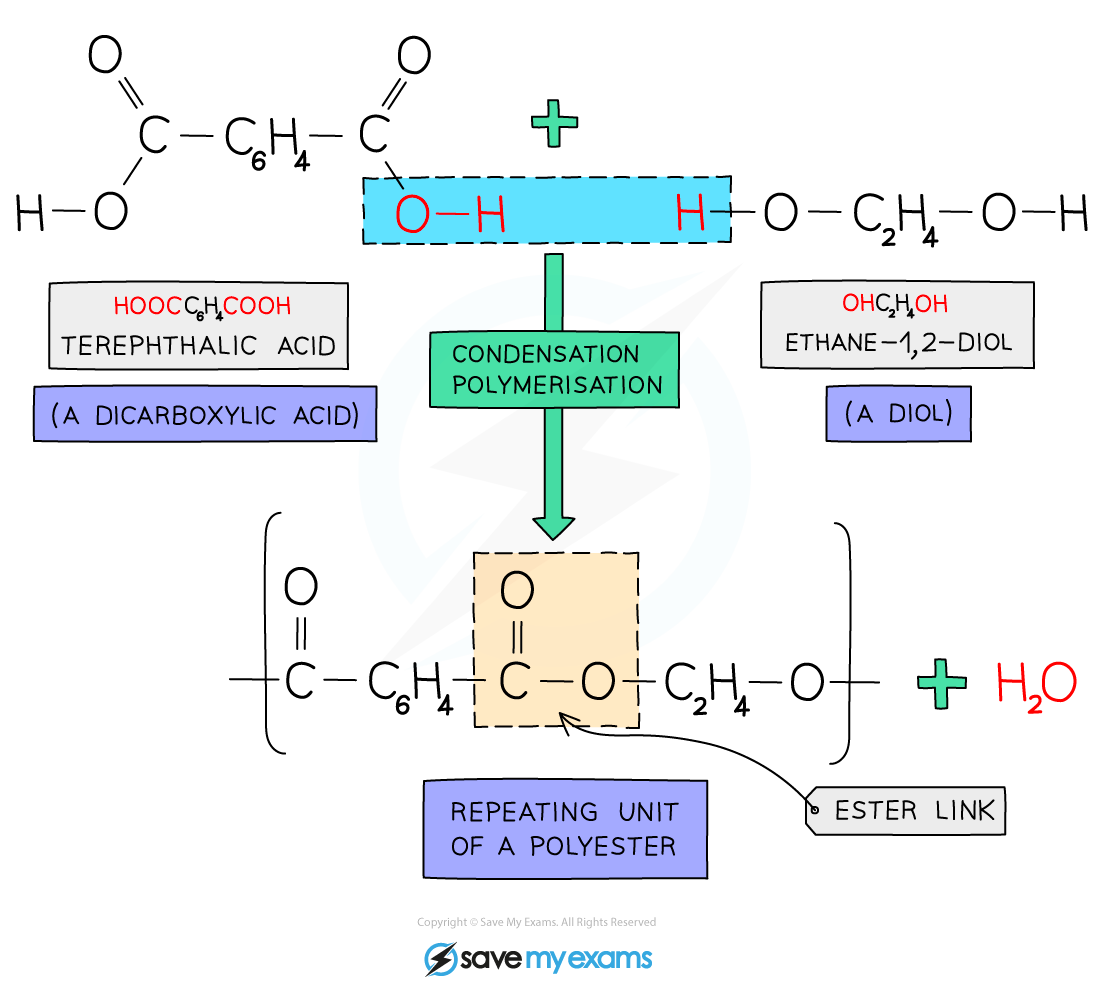
For a condensation polymer, split the $\mathrm{-CO-NH-}$ or $\mathrm{-CO-O-}$ linkage. Restore $\mathrm{-COOH}$ at acid ends and restore $\mathrm{-NH_2}$ or $\mathrm{-OH}$ at the other ends. The removed $\mathrm{OH}$ and $\mathrm{H}$ form water at each linkage.
Plastic and recycling
Nylon is a polyamide; its repeat unit can be represented as:
$$\mathrm{[-CO-(CH_2)_4-CO-NH-(CH_2)_6-NH-]_n}$$
PET is a polyester; its repeat unit can be represented as:
$$\mathrm{[-CO-C_6H_4-CO-O-CH_2CH_2-O-]_n}$$
Proteins are natural polyamides formed from amino acids with peptide, or amide, linkages. Each amino acid contains an amino group, $\mathrm{-NH_2}$, and a carboxylic acid group, $\mathrm{-COOH}$. When amino acids join, water is removed and a $\mathrm{-CO-NH-}$ peptide linkage forms. A simplified protein chain is:
$$\mathrm{[-NH-CH(R)-CO-]_n}$$
PET can be recycled by converting it to monomers.
Addition polymers form no small molecule; condensation polymers release one at each linkage. Plastics may accumulate in landfill and oceans, and burning can produce toxic gases. Reduce, reuse, and recycle plastics where possible.
Exam checks
- Draw every atom and bond when asked for a displayed formula.
- Balance equations and include conditions above the arrow.
- Show repeat-unit brackets and subscript $n$.
- Identify the functional group, homologous series, saturation, and polymer type.