1. Atoms and nuclei
An atom has a tiny, positively charged nucleus surrounded by negatively charged electrons. Most of an atom is empty space. A neutral atom has equal numbers of protons and electrons. Losing electrons forms a positive ion; gaining electrons forms a negative ion.
Alpha-scattering experiment
Rutherford directed alpha particles at thin gold foil and used a surrounding screen to detect where they went. Most passed straight through; some deflected, and very few bounced back. Close approaches to the positively charged nucleus repelled the positively charged alpha particles.
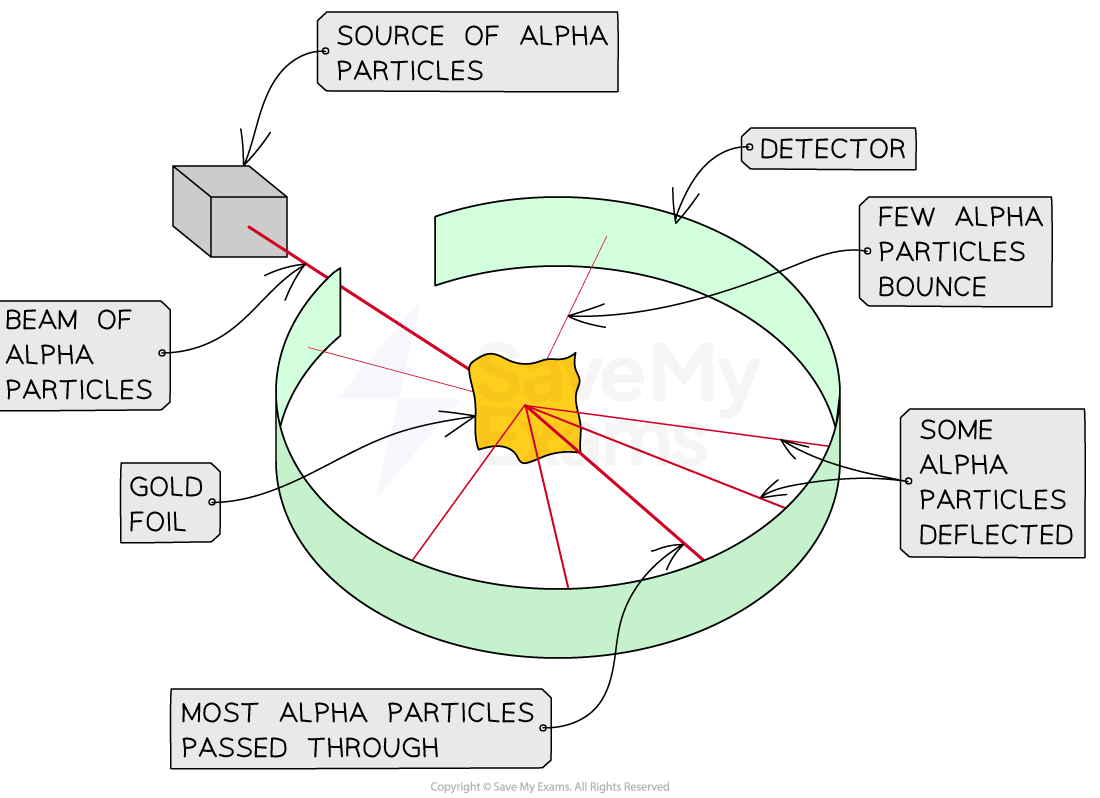
Importance: The results showed that atoms are mostly empty space, with positive charge and most mass concentrated in a tiny, dense nucleus. They replaced the plum-pudding model with the nuclear model of the atom.
The Nucleus
The nucleus contains protons and neutrons. Protons have relative charge $+1$, neutrons $0$, and electrons $-1$. Protons and neutrons are nucleons.
- Proton number, $Z$: number of protons; it identifies the element and determines nuclear charge.
- Nucleon number, $A$: total number of protons and neutrons. It is closely related to nuclear mass: a nucleus with larger $A$ generally has greater mass.
- Neutron number: $A-Z$.
A nuclide is written ${}^A_Z\mathrm{X}$, where $\mathrm{X}$ is the chemical symbol. For example, ${}^{23}_{11}\mathrm{Na}$ has $11$ protons and $23-11=12$ neutrons. Its nuclear charge is $+11$ in relative-charge units.
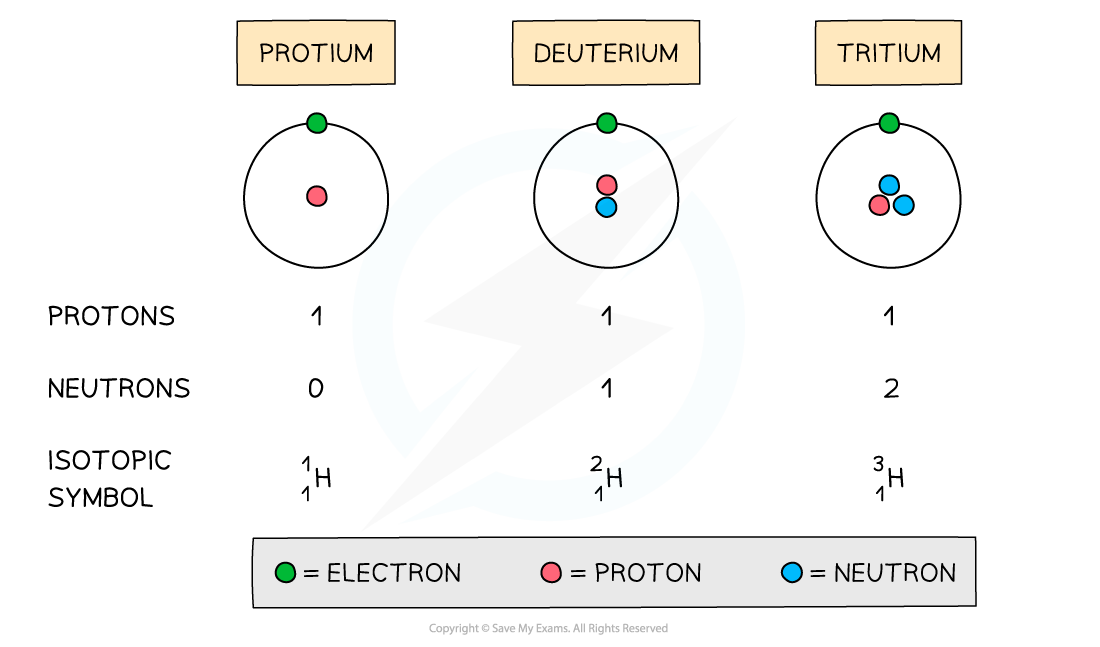
Isotopes are atoms of the same element with the same $Z$ but different $A$. They have the same number of protons but different numbers of neutrons.
2. Fission and fusion
Both processes change nuclei and can release energy. In nuclear reactions, conserve proton number and nucleon number: the totals on each side of a nuclide equation must match. Some mass is converted to energy, so total mass need not remain the same.
- Fission: a large nucleus splits into smaller nuclei, often after absorbing a neutron. Additional neutrons may be released.
- Fusion: small nuclei join to form a larger nucleus. Fusion of hydrogen nuclei powers the Sun.
Worked example — balance a fusion equation:
$$ \ce{^2_1H + ^3_1H -> ^4_2He + ^1_0n} $$
Check: nucleon numbers are $2+3=4+1$; proton numbers are $1+1=2+0$. Use the same checks to find missing particles or numbers in any nuclear equation.
Worked example — find neutrons released in fission:
$$ \ce{^235_92U + ^1_0n -> ^141_56Ba + ^92_36Kr + x^1_0n} $$
The total nucleon number before fission is $235+1=236$. The two product nuclei contain $141+92=233$ nucleons, so $x=236-233=3$ neutrons are released. Check proton number: $92=56+36$.
3. Radioactivity and detection
Radioactive decay is the spontaneous, random change of an unstable nucleus. It emits alpha, beta or gamma radiation. Spontaneous means decay is not triggered by an external event; random means the decay of a particular nucleus cannot be predicted.
Background radiation is always present. Sources include radon gas, rocks, food and cosmic rays. An ionisation radiation detector, such as a Geiger–Müller tube connected to a counter, records a count rate, usually in counts per second or counts per minute.
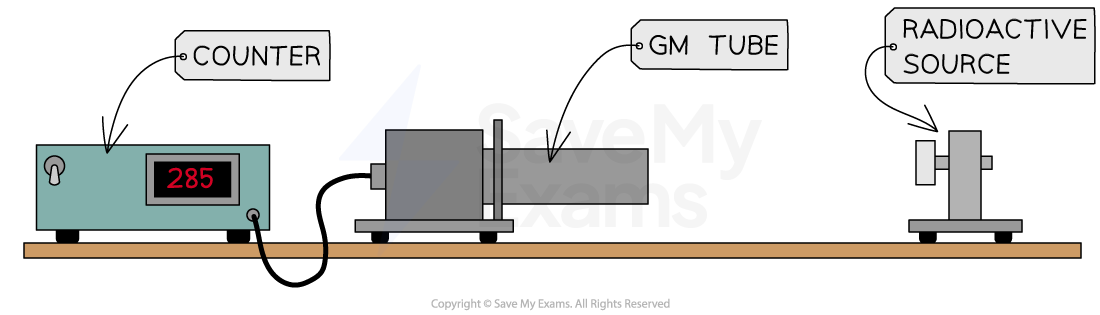
To find the source’s count rate, subtract background count rate from the measured rate. For example, the total reading with a source present is $74\text{ counts/min}$ and the background is $12\text{ counts/min}$. The source count rate is $74-12=62\text{ counts/min}$.
4. The three nuclear emissions
| Radiation | Nature | Ionising effect | Penetrating ability |
|---|---|---|---|
| Alpha, $\alpha$ | Helium nucleus: two protons and two neutrons; charge $+2$ | Strong | Weak; stopped by paper or a short distance in air |
| Beta, $\beta$ | Fast electron; charge $-1$ | Moderate | Moderate; stopped by a thin sheet of aluminium |
| Gamma, $\gamma$ | Electromagnetic radiation; no mass or charge | Weak | Strong; reduced by thick lead or concrete, not completely stopped by a thin sheet |
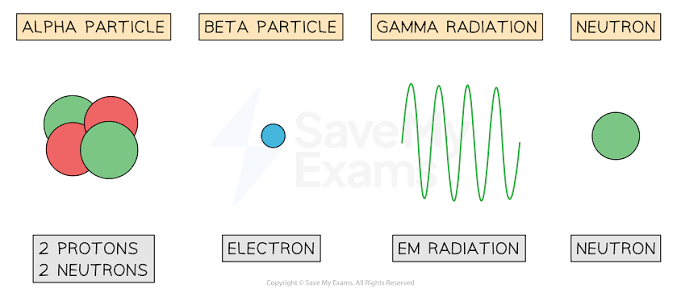
Ionisation happens when radiation removes electrons from atoms. Alpha is strongly ionising because its relatively large charge interacts strongly with matter. Gamma is weakly ionising but penetrates far because it has no charge. Beta lies between them in ionising and penetrating ability.
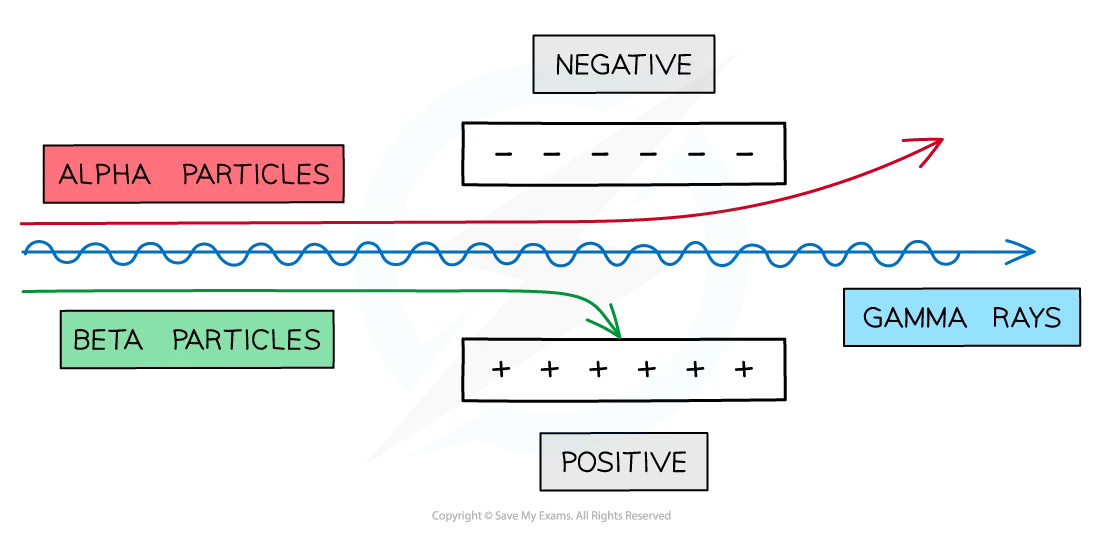
Supplement — deflection: In an electric field, alpha bends towards the negative plate, beta bends towards the positive plate, and gamma is not deflected. Beta bends more than alpha because beta particles have much smaller mass. Magnetic fields also deflect charged alpha and beta particles in opposite directions; gamma is undeflected.
5. Radioactive decay equations
In alpha decay, the nucleus emits an alpha particle. Its $A$ decreases by $4$ and its $Z$ decreases by $2$, so it becomes a different element:
$$ \ce{^238_92U -> ^234_90Th + ^4_2He} $$
In beta-minus decay, a neutron changes into a proton and an electron. The emitted electron is the beta particle. The nucleon number stays the same, while the proton number increases by $1$:
$$ \ce{^14_6C -> ^14_7N + ^0_-1e} $$
In gamma emission, an excited nucleus loses energy but its proton and nucleon numbers stay unchanged:
$$ \ce{^A_ZX* -> ^A_ZX + \gamma} $$
Isotopes may be unstable because they have excess neutrons or very large nuclei. When writing any decay equation, check that the sums of $A$ and $Z$ balance on both sides.
6. Half-life
The half-life of an isotope is the time taken for half the unstable nuclei in a sample to decay. After each half-life, the number of undecayed nuclei—or the corrected count rate—halves. Decay is random, so this describes a large sample, not a prediction for one nucleus.
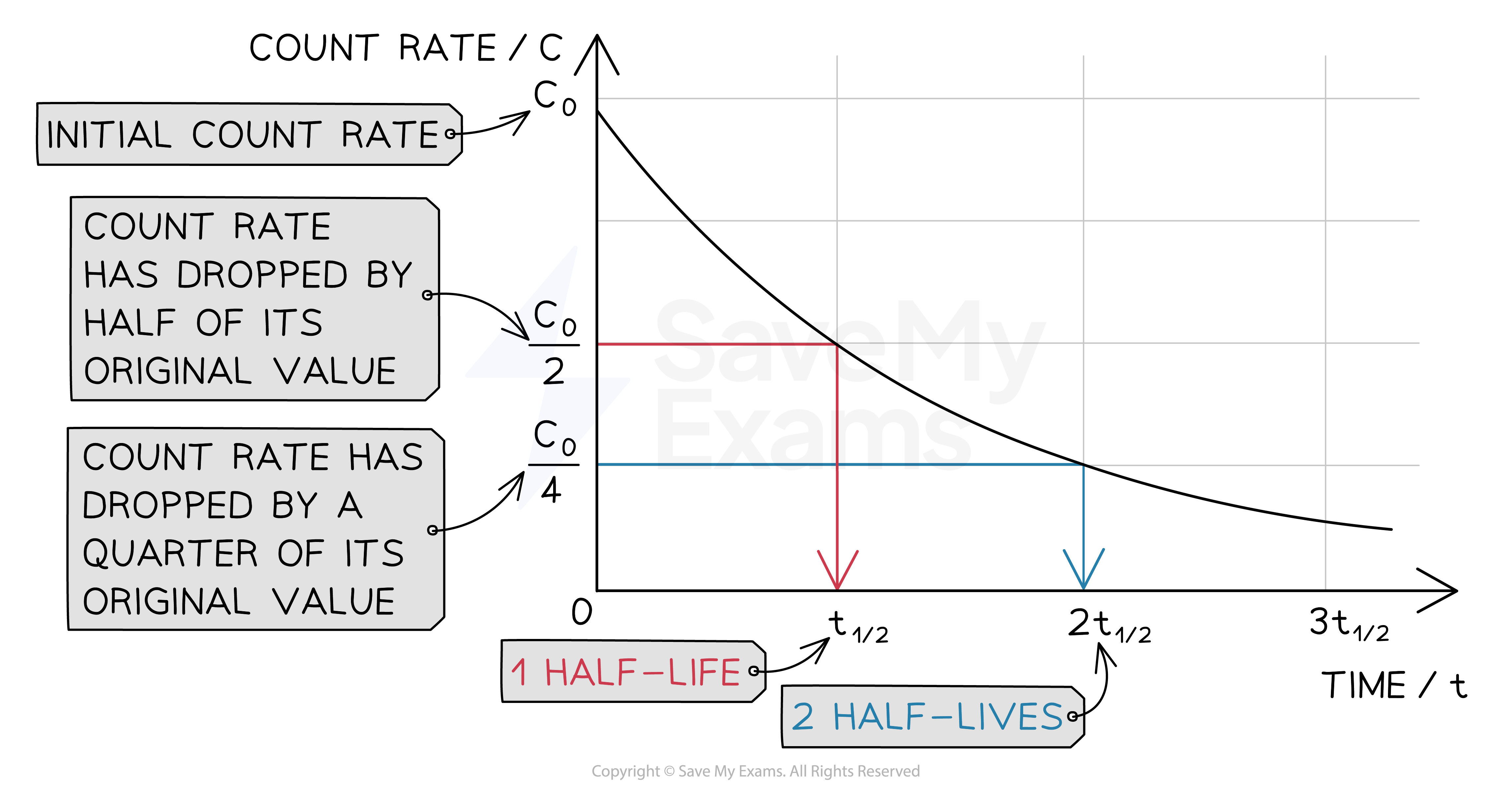
Worked example: A corrected count rate falls from $800$ to $200\text{ counts/min}$ in $6\text{ min}$. It halves twice: $800\rightarrow400\rightarrow200$. Therefore $6\text{ min}$ is two half-lives, and the half-life is $6/2=3\text{ min}$.
To find half-life from a decay curve, choose a count rate, find half that value, then read the time interval between them. Repeat with other pairs and use an average if readings are imprecise.
7. Radiation safety
Ionising radiation can kill cells, cause mutations or lead to cancer. Handle sources carefully during movement, use and storage. Reduce exposure by:
- Reducing time near the source.
- Increasing distance from it; use tongs or remote handling rather than hands.
- Using shielding between the source and people, such as suitable lead shielding for gamma sources.
Store radioactive sources in labelled, shielded containers when not in use. Match shielding to the radiation: paper stops alpha, thin aluminium stops beta, while gamma requires much thicker shielding.
8. Uses of radioactivity
Choose an isotope with suitable radiation type, penetration and half-life for each use:
- Smoke alarms: alpha radiation ionises air; smoke reduces the ionisation and triggers the alarm.
- Food irradiation: radiation kills microbes and pests, slowing spoilage.
- Sterilisation: gamma radiation kills microorganisms in packaged medical equipment.
- Thickness monitoring: a beta source and detector measure how much radiation passes through a sheet; a thicker sheet lets fewer beta particles through.
- Cancer diagnosis and treatment: gamma-emitting isotopes can be detected from outside the body or used to damage cancer cells.