Biological molecules
Biological molecules are substances made by living organisms. Carbohydrates, fats and oils, and proteins contain different elements and are built from smaller molecules. Food tests identify some of these molecules in a sample.
Elements and building blocks
| Molecule | Elements | Smaller molecules or units |
|---|---|---|
| Carbohydrates | Carbon, hydrogen, oxygen | Starch, glycogen, and cellulose are made from glucose molecules. |
| Fats and oils | Carbon, hydrogen, oxygen | Made from fatty acids and glycerol. |
| Proteins | Carbon, hydrogen, oxygen, nitrogen; sometimes sulfur | Made from amino acids. |
A large molecule made from many repeating smaller units is often called a polymer. The smaller units are monomers. This terminology is useful, but remember the exact syllabus relationships above.
Carbohydrates
Carbohydrates include:
- Monosaccharides, such as glucose, which are single sugar molecules;
- Disaccharides, such as sucrose and maltose, which contain two sugar units; and
- Polysaccharides, such as starch, glycogen, and cellulose, which contain many glucose units.
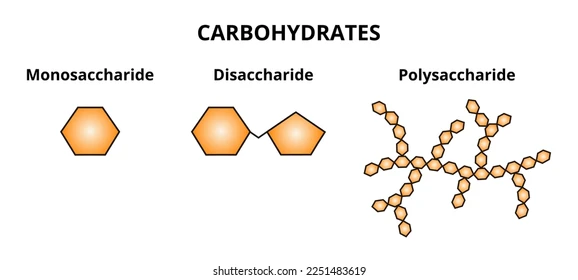
Glucose is soluble and is used in respiration. Starch is an insoluble storage carbohydrate in plants. Glycogen is an insoluble storage carbohydrate in animals, especially in the liver and muscles. Cellulose forms strong plant cell walls. Cellulose is not digested by humans and contributes to dietary fibre.
Starch and glycogen are suitable storage molecules because they are compact and insoluble. Being insoluble means they do not dissolve and move away easily or greatly affect the cell’s water potential.
Fats and oils
A fat or oil is formed from glycerol and fatty acids. Fats are usually solid at room temperature; oils are usually liquid. Fats and oils:
- store energy for long-term use;
- provide thermal insulation;
- cushion and protect organs; and
- form part of cell membranes as phospholipids.
Fats and oils contain proportionally less oxygen than carbohydrates and release a large amount of energy when respired. These functions are enrichment for this topic but help explain why organisms store and use fats.
Proteins
Proteins are made from amino acids joined in chains. Different proteins contain different sequences and numbers of amino acids. The sequence affects the final shape of the protein and therefore its function.
Proteins are used for:
- growth and repair of tissues;
- enzymes that catalyse metabolic reactions;
- antibodies in immune defence;
- haemoglobin for oxygen transport; and
- some hormones and cell structures.
The protein test detects peptide bonds between amino acids. A solution containing only free amino acids does not give a positive biuret result.
Food tests
Prepare a food sample by crushing it with water and filtering it if necessary. Test separate portions of the sample. Include a negative control when appropriate, use equal volumes for comparisons, and compare the result with the original reagent colour. Heat Benedict’s test in a boiling-water bath, not directly over a flame.
| Substance | Reagent and condition | Positive result | Negative result |
|---|---|---|---|
| Starch | Iodine solution | Blue-black | Yellow-brown |
| Reducing sugar | Benedict’s solution; heat in a water bath | Green, yellow, orange, or brick-red precipitate | Blue |
| Protein | Biuret reagent | Lilac or purple | Blue |
| Fat or oil | Ethanol, then water | Milky-white/cloudy emulsion | Clear solution |
| Vitamin C | Blue DCPIP | DCPIP becomes colourless | Remains blue |
Starch: iodine test
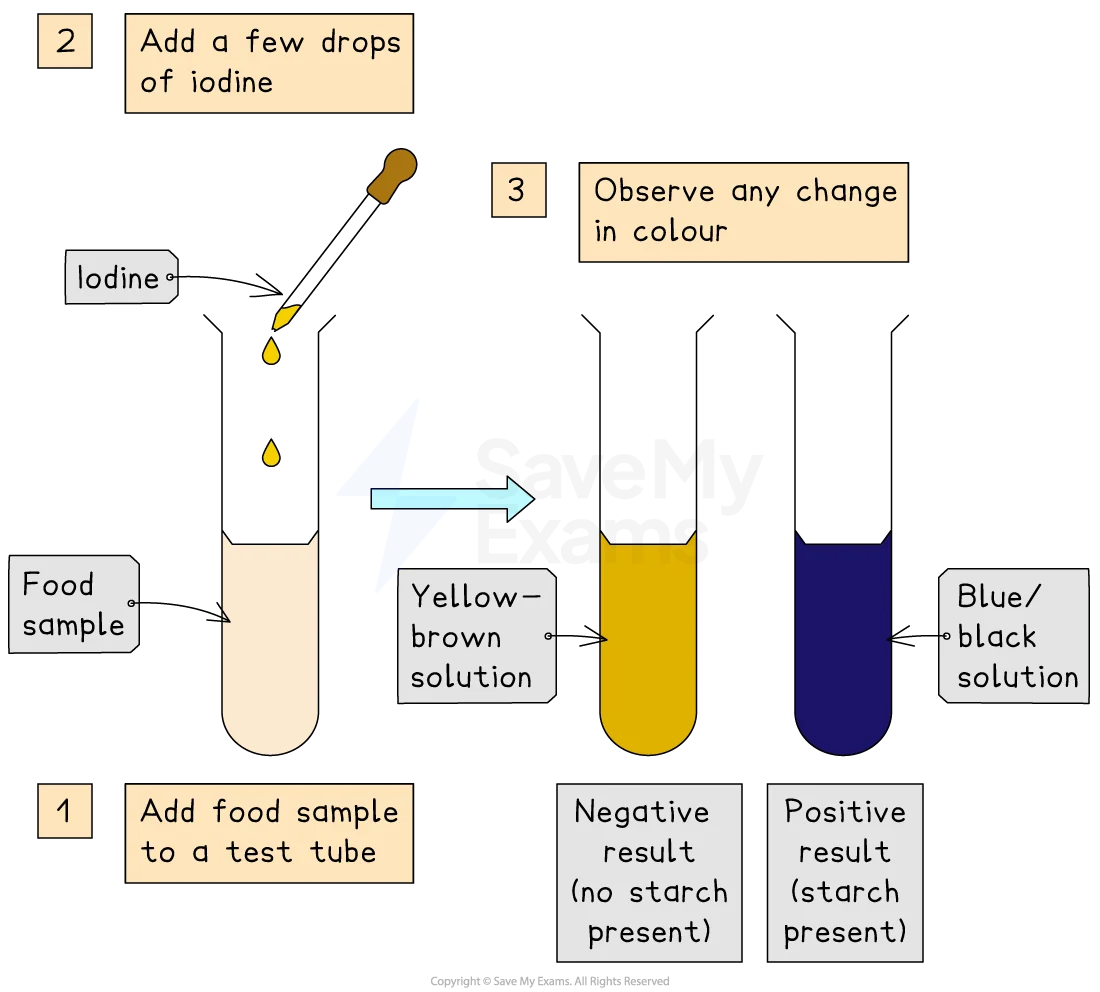
- Add iodine solution to the food sample.
- A blue-black colour shows starch is present.
- Iodine remaining yellow-brown is a negative result.
The result is qualitative: it shows whether starch is present, not the exact mass of starch.
Reducing sugars: Benedict’s test
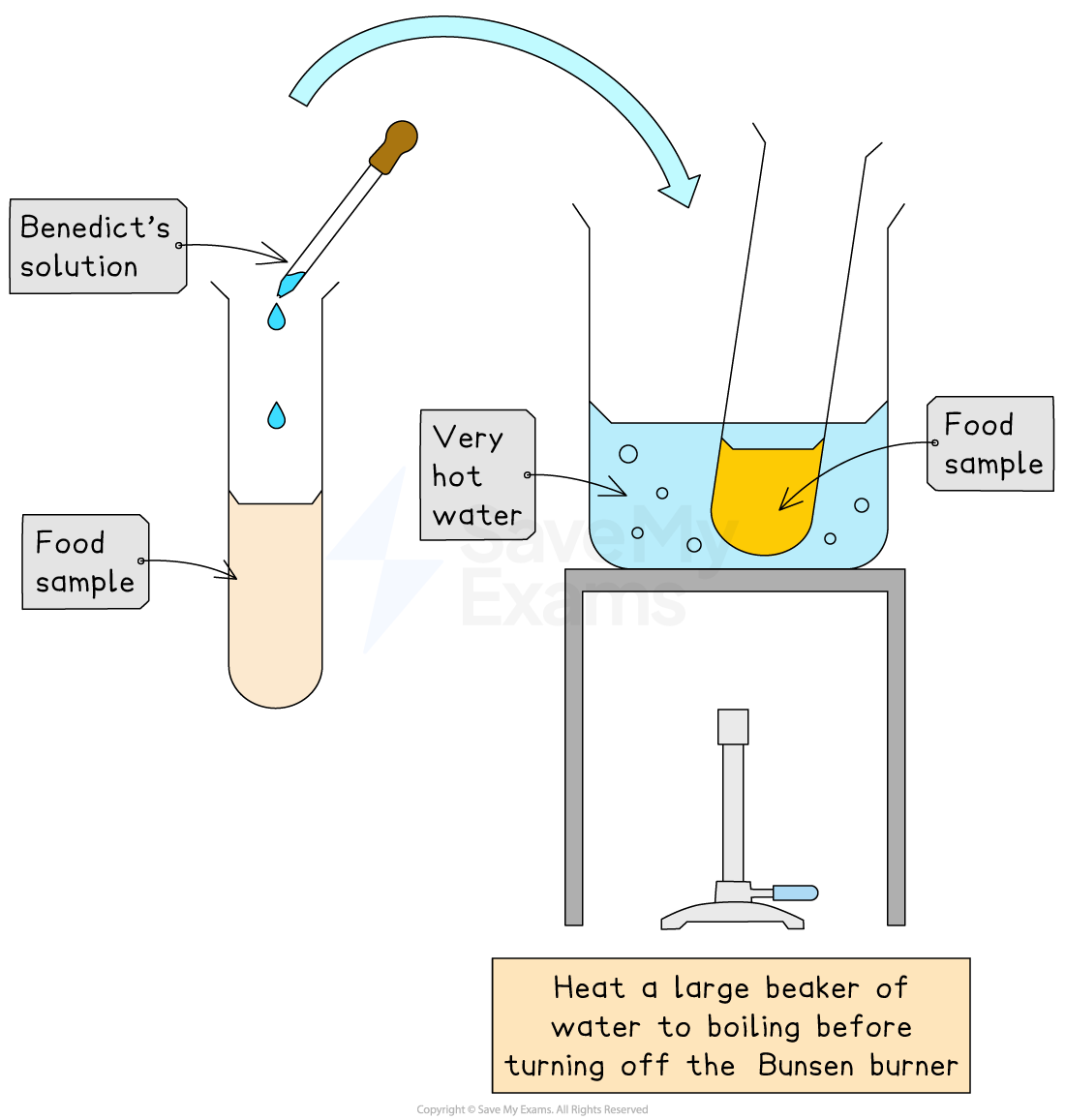
- Add Benedict’s solution to the food sample.
- Heat the mixture in a boiling-water bath.
- A negative result remains blue.
- A positive result changes from blue through green, yellow, or orange to a brick-red precipitate.
Glucose and maltose are reducing sugars. Sucrose is not a reducing sugar, so it gives a negative Benedict’s test unless it has first been broken down. Under controlled conditions, a larger colour change can indicate a greater reducing-sugar concentration, but colour comparisons should use equal sample and reagent volumes.
Protein: biuret test
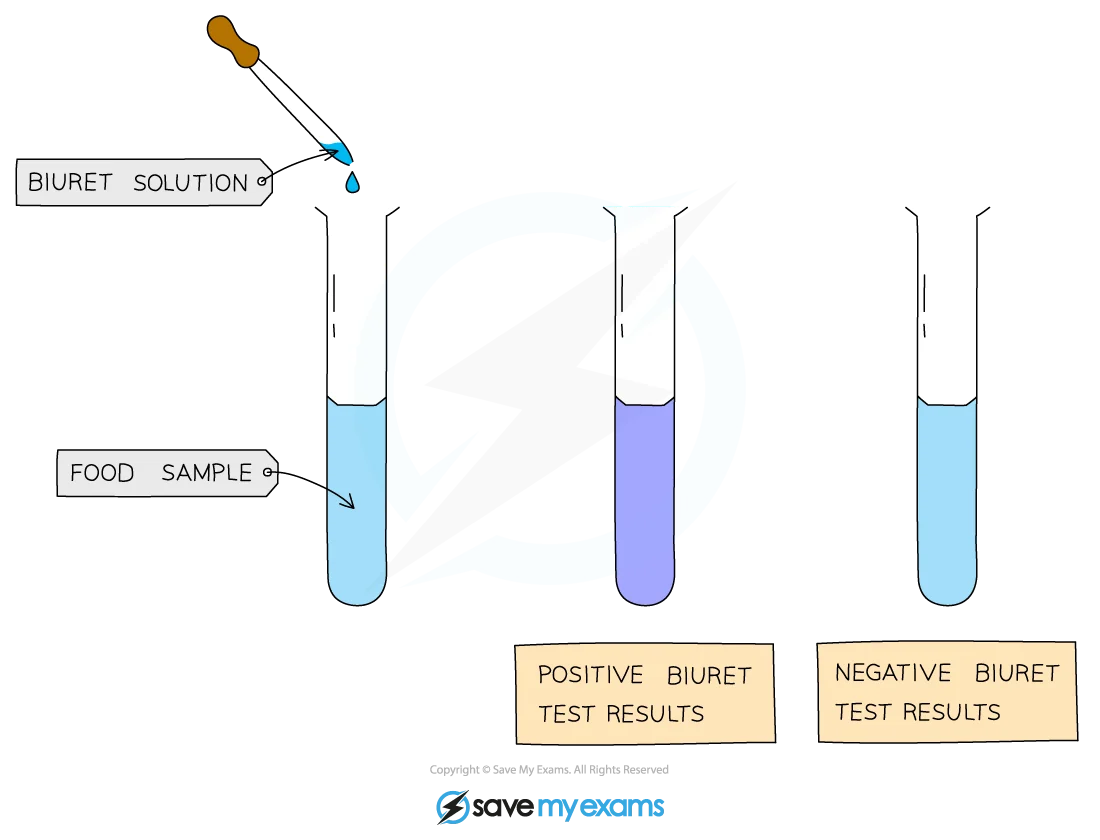
- Add biuret reagent to the food sample.
- A lilac or purple colour shows protein is present.
- A negative result remains blue.
The test detects peptide bonds. Free amino acids do not give a positive biuret result because they are not joined by peptide bonds.
Fats and oils: ethanol-emulsion test
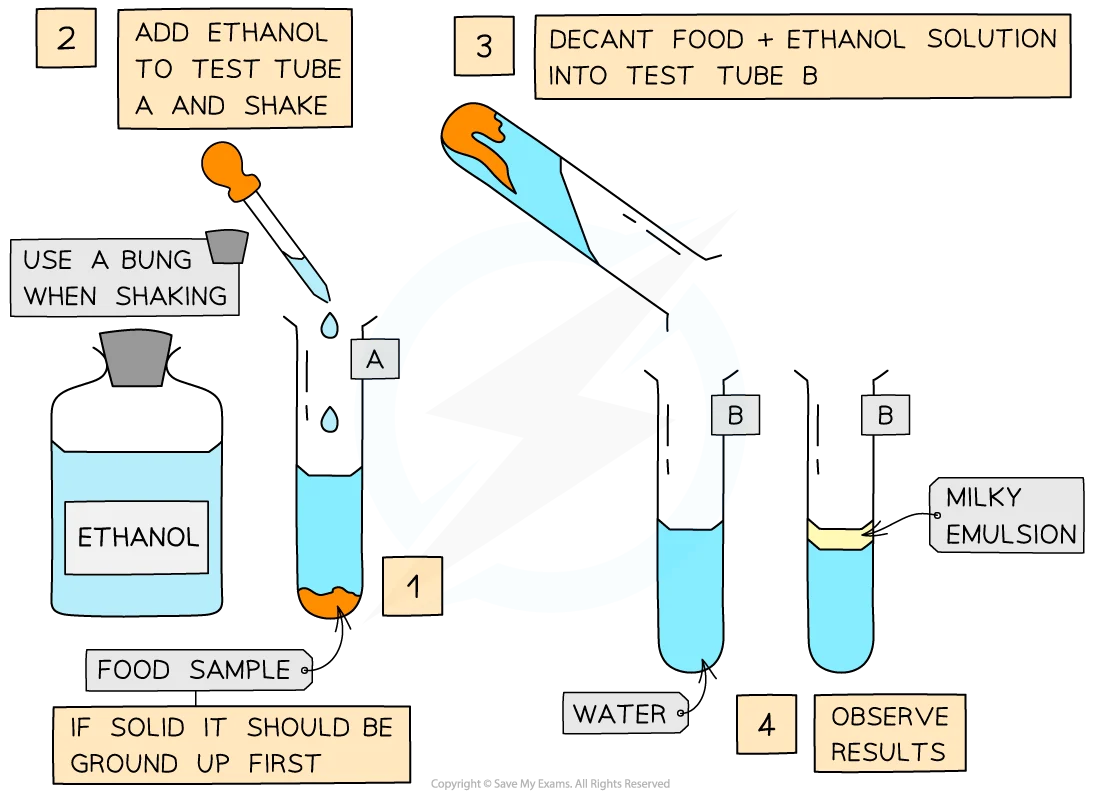
- Shake the food sample with ethanol to dissolve any fat.
- Add water.
- A milky-white or cloudy emulsion shows fat or oil is present.
- A clear solution is a negative result.
The emulsion forms because fat dissolves in ethanol but does not dissolve in water. Small droplets scatter light and make the mixture look cloudy.
Vitamin C: DCPIP test
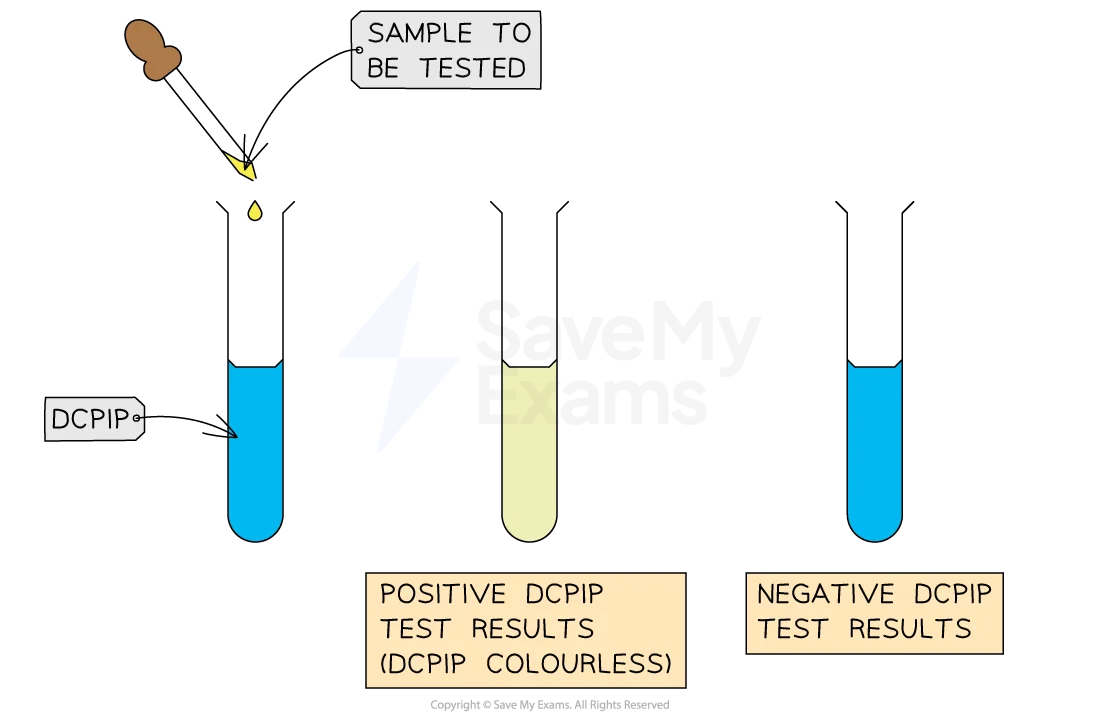
- Add the food sample to blue DCPIP solution, or add the sample drop by drop to a measured volume of DCPIP.
- Vitamin C reduces DCPIP, changing it from blue to colourless.
- When comparing samples, use the same volume and concentration of DCPIP. Record the volume of sample needed to reach the same colourless endpoint.
A smaller volume needed to decolourise a fixed amount of DCPIP suggests a higher vitamin C concentration. Use a colourless or filtered sample where possible because the food’s own colour can obscure the endpoint.
Worked interpretation
If separate portions of a food sample turn iodine blue-black, give a brick-red Benedict’s result after heating, turn biuret reagent purple, produce a cloudy ethanol emulsion, and decolourise DCPIP, the sample contains starch, a reducing sugar, protein, fat or oil, and vitamin C. Each result identifies a different substance; one test does not identify all nutrients.
DNA structure (Supplement)
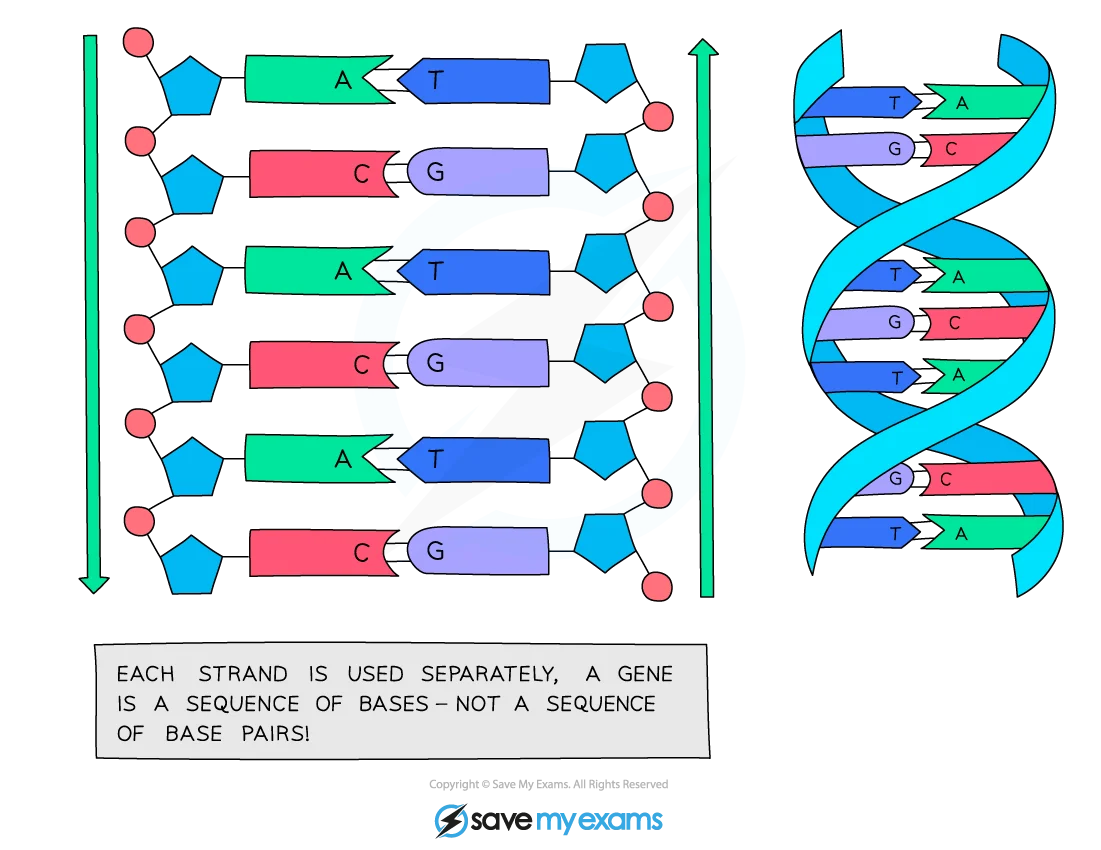
DNA is a molecule with a double-helix structure. It contains bases arranged in complementary pairs:
- adenine (A) pairs with thymine (T);
- cytosine (C) pairs with guanine (G).
The order of bases stores genetic information. The sugar-phosphate backbone is on the outside and the bases point inwards. Hydrogen bonds between complementary bases hold the two strands together, so the base sequence on one strand determines the matching sequence on the other.
Exam checks
- State the elements in carbohydrates, fats/oils, and proteins.
- Remember: starch, glycogen, and cellulose are made from glucose; proteins are made from amino acids; fats and oils are made from fatty acids and glycerol.
- State both the reagent and the positive colour or appearance for every food test.
- Benedict’s test requires heating.
- DCPIP is blue before the test and colourless after vitamin C reduces it.
- Use separate sample portions and controls in food-test investigations.
- DNA base pairs are A–T and C–G.