Enzymes
Enzymes as biological catalysts
A catalyst increases the rate of a chemical reaction without being used up or permanently changed. Enzymes are proteins that act as biological catalysts in metabolic reactions.
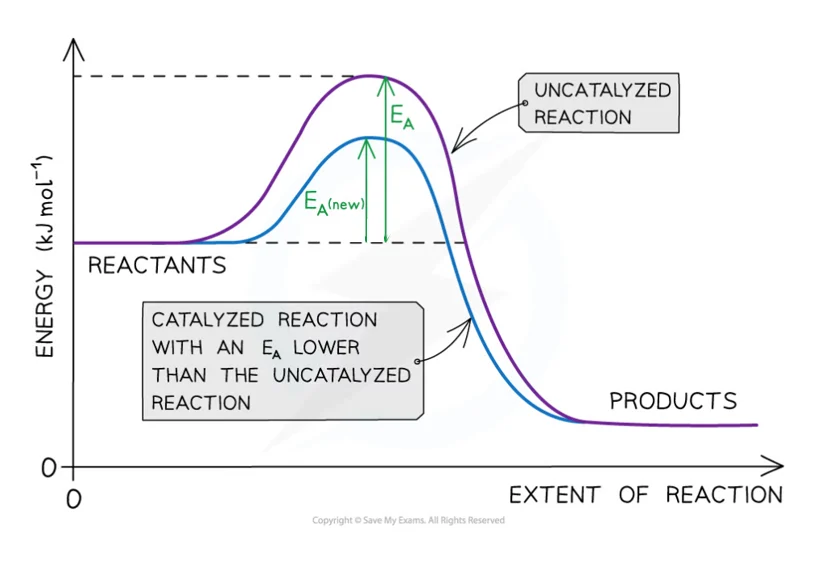
Enzymes are essential because reactions in living cells would be too slow at normal cell temperatures without them. The same enzyme molecule can be used repeatedly because it is not changed permanently by the reaction.
Enzyme action
- The substrate is the molecule on which an enzyme acts.
- The active site is the part of an enzyme where the substrate binds.
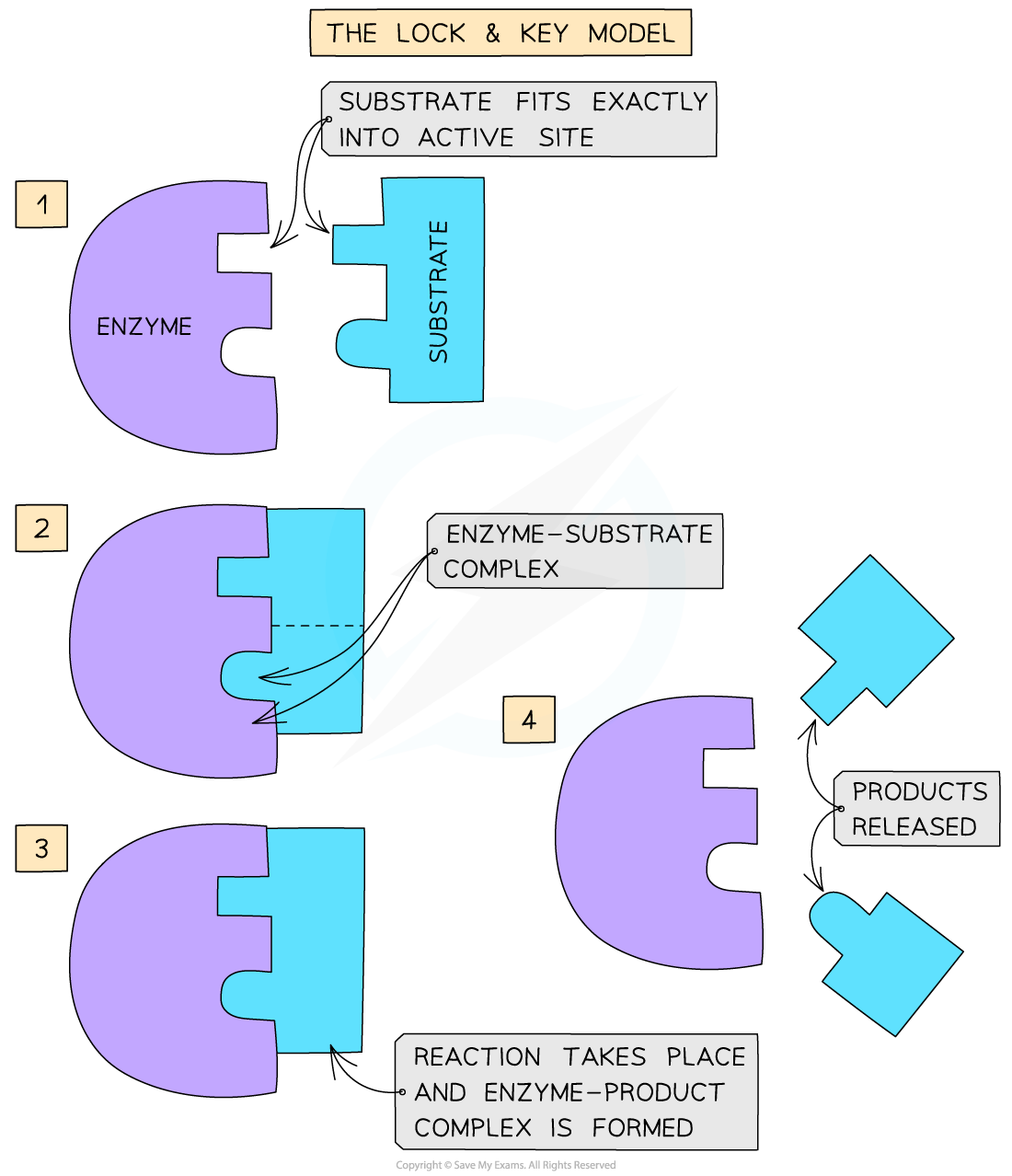
- The active site has a shape complementary to the substrate.
- The temporary combination of enzyme and substrate is the enzyme-substrate complex.
- The reaction changes the substrate into one or more products.
Sequence of enzyme action
- A substrate collides with the active site.
- The substrate binds because its shape is complementary to the active site.
- An enzyme-substrate complex forms and the reaction occurs.
- Products leave the active site.
- The unchanged enzyme is available to catalyse another reaction.
Specificity
Each enzyme has a particular active-site shape. Only a substrate with a complementary shape can bind effectively, so an enzyme catalyses only a particular reaction or a small group of related reactions. Different amino acid sequences give enzymes different three-dimensional shapes and active sites.
Effect of temperature
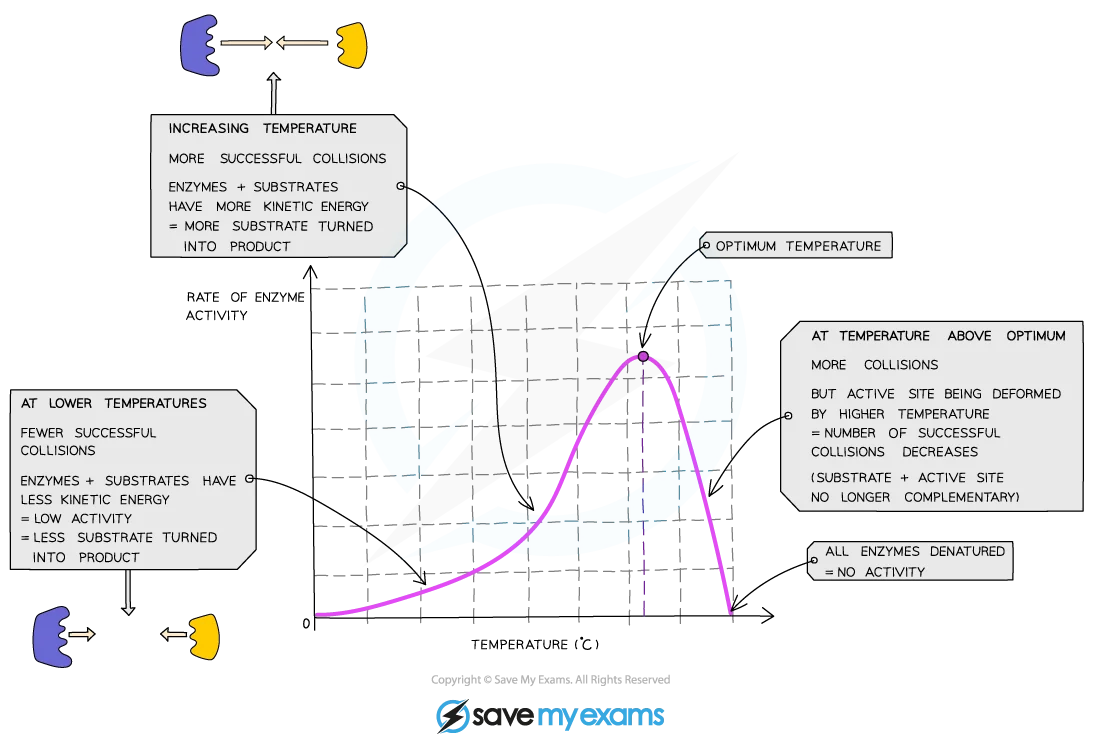
At low temperature, enzyme and substrate molecules have less kinetic energy. They move more slowly, so there are fewer successful collisions and the reaction rate is low.
As temperature increases, kinetic energy and collision frequency increase. More enzyme-substrate complexes form, so the rate increases up to the optimum temperature, where the rate is highest.
Above the optimum, heat breaks bonds maintaining the enzyme’s shape. The active site changes shape, so the substrate no longer fits. The enzyme is denatured and the rate falls sharply. Denaturation is usually permanent.
Effect of pH
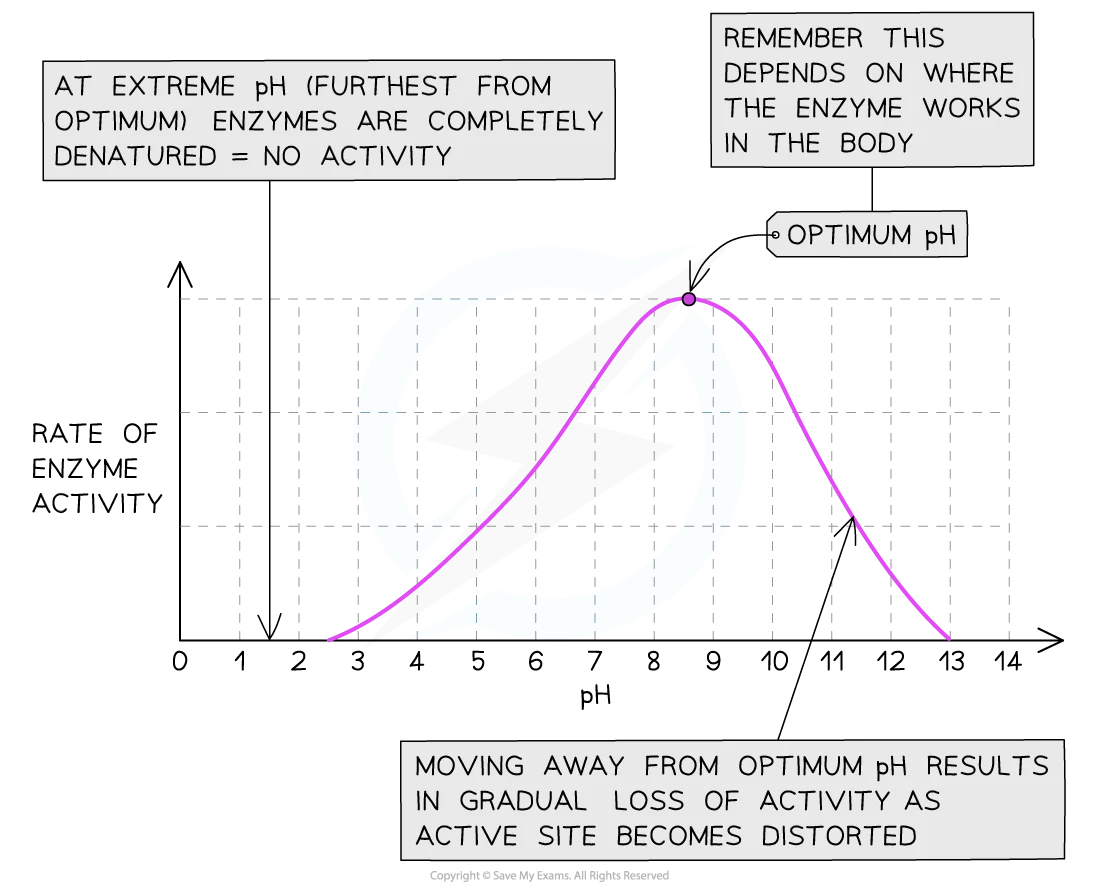
Each enzyme has an optimum pH. At the optimum, the active site has the correct shape and the reaction rate is highest.
A pH above or below the optimum changes charges and bonds within the enzyme. This changes the active-site shape, so fewer substrate molecules fit and the rate decreases. Very extreme pH can denature the enzyme.
Different enzymes have different optimum pH values because they function in different environments. For example, pepsin works in acidic stomach conditions, while some intestinal enzymes work in alkaline conditions.
Investigating enzyme activity
Temperature investigation
Amylase can be used to investigate the effect of temperature on enzyme activity.
- Prepare equal volumes and concentrations of amylase and starch.
- Place reaction mixtures in water baths at different temperatures.
- Keep pH constant with a buffer and allow the solutions to reach the bath temperature.
- Mix amylase and starch, then test samples with iodine at regular intervals.
- Record the time until iodine remains yellow-brown, showing that starch has been digested.
- Repeat each temperature and calculate a mean time or rate, using rate as approximately (1/\text{time}).
The independent variable is temperature. The dependent variable is time or rate of starch digestion. Keep enzyme concentration, starch concentration, volumes, pH, sampling interval, and total reaction conditions constant. The graph should rise to an optimum and then fall sharply as the enzyme denatures.
pH investigation
- Prepare equal volumes and concentrations of amylase and starch with buffer solutions of different pH values.
- Keep temperature constant, preferably using a water bath.
- Mix the enzyme and substrate and test samples with iodine at regular intervals.
- Record the time until starch is absent, repeat trials, and calculate mean rates.
The independent variable is pH. Keep temperature, enzyme and starch concentrations, volumes, and sampling intervals constant. The graph should have a maximum rate at the optimum pH and lower rates on either side.
Improving reliability and validity
- Use the same enzyme and substrate batches.
- Measure volumes accurately.
- Repeat each condition and calculate a mean.
- Use a suitable range of temperatures or pH values around the expected optimum.
- Control variables so the measured difference is caused by the independent variable.
- Use a clear colour endpoint or another consistent rate measurement.
Exam checks
- Enzymes are proteins and biological catalysts.
- The active site is complementary to the substrate, forming an enzyme-substrate complex.
- Low temperature slows reactions but does not normally denature enzymes.
- High temperature changes active-site shape and can denature enzymes.
- Extreme pH changes active-site shape and can denature enzymes.
- In an investigation, state the independent variable, dependent variable, controls, repeats, and expected graph.