Movement into and out of cells
Diffusion
Diffusion is the net movement of particles from a region of higher concentration to a region of lower concentration, down a concentration gradient. Particles move randomly because they have kinetic energy. The energy for diffusion comes from this kinetic energy, not from respiration or ATP.
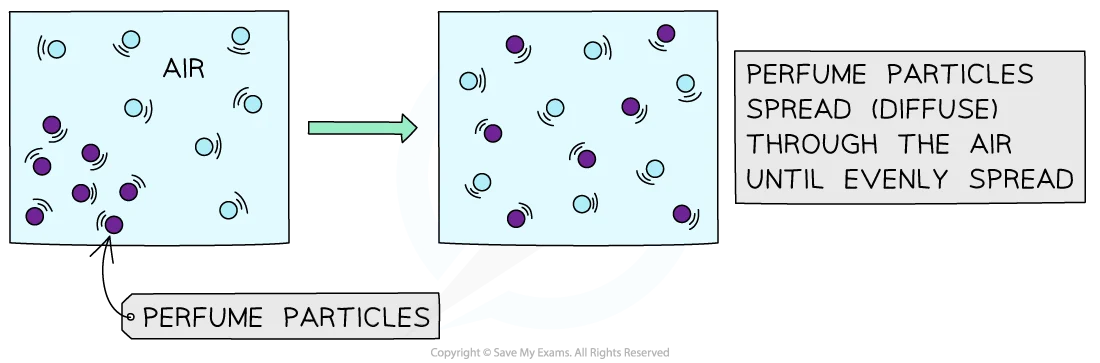
Diffusion can occur through a cell membrane or through air and water. It is important for:
- oxygen moving from alveoli into blood; Alveoli have a large surface area and a thin surface for rapid gas exchange.
- carbon dioxide moving from blood into alveoli; and
- waste solutes such as urea moving out of cells.
Some solutes, including glucose in many cell-membrane contexts, require carrier proteins. Do not describe glucose as always crossing membranes by simple diffusion.
Factors affecting diffusion rate
- Concentration gradient: a steeper gradient gives faster net movement.
- Surface area: a larger surface gives more space for particles to cross at once.
- Temperature: a higher temperature gives particles more kinetic energy and usually increases the rate.
- Diffusion distance: a shorter distance gives a faster rate.
For a fair investigation, change one factor, measure diffusion rate, keep other factors constant, and repeat measurements.
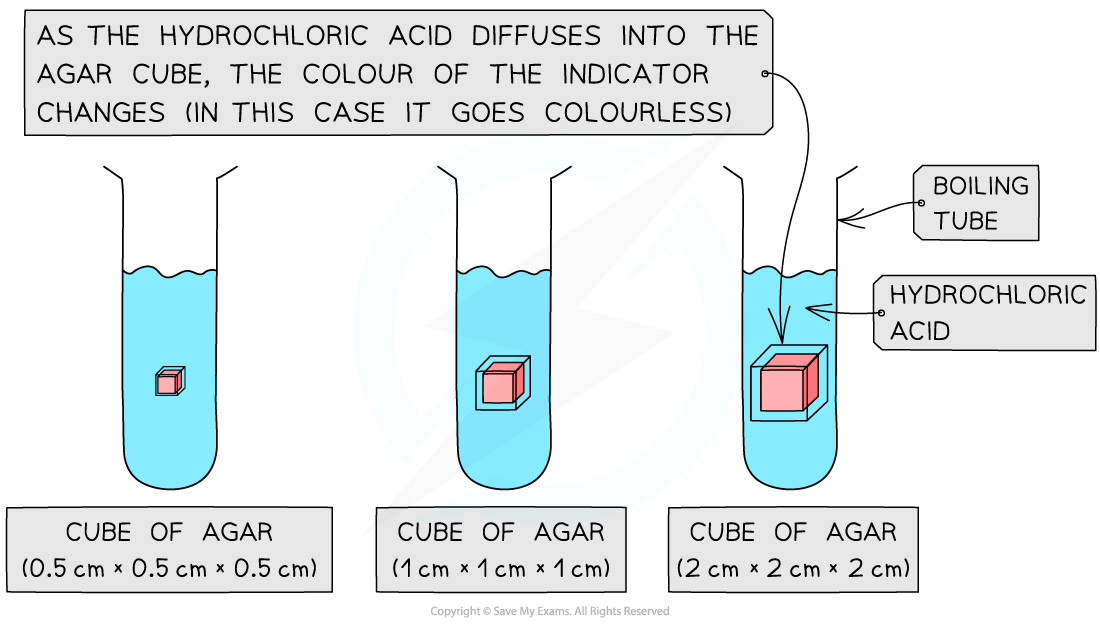
One named model is an agar-cube experiment:
- Prepare equal agar cubes containing sodium hydroxide and phenolphthalein
- Place them in dilute hydrochloric acid, and record the time for acid to reach the centre and decolourise each cube.
- Use different cube sizes to compare surface area and diffusion distance;
- Use different acid concentrations to compare concentration gradients; and use water baths to compare temperatures.
Keep agar composition, acid volume, mixing, and observation method constant.
Osmosis
Osmosis is the net movement of water molecules from a region of higher water potential to a region of lower water potential through a partially permeable membrane.
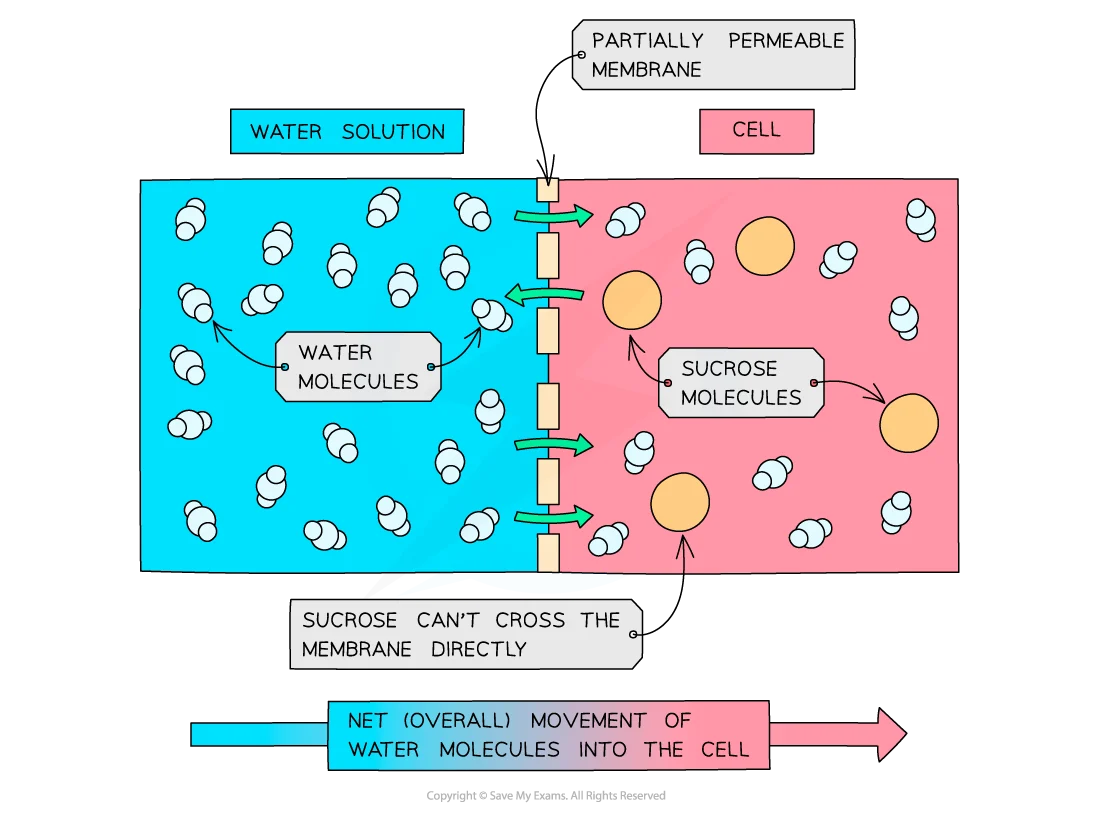
- Pure water has the highest water potential, defined as zero.
- Dissolved solutes lower water potential, making it more negative.
- Water moves from higher (less negative) water potential to lower (more negative) water potential.
- A partially permeable membrane allows water molecules through but restricts some solute molecules.
Water is an important solvent. Dissolved substances can be transported in blood, used in digestion, and removed in urine during excretion.
Effects on cells
| Surrounding solution | Animal cell | Plant cell |
|---|---|---|
| More dilute; higher water potential | Water enters; cell swells and may burst | Water enters; cell becomes turgid |
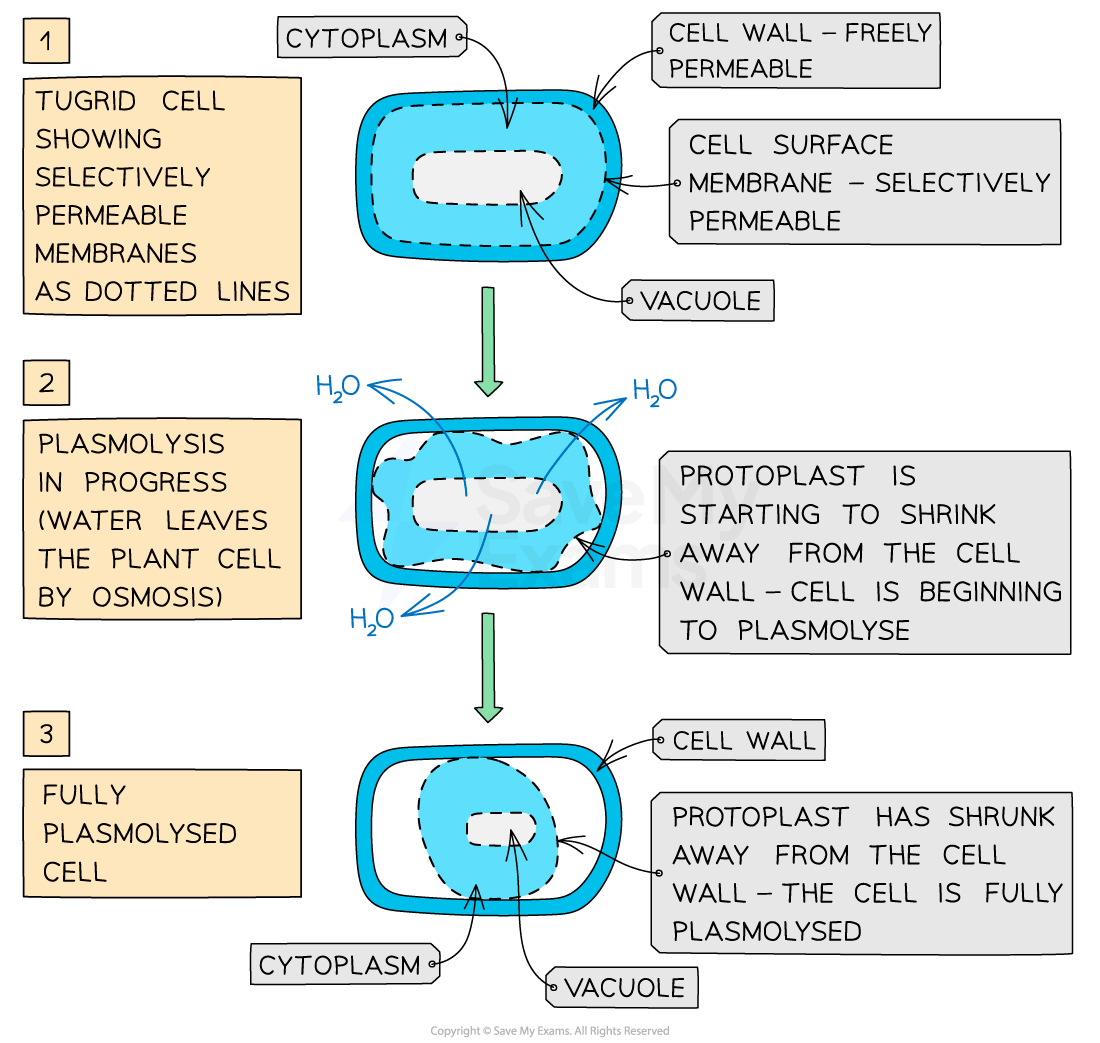
| More concentrated; lower water potential | Water leaves; cell shrinks | Cell loses turgor and becomes flaccid; severe water loss causes plasmolysis |
| Similar water potential | No net movement; cell stays near its normal size | No net movement; cell is usually flaccid |
Plasmolysis occurs only in plant cells: the cell membrane pulls away from the cell wall after water loss. An animal cell shrinks, but it does not plasmolyse.
Turgor pressure and water uptake
Water entering a plant cell by osmosis pushes the cell membrane against the cell wall. This pressure is turgor pressure. Turgid cells support non-woody stems and leaves. If water loss exceeds water uptake, cells lose turgor and the plant wilts.
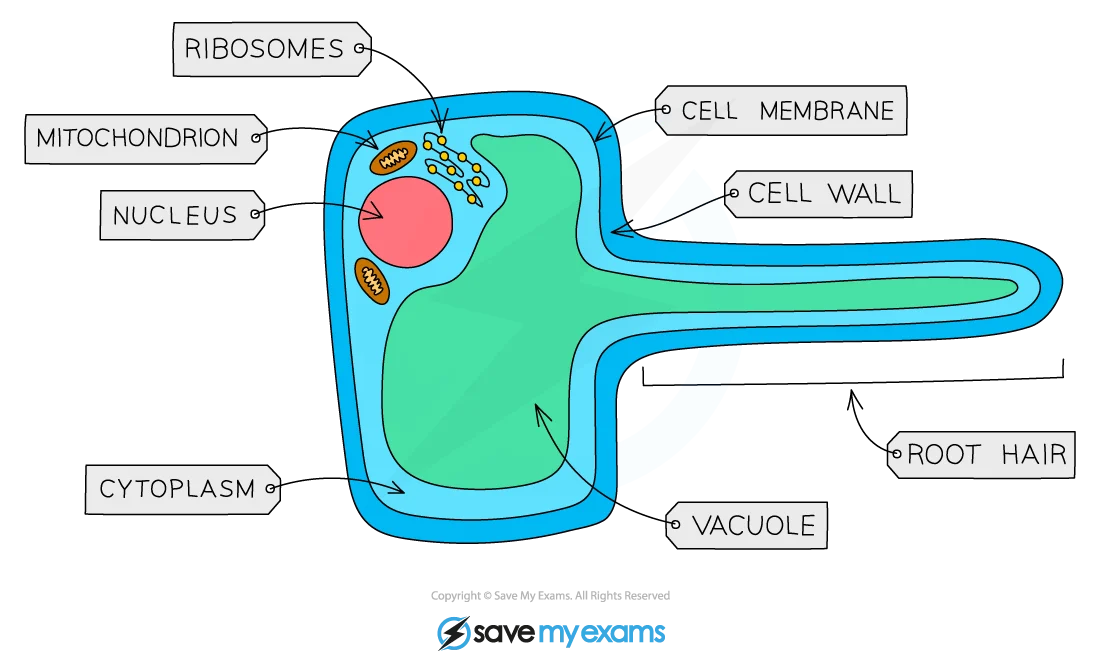
Water potential and osmosis are important in root water uptake and in water loss from leaves. Water moves into root hair cells when the cell sap has a lower water potential than the soil solution, then moves through the root towards the xylem.
Osmosis investigations
Dialysis tubing:
- Soak and tie dialysis tubing, then fill it with a known sugar solution.
- Record its starting mass or volume.
- Place it in distilled water or a solution of known concentration for a fixed time.
- Record the final mass or volume and calculate the change.
- Repeat with a control and several concentrations.
A gain in mass shows net water entry; a loss shows net water exit. The tubing models a partially permeable membrane.
Plant tissue:
- Cut equal potato cylinders, measure their initial mass, and place them in solutions of different concentrations.
- Keep cylinder size, solution volume, temperature, and time constant.
- Blot and measure final mass; calculate percentage change in mass.
- Repeat and plot percentage mass change against solution concentration.
The concentration giving no percentage mass change estimates the cell-sap concentration, because there is no net water movement there.
Active transport
Active transport is the movement of particles from lower concentration to higher concentration, against a concentration gradient. It requires energy from respiration.
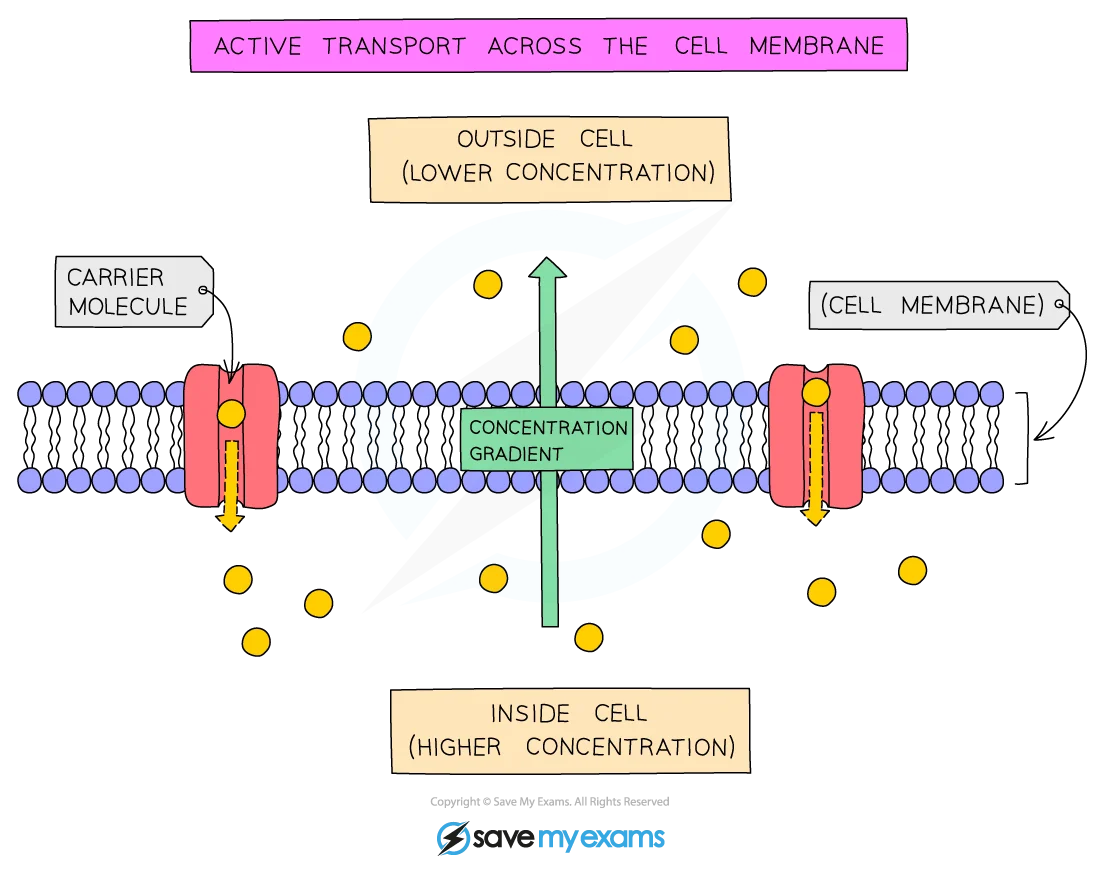
Protein carrier molecules in the cell membrane bind specific ions or molecules and move them across the membrane. This allows cells to take up substances even when their concentration is already higher inside the cell.
Root hair cells
Root hair cells use active transport to absorb mineral ions, such as nitrate ions, from dilute soil solution. Their long projection gives a large surface area. They contain mitochondria that release energy by respiration for active transport.
Comparison
| Feature | Diffusion | Osmosis | Active transport |
|---|---|---|---|
| Substance moved | Particles, including gases and some solutes | Water molecules only | Specific ions or molecules |
| Direction | High to low concentration | High to low water potential | Low to high concentration |
| Energy | Kinetic energy; no respiration energy | No respiration energy | Energy from respiration |
| Membrane | May occur through a membrane | Requires a partially permeable membrane | Requires carrier proteins in a membrane |
| Example | Oxygen into blood | Water into a root hair cell | Mineral ions into a root hair cell |
Exam checks
- Diffusion uses random particle movement and kinetic energy.
- Osmosis describes water movement and water potential, not solute movement.
- Turgid, flaccid, and plasmolysed describe plant-cell states; plasmolysis does not describe animal cells.
- Active transport moves against a concentration gradient and requires energy from respiration.
- In investigations, state the variable changed, measurement taken, controls, repeats, and expected result.