Plant nutrition
Photosynthesis
Photosynthesis is the synthesis of carbohydrates from raw materials using light energy.
Word equation:
carbon dioxide + water → glucose + oxygen
Balanced chemical equation:
$$6CO_2 + 6H_2O \rightarrow C_6H_{12}O_6 + 6O_2$$
Chlorophyll is a green pigment in chloroplasts. It transfers light energy to the photosynthesis reactions. Carbon dioxide enters through stomata and water arrives through xylem.
Uses and storage of carbohydrates
- Starch: storage carbohydrate in plants.
- Cellulose: makes strong plant cell walls.
- Glucose: used in respiration to release energy.
- Sucrose: transported in phloem to other parts of the plant.
- Nectar: contains sugars that attract pollinators.
Leaf structure and adaptations
Leaves are thin and have a large surface area. These features give a short diffusion distance and allow absorption of much light.
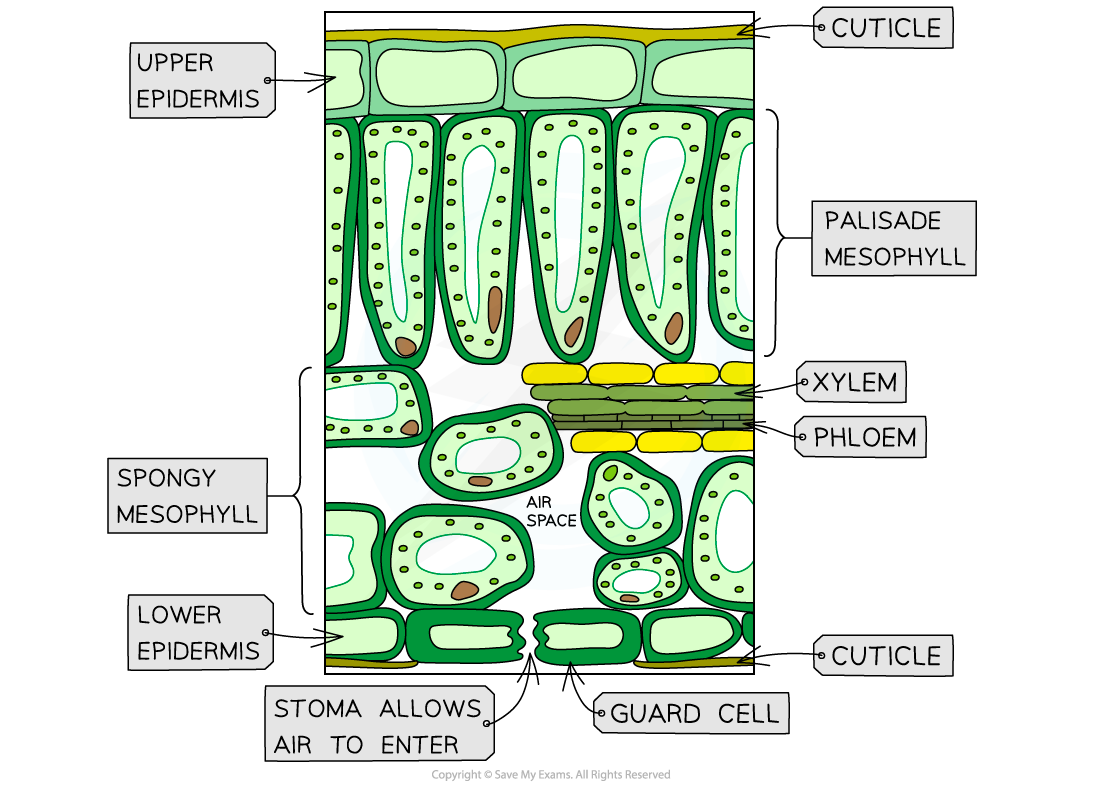
| Structure | Adaptation and role in photosynthesis |
|---|---|
| Chloroplasts | Contain chlorophyll and absorb light energy. |
| Cuticle | Waxy layer that reduces water loss while allowing light through. |
| Epidermis | Protective, transparent layer allowing light to reach photosynthetic cells. |
| Stomata | Pores allowing carbon dioxide in and oxygen and water vapour out. |
| Guard cells | Open and close stomata, controlling gas exchange and water loss. |
| Palisade mesophyll | Near the upper surface; cells contain many chloroplasts for light absorption. |
| Spongy mesophyll and air spaces | Air spaces allow carbon dioxide to diffuse through the leaf. |
| Vascular bundles | Contain xylem and phloem. Xylem supplies water; phloem transports sucrose away. |
| Xylem | Carries water and mineral ions to the leaf. |
| Phloem | Carries sucrose away from the leaf to sinks. |
Mineral ions
- Nitrate ions are needed to make amino acids. Amino acids are joined to make proteins, including enzymes. Plants obtain nitrate ions from soil through their roots.
- Magnesium ions are needed to make chlorophyll. A shortage reduces chlorophyll and photosynthesis.
Factors affecting photosynthesis rate
Light intensity
Increasing light intensity usually increases the rate until another factor becomes limiting. At higher intensities, the rate reaches a plateau.
Carbon dioxide concentration
Increasing carbon dioxide concentration usually increases the rate until another factor becomes limiting. The rate then reaches a plateau.
Temperature
Increasing temperature increases the rate up to an optimum because enzyme-controlled reactions become faster. Above the optimum, the rate decreases because enzymes lose their functional shape.
A limiting factor is a factor in shortest supply that restricts the rate. If light is limiting, adding carbon dioxide will have little effect. If carbon dioxide is limiting, increasing light may have little effect. The limiting factor can change as conditions change.
Required investigations
Testing for starch
Starch is evidence that photosynthesis has produced glucose. To test a leaf:
- Boil the leaf briefly in water to kill it and stop reactions.
- Heat it in ethanol in a hot-water bath to remove chlorophyll.
- Rinse it in warm water and add iodine solution.
- Blue-black areas contain starch; yellow-brown areas do not.
Ethanol is flammable, so use a hot-water bath, not a naked flame.
Need for chlorophyll
Use a variegated leaf with green and non-green regions. Destarch the plant, expose it to light, and test the leaf for starch. Green regions should turn blue-black because they contain chlorophyll; non-green regions should remain yellow-brown. Keep light exposure and other conditions the same.
Need for light
Destarch a plant, cover part of a leaf so it receives no light, and leave the rest exposed. Test the leaf for starch. The exposed region should turn blue-black; the covered region should remain yellow-brown. The uncovered region is the control comparison.
Need for carbon dioxide
Destarch two similar plants. Place one in a sealed container with a carbon-dioxide absorber and place the other in an otherwise identical container without the absorber. Keep both in the same light and test leaves for starch. The plant without carbon dioxide should not form starch in the tested period. Use equal plant size, light, temperature, and time.
Light and dark gas exchange
Place similar aquatic plants in sealed containers containing hydrogencarbonate indicator. Put one in light and one in darkness, keeping plant size, temperature, and time constant. Photosynthesis removes carbon dioxide in light, so the indicator becomes more purple. In darkness, respiration adds carbon dioxide, so the indicator becomes more yellow. The exact starting colour depends on the indicator concentration.
Measuring rate and limiting factors
To compare light intensity, carbon dioxide concentration, or temperature:
- change one independent variable;
- measure oxygen production or another valid rate indicator;
- keep plant type, size, time, and other conditions constant;
- repeat measurements and calculate a mean; and
- plot rate against the variable.
A plateau shows that another factor has become limiting.
Exam checks
- Chlorophyll transfers light energy; it is not a raw material in the equation.
- Starch testing shows where photosynthesis has produced stored carbohydrate.
- Xylem carries water to leaves; phloem carries sucrose away.
- Explain limiting factors using “another factor becomes limiting” rather than saying photosynthesis stops immediately.
- In an investigation, identify the variable changed, measurement, controls, repeats, and expected result.