Meaning of excretion
Excretion is the removal of waste products of metabolism and excess substances from an organism. It is different from egestion, which is the removal of undigested food from the digestive system.
In humans:
- carbon dioxide is excreted by the lungs
- urea, excess water, and excess ions are excreted by the kidneys.
Carbon dioxide excretion
Carbon dioxide is produced during respiration in cells. It diffuses into the blood and is transported to the lungs. In the lungs, carbon dioxide diffuses from the blood into the alveoli and is breathed out.
Urinary system
The urinary system consists of:
- Kidneys: filter the blood and form urine
- Ureters: carry urine from each kidney to the bladder
- Bladder: stores urine temporarily
- Urethra: carries urine from the bladder out of the body.
The flow of urine is:
kidney → ureter → bladder → urethra → outside the body
Kidney structure
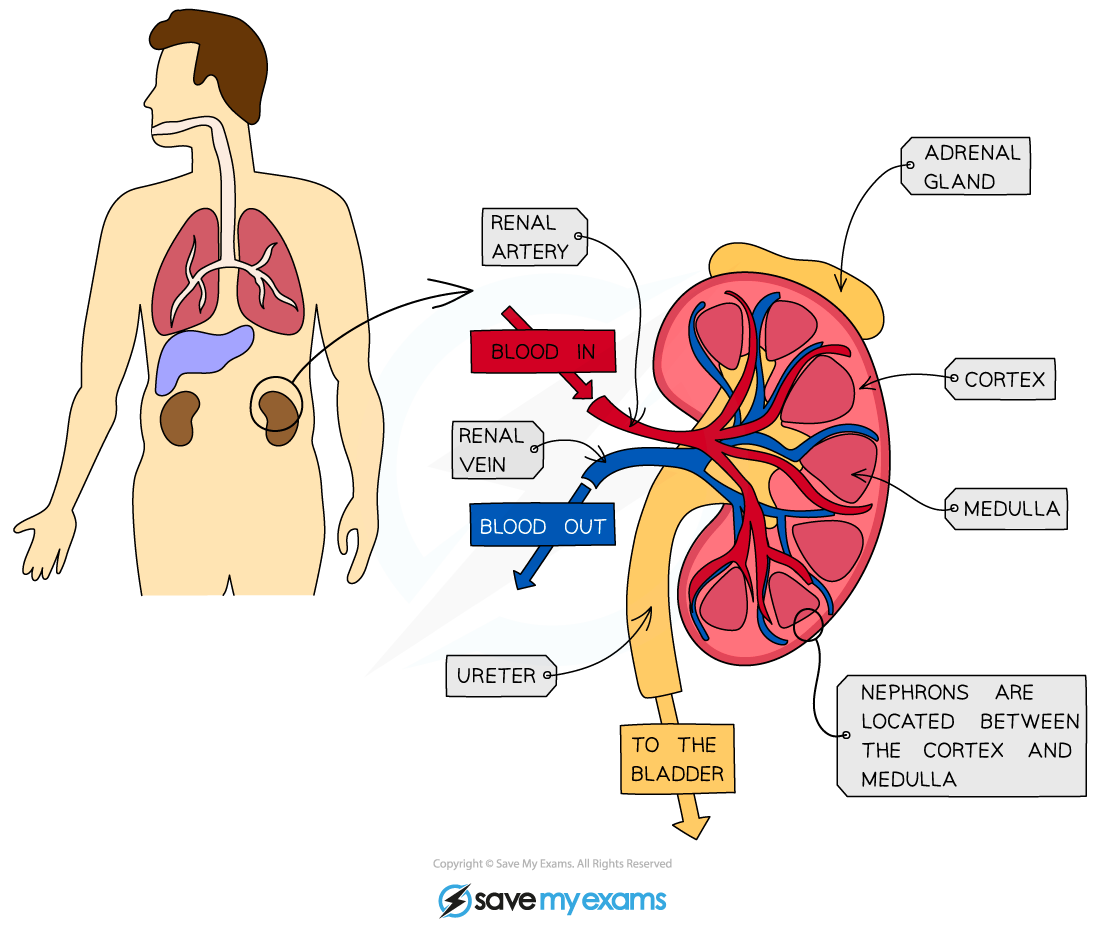 Each kidney has two regions:
- Cortex: the outer region
- Medulla: the inner region.
Nephrons extend through the cortex and medulla. Blood is filtered in the nephron, and useful substances are returned to the blood. The fluid left behind becomes urine.
Nephron function
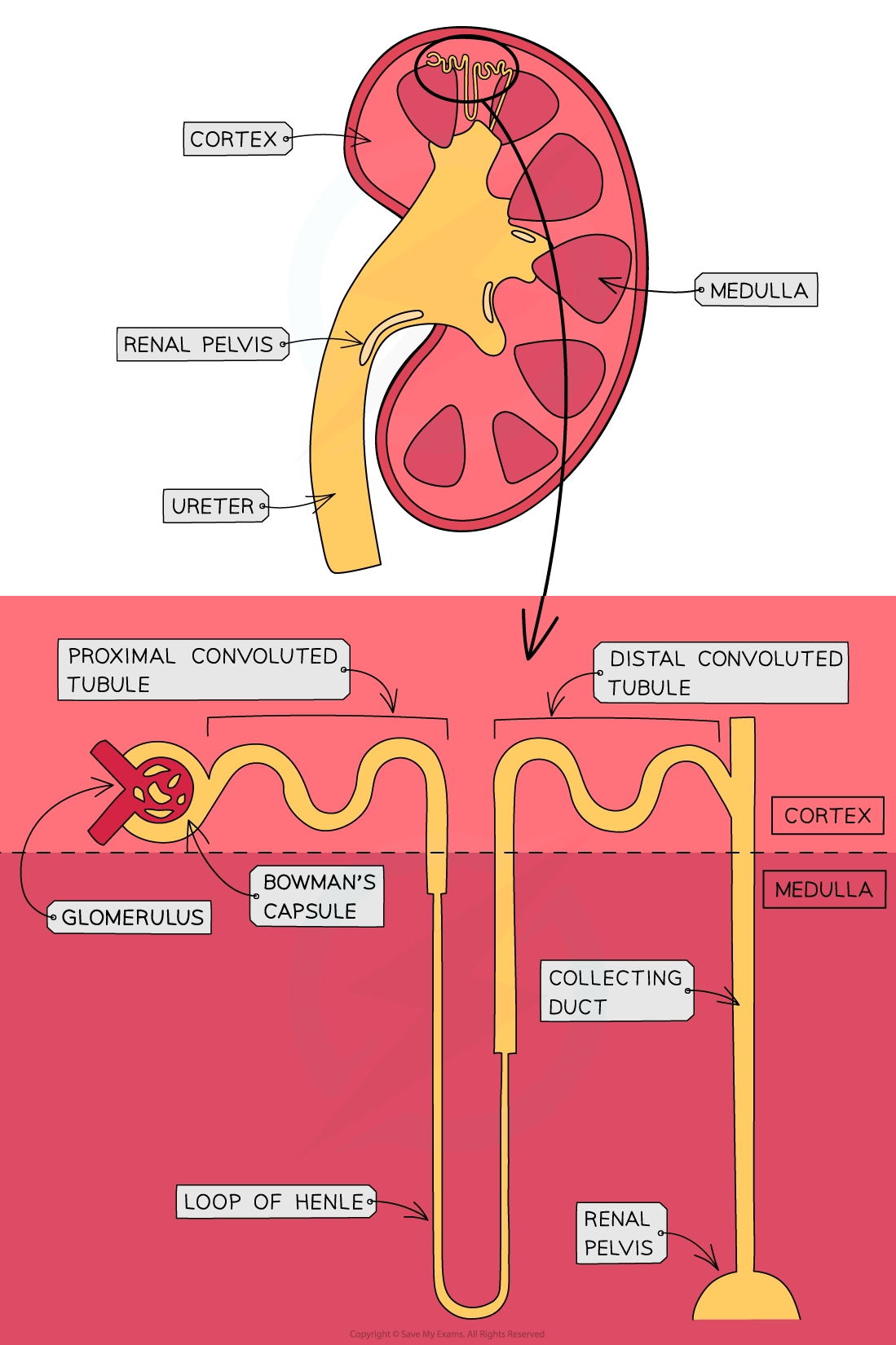
A nephron is a microscopic tubule supplied by blood capillaries. Its main parts include the glomerulus, Bowman’s capsule, tubule, and collecting duct.
1. Filtration
The glomerulus is a network of capillaries inside Bowman’s capsule. Blood enters the glomerulus at relatively high pressure. Small molecules, including:
- water
- glucose
- some ions
- urea
are forced from the blood into Bowman’s capsule. This liquid is called the filtrate. Blood cells and large plasma proteins remain in the blood because they are too large to pass through the filtration barrier.
2. Selective reabsorption
As filtrate passes along the nephron:
- all glucose is normally reabsorbed into the blood
- some ions are reabsorbed into the blood
- most water is reabsorbed into the blood.
This prevents useful substances and too much water from being lost. The amount of water and ions reabsorbed varies according to the body’s needs.
3. Urine formation
The substances not reabsorbed remain in the tubule and form urine. Urine contains:
- urea
- excess water
- excess ions.
Urine passes from the collecting ducts into the ureters and then to the bladder.
Liver, amino acids, and urea
Amino acids absorbed from the small intestine are transported in the blood to cells. The liver assimilates some amino acids by using them to make proteins, including plasma proteins. The body cannot store excess amino acids. In the liver, excess amino acids undergo deamination:
- The amino group is removed from an amino acid.
- Ammonia is produced.
- The liver converts ammonia into urea.
- Urea is transported in the blood to the kidneys.
- The kidneys excrete urea in urine.
The remaining carbon-containing part of the amino acid can be used in respiration or converted into other substances. The important exam sequence is:
excess amino acids → deamination in liver → ammonia → urea → kidneys → urine
Importance of excretion
Excretion is important because waste products and excess substances can harm cells or disturb internal conditions.
- Urea: high concentrations are toxic. Excreting urea prevents it from accumulating in the blood and tissues.
- Excess water: removing it helps maintain the correct concentration of body fluids. Too much water dilutes body fluids; too little water causes dehydration.
- Excess ions: removing them helps maintain the correct ion concentration needed for normal cell, nerve, and muscle function.
- Carbon dioxide: removing it prevents carbon dioxide from accumulating in the blood and affecting internal conditions.
Exam summary
- Excretion removes metabolic waste and excess substances.
- Lungs excrete carbon dioxide.
- Kidneys excrete urea, excess water, and ions.
- Urine flows kidney → ureter → bladder → urethra.
- Kidney regions are the cortex and medulla.
- The glomerulus filters small molecules from the blood.
- The nephron reabsorbs glucose, some ions, and most water.
- Urea is formed in the liver from excess amino acids after deamination.
- Urea, excess water, and excess ions remain in urine and are excreted.