Chemistry of the environment
Water tests
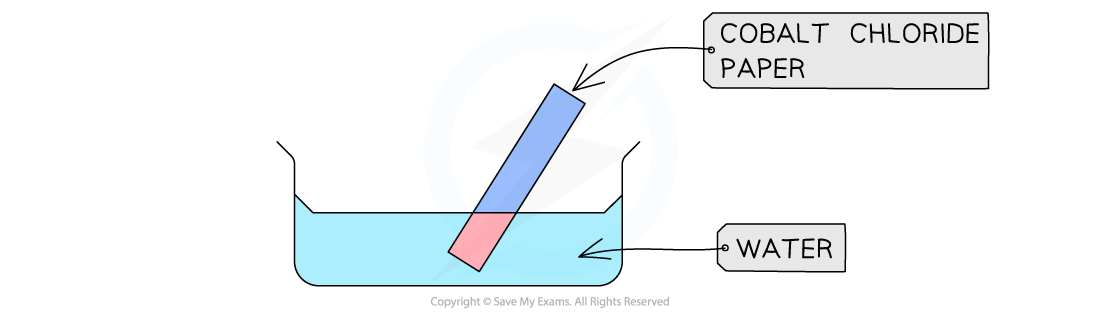
- Anhydrous cobalt(II) chloride is blue. It turns pink when water is present.
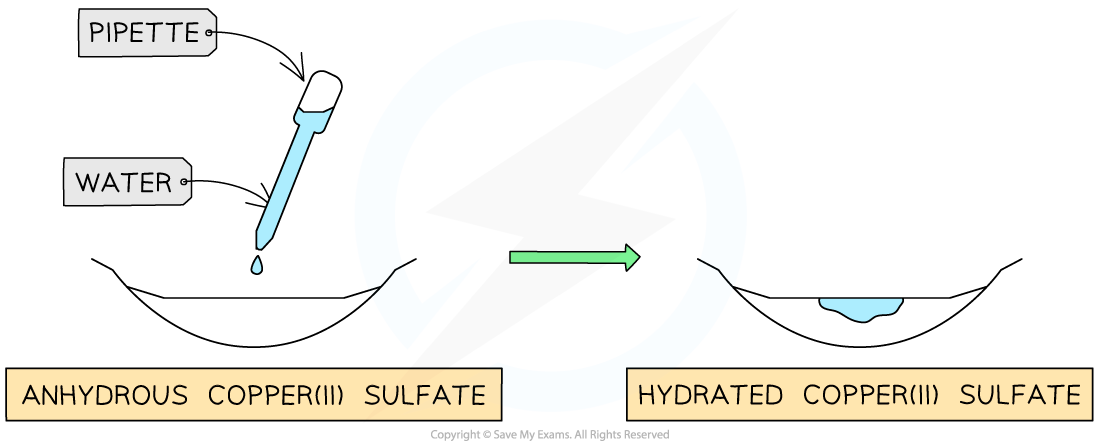
- Anhydrous copper(II) sulfate is white. It turns blue when water is present.
Purity
- A pure substance has a sharp melting point and boiling point. Impurities usually change and broaden these values.
- Distilled water is used to avoid dissolved impurities interfering with an experiment.
Natural water
Natural water may contain dissolved oxygen, metal compounds, plastics, sewage, microbes, nitrates, and phosphates. Dissolved oxygen supports aquatic life.
Some dissolved metal compounds provide useful minerals, but toxic metals can harm organisms. Sewage microbes can cause disease. Nitrates and phosphates promote algal growth; decomposition then removes oxygen and may kill aquatic organisms.
Domestic water treatment
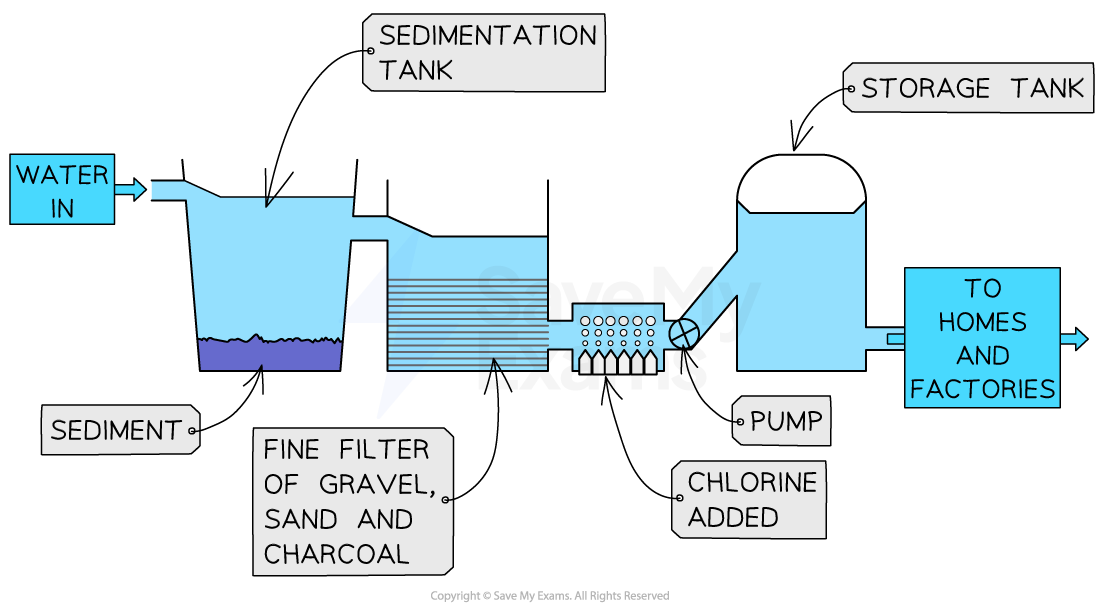
- Sedimentation allows suspended solids to settle.
- Filtration removes insoluble particles.
- Activated carbon removes unpleasant tastes and smells.
- Chlorination kills microbes.
Air composition
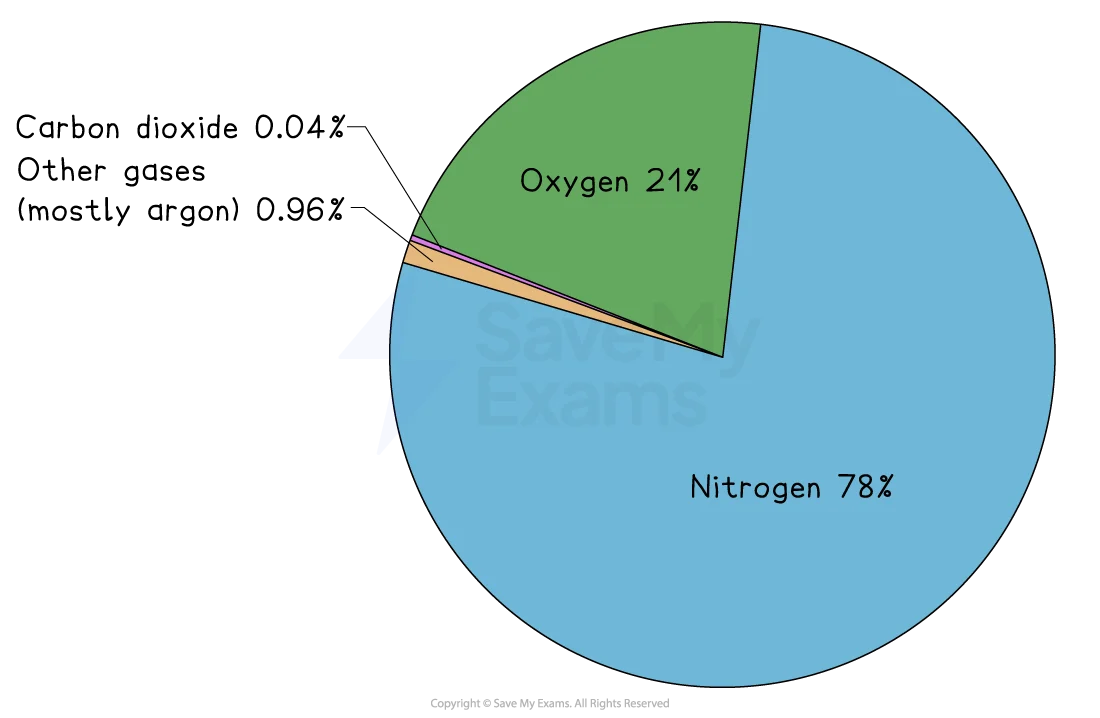
Clean, dry air contains approximately 78% nitrogen, 21% oxygen, and a small remainder of noble gases and carbon dioxide.
Air pollutants
| Pollutant | Main source | Harmful effect |
|---|---|---|
| Carbon dioxide, $\mathrm{CO_2}$ | Complete combustion of fossil fuels | Global warming and climate change |
| Carbon monoxide, $\mathrm{CO}$ | Incomplete combustion | Toxic; reduces oxygen transport in blood |
| Particulates | Incomplete combustion and industrial processes | Respiratory disease and cancer risk |
| Methane, $\mathrm{CH_4}$ | Decomposition and animal digestion | Global warming and climate change |
| Nitrogen oxides, $\mathrm{NO_x}$ | High-temperature engines | Acid rain, smog, and respiratory problems |
| Sulfur dioxide, $\mathrm{SO_2}$ | Sulfur-containing fossil fuels | Acid rain and respiratory problems |
Strategies include planting trees, reducing fossil-fuel use, using renewable or hydrogen energy, reducing livestock emissions, using low-sulfur fuels, catalytic converters, and flue-gas desulfurisation.
Greenhouse effect
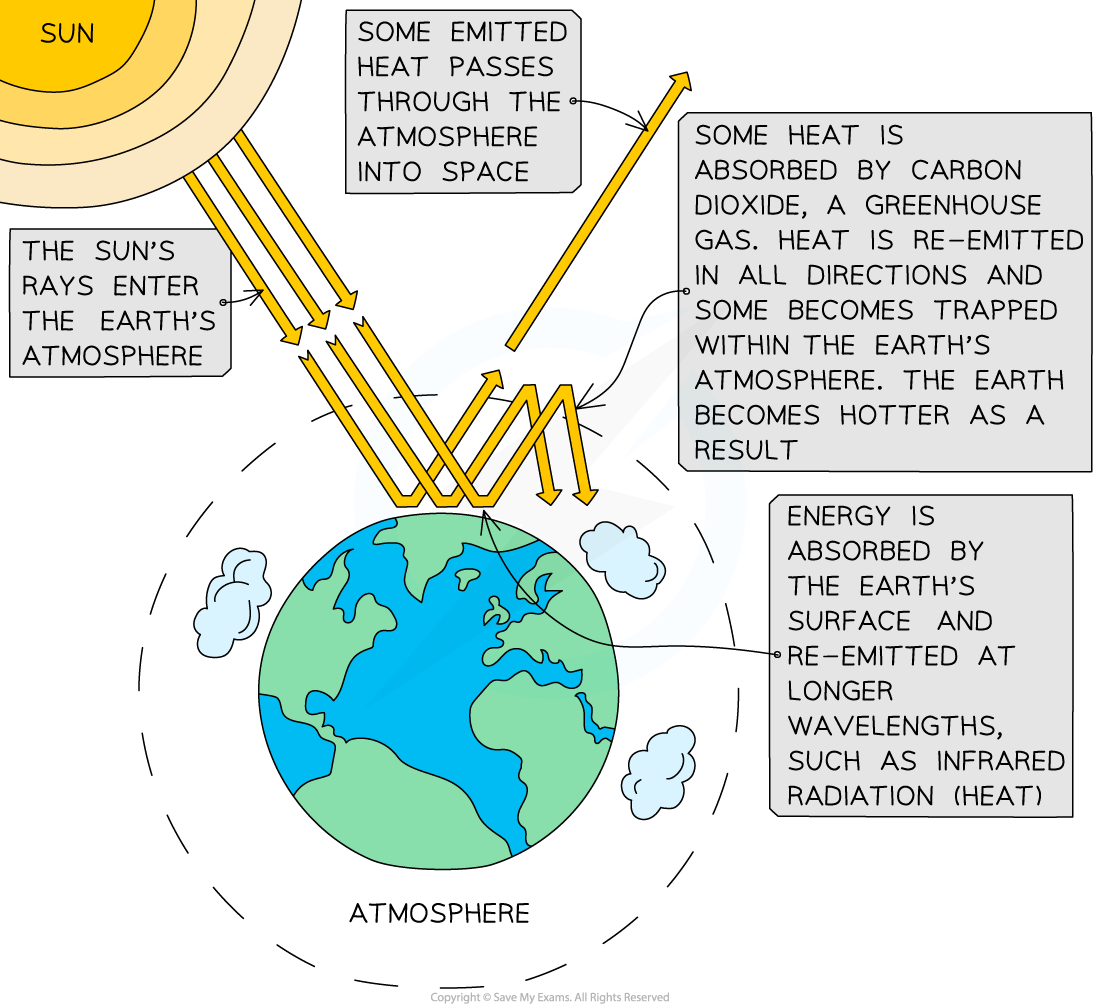
The surface absorbs incoming radiation and emits infrared thermal radiation. Greenhouse gases such as $\mathrm{CO_2}$ and methane absorb some outgoing infrared radiation and re-emit it in all directions. Some is emitted back towards Earth, so less thermal energy escapes to space. Increasing greenhouse-gas concentration increases global warming.
Photosynthesis
Photosynthesis uses light energy and chlorophyll:
$$\text{carbon dioxide}+\text{water} \rightarrow \text{glucose}+\text{oxygen}$$
$$\mathrm{6CO_2(g)+6H_2O(l) \rightarrow C_6H_{12}O_6(aq)+6O_2(g)}$$
The glucose stores chemical energy and oxygen is released.
Nitrogen oxides and catalytic converters
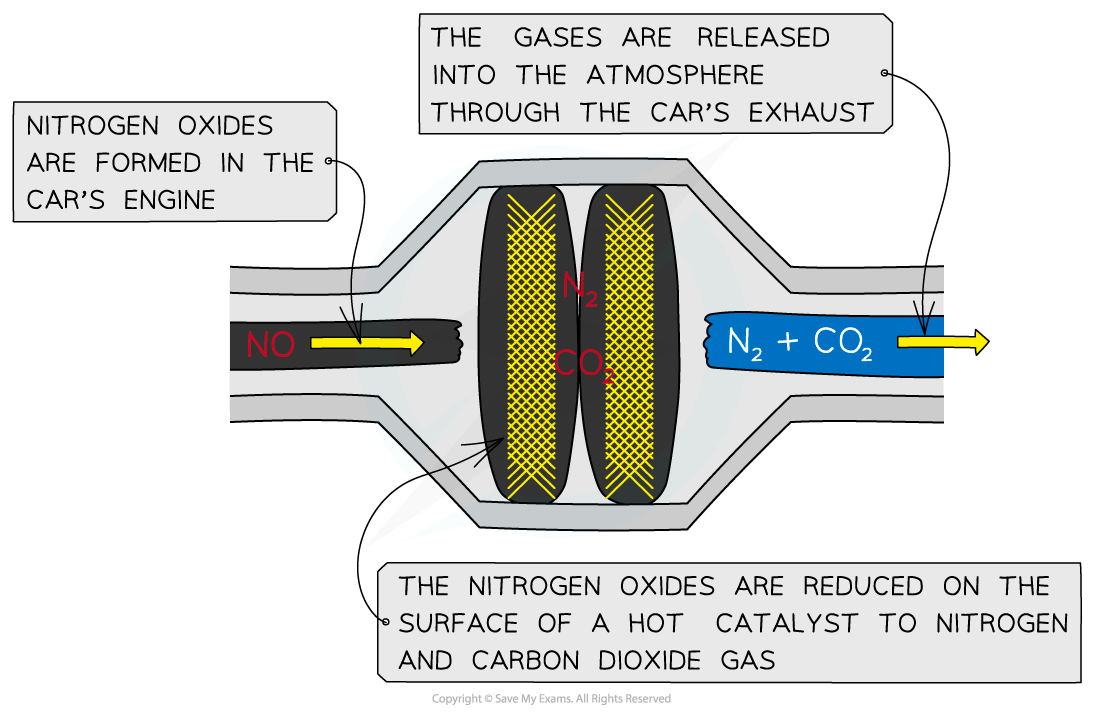
High temperatures inside engines allow nitrogen and oxygen from air to react, forming nitrogen oxides. A catalytic converter uses carbon monoxide to reduce nitrogen monoxide:
$$\mathrm{2CO(g)+2NO(g) \rightarrow 2CO_2(g)+N_2(g)}$$
This removes nitrogen monoxide and produces less harmful nitrogen gas.
Summary
Key points from the Chemistry of the Environment:
- Water tests using anhydrous cobalt(II) chloride and copper(II) sulfate detect hydration in substances.
- Natural water contains beneficial substances (dissolved oxygen, minerals) and harmful substances (toxic metals, plastics, sewage microbes, nitrates, phosphates).
- Domestic water treatment ensures safety through sedimentation, carbon treatment, and chlorination.
- Air composition is 78% nitrogen, 21% oxygen, noble gases, and carbon dioxide.
- Air pollutants cause global warming, acid rain, and respiratory issues through various combustion sources.
- Mitigation strategies include planting trees, reducing livestock numbers, developing renewable energy, using catalytic converters, low-sulfur fuels, and flue gas desulfurisation.