Human nutrition
Balanced diet
A balanced diet contains suitable amounts of carbohydrates, fats and oils, proteins, vitamins, minerals, fibre, and water for health, growth, energy, and repair. Requirements vary with age, activity, pregnancy, and health.
| Nutrient | Sources | Importance |
|---|---|---|
| Carbohydrates | Bread, rice, potatoes, pasta, cereals | Energy for respiration |
| Fats and oils | Butter, oils, meat, nuts, seeds | Energy store, insulation, and part of cell membranes |
| Proteins | Meat, fish, eggs, milk, beans, nuts | Growth and repair; making enzymes and other proteins |
| Vitamin C | Citrus fruits, berries, peppers, green vegetables | Healthy skin and gums; deficiency causes scurvy |
| Vitamin D | Sunlight, oily fish, eggs, fortified foods | Helps calcium absorption and healthy bones; deficiency causes rickets |
| Calcium ions | Milk, cheese, yoghurt, leafy vegetables | Strong bones and teeth; deficiency can contribute to rickets |
| Iron ions | Meat, liver, beans, leafy vegetables | Needed to make haemoglobin; deficiency can cause anaemia |
| Fibre | Whole grains, fruits, vegetables, beans | Adds bulk and helps food move through the alimentary canal |
| Water | Drinks, fruits, vegetables, soups | Solvent for digestion; transport; temperature control; raw material in reactions |
The digestive system
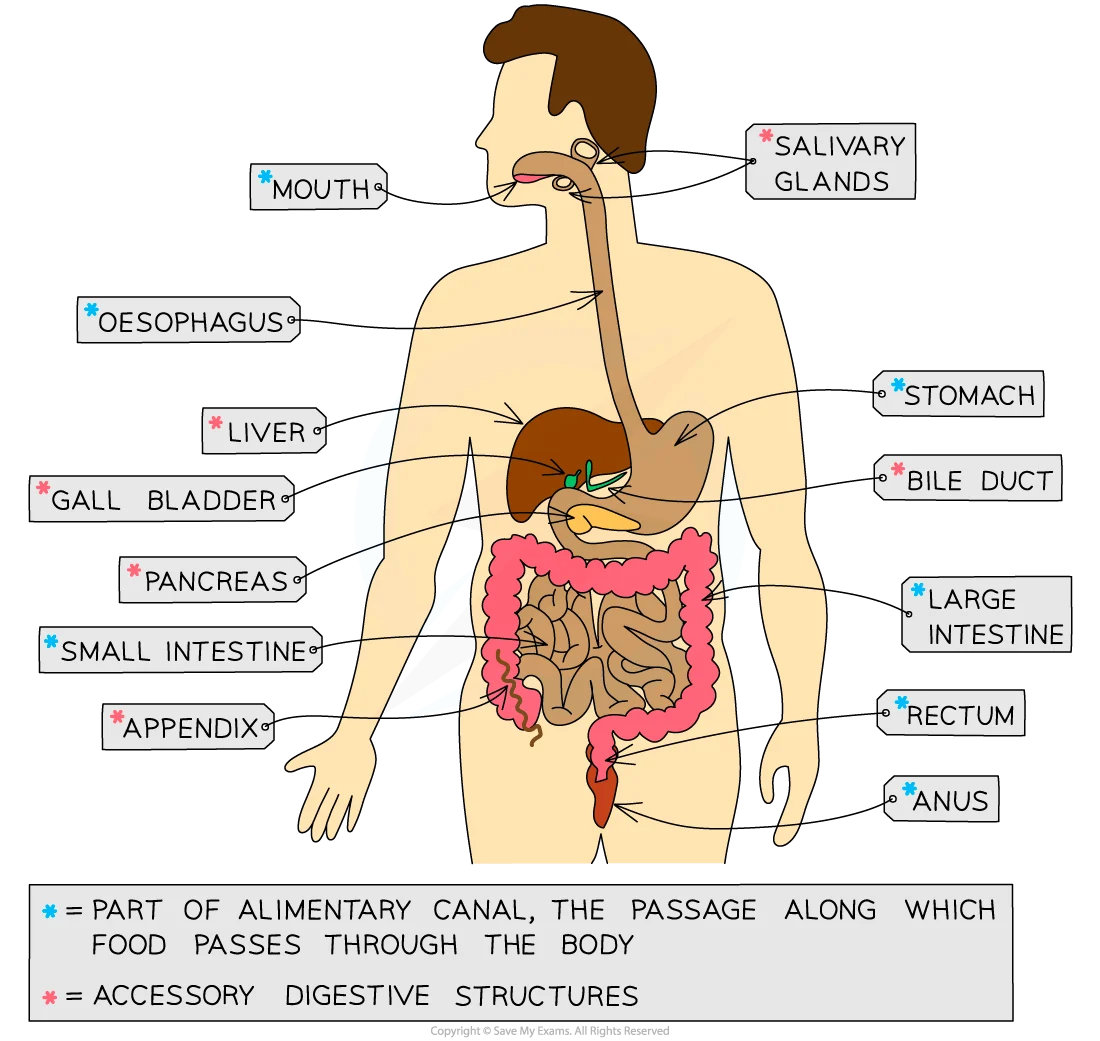
The alimentary canal is a tube through which food passes:
mouth → oesophagus → stomach → small intestine → large intestine
The associated organs are the salivary glands, pancreas, liver, and gall bladder.
Digestive processes
- Ingestion: taking food into the mouth.
- Digestion: breaking down large, insoluble food molecules into small, soluble molecules.
- Absorption: movement of small, soluble molecules through the wall of the small intestine into the blood or lymph.
- Assimilation: use of absorbed nutrients by cells.
- Egestion: removal of undigested food from the alimentary canal.
Physical digestion
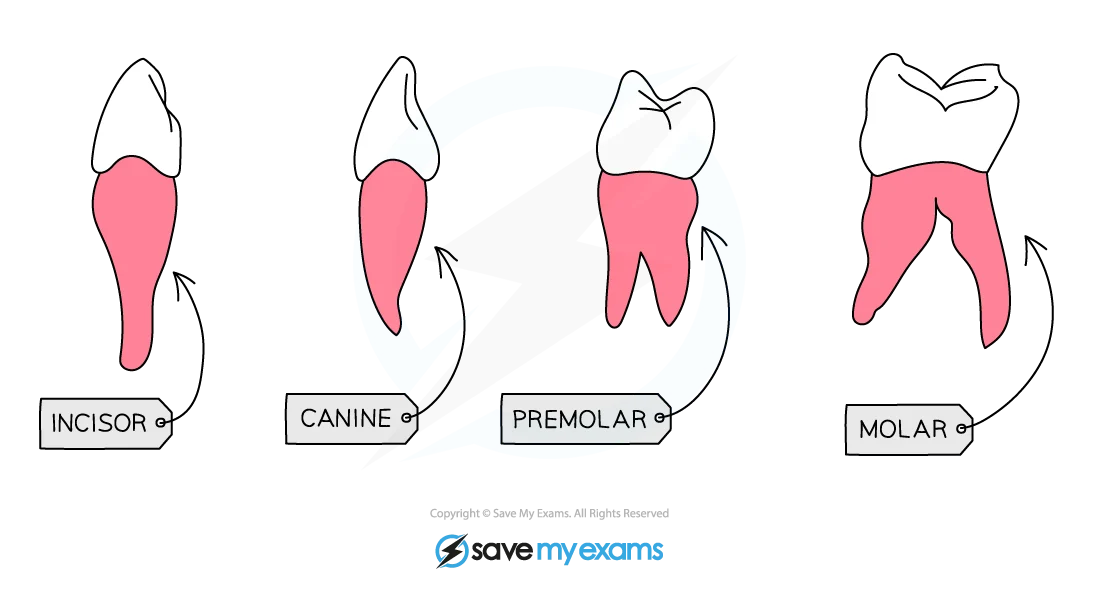
Physical digestion breaks food into smaller pieces without chemical change. It increases surface area for enzyme action.
- Incisors cut food.
- Canines tear food.
- Premolars crush food.
- Molars crush and grind food.
- The stomach churns food and mixes it with gastric juice.
Tooth structure
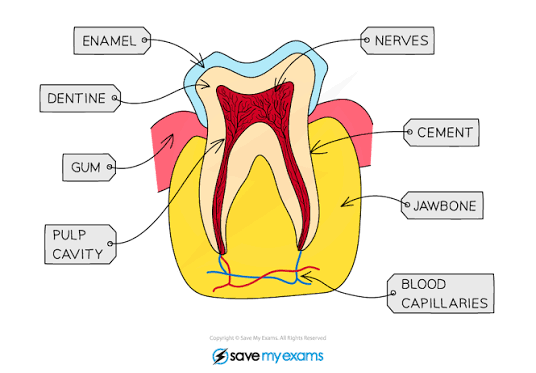
- Enamel: very hard outer covering that protects the tooth.
- Dentine: layer beneath enamel that supports the tooth.
- Pulp cavity: contains nerves and blood vessels; nerves detect pain and blood vessels supply the living tissues.
- Cement: covers the root and helps attach the tooth to the jaw.
Chemical digestion
Digestive enzymes are biological catalysts. They break large insoluble molecules into small soluble molecules that can be absorbed.
| Enzyme | Secreted by | Acts in | Substrate and products |
|---|---|---|---|
| Amylase | Salivary glands and pancreas | Mouth and small intestine | Starch → maltose and other reducing sugars |
| Proteases, including pepsin and trypsin | Stomach and pancreas | Stomach and small intestine | Protein → amino acids; pepsin first produces shorter protein molecules in the stomach |
| Lipase | Pancreas | Small intestine | Fats and oils → fatty acids and glycerol |
Stomach
Hydrochloric acid (HCl) in gastric juice kills bacteria and provides the acidic pH needed for pepsin to work. The stomach also churns food.
Bile
The liver produces bile, which is stored in the gall bladder and released into the small intestine. Bile:
- neutralises acidic food arriving from the stomach;
- emulsifies fats and oils into small droplets;
- increases the surface area available for lipase action.
Emulsification is physical, not chemical, digestion.
Digestion pathways
Starch
- Amylase in saliva begins digestion in the mouth: starch → maltose.
- Amylase from the pancreas continues digestion in the small intestine.
- Other enzymes convert maltose to glucose.
- Glucose is absorbed through the villi into blood capillaries.
Protein
- Pepsin begins protein digestion in the stomach.
- Pancreatic proteases, including trypsin, act in the small intestine.
- Proteins and shorter protein molecules are broken down into amino acids.
- Amino acids are absorbed into blood capillaries.
Fats and oils
- Bile emulsifies fats in the small intestine.
- Lipase breaks fats into fatty acids and glycerol.
- These products are absorbed through the villi, mainly into lacteals.
Absorption in the small intestine
The small intestine is the main site of nutrient absorption. Most water is absorbed from the small intestine; some is absorbed from the colon.
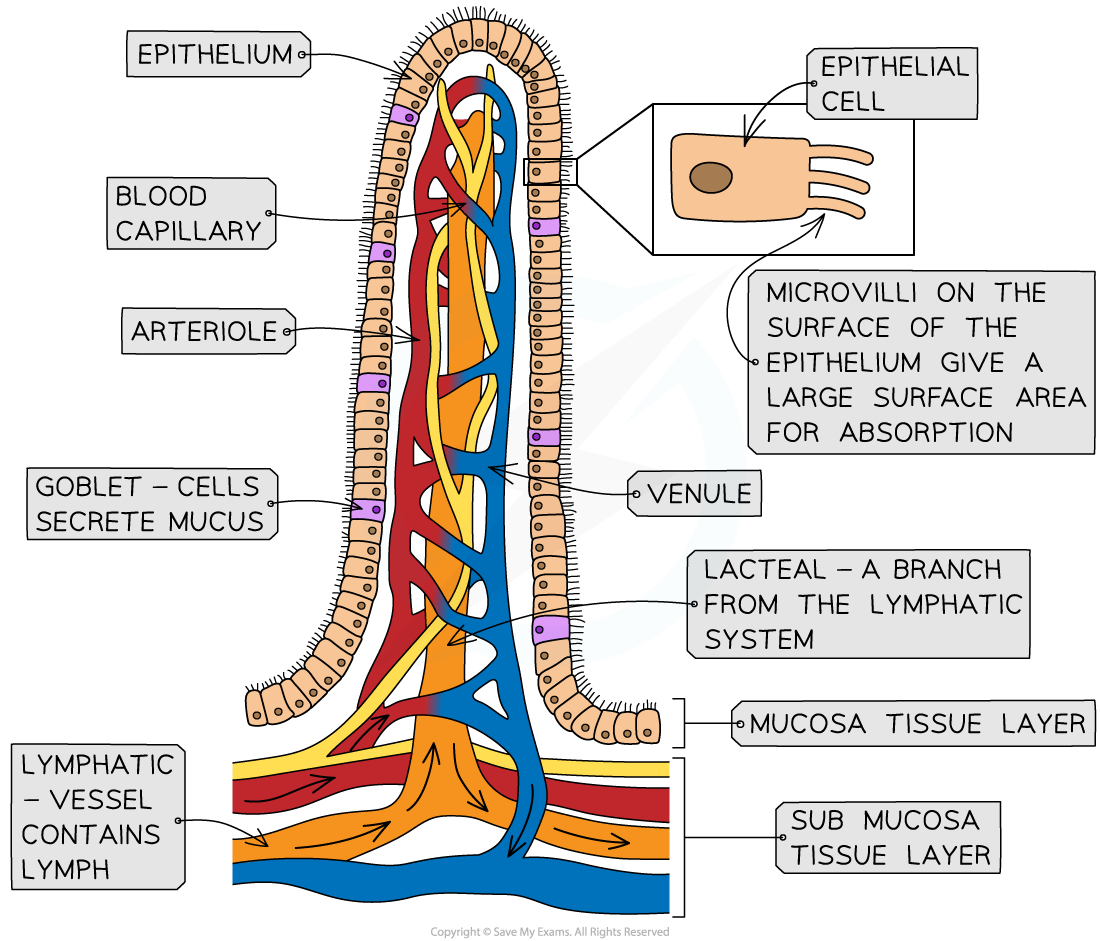
A villus has:
- a large surface area, increased further by microvilli;
- an epithelium one cell thick, giving a short diffusion distance;
- a dense network of blood capillaries;
- a lacteal, a lymph vessel inside the villus.
Villi and microvilli increase surface area. Capillaries carry away glucose and amino acids, maintaining concentration gradients for absorption. Lacteals absorb products of fat digestion.
Exam checks
- Do not confuse absorption with assimilation: absorption moves nutrients into blood or lymph; assimilation is their use by cells.
- Do not confuse egestion with excretion: egestion removes undigested food; excretion removes metabolic waste.
- Bile emulsifies fats but does not digest them chemically.
- Remember: amylase acts on starch, proteases act on proteins, and lipase acts on fats and oils.
- Include both enzyme location and products in digestion answers.