Xylem and Phloem Functions
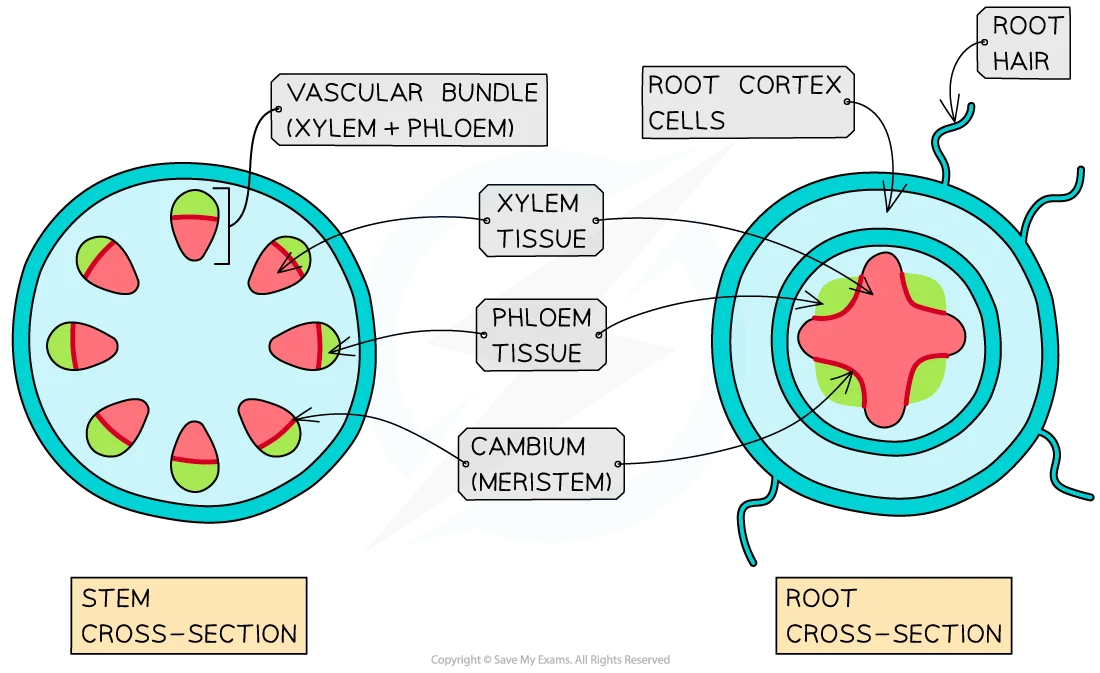
Xylem
- Transports water and mineral ions from roots to leaves.
- Provides structural support to plants.
- Xylem vessels are dead and have no cell contents. Their hollow, continuous tubes have lignified walls, giving low resistance to water flow and support.
Phloem
- Transports sucrose and amino acids from leaves to other parts
- Living cells
- Moves substances from sources (leaves) to sinks (growing tissues)
Identification in Plant Parts
| Plant Part | Xylem | Phloem |
|---|---|---|
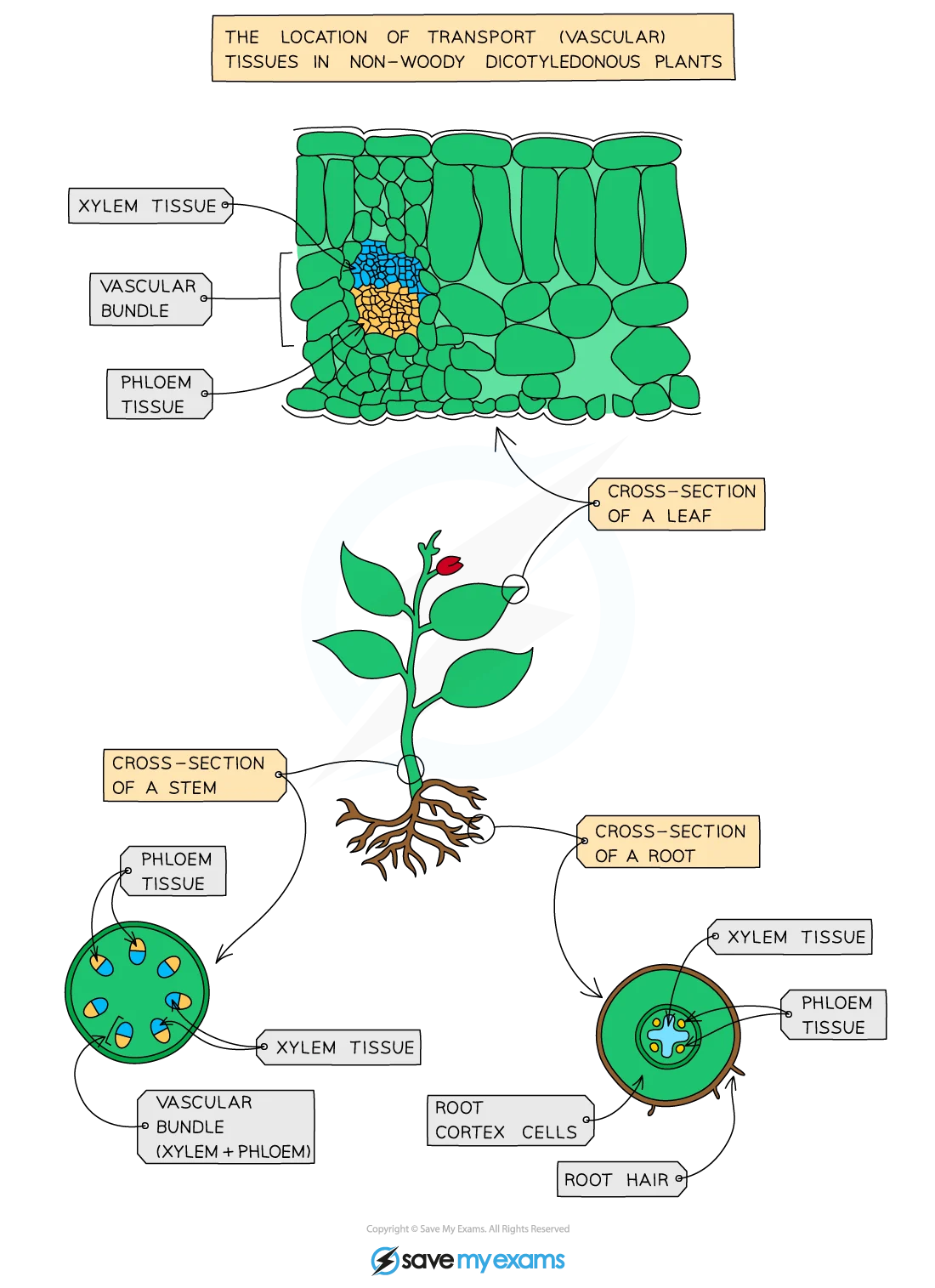
| Roots | Present in vascular bundles | Present in vascular bundles |
| Stems | Present in vascular bundles | Present in vascular bundles |
| Leaves | Veins contain xylem | Veins contain phloem |
Root Hair Cells
Structure and Function
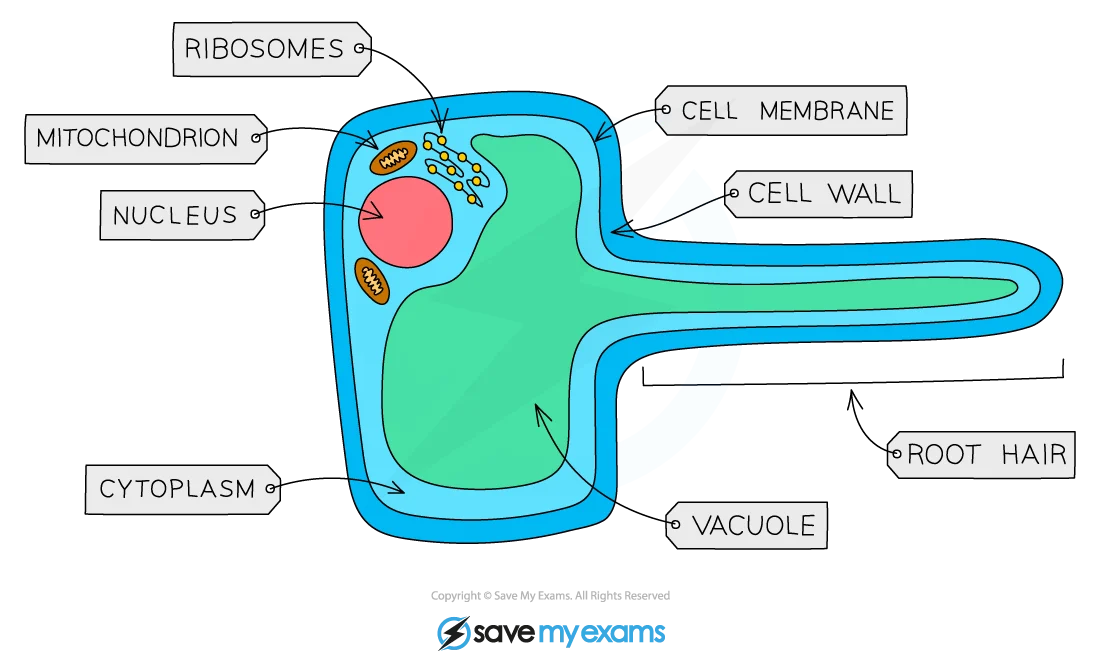
Root hair cells are specialized epidermal cells extending into soil. They have a long projection that increases surface area significantly.
| Feature | Description | Function |
|---|---|---|
| Long projections (root hairs) | Elongated extensions from epidermis cells | Increases surface area 50-200 times for faster water/mineral uptake |
| Thin cell wall | Short diffusion distance between soil solution and cell membrane | Allows faster water uptake by osmosis |
| Large central vacuole | Filled with concentrated cell sap | Creates a lower water potential, drawing water in by osmosis |
| Mitochondria | Abundant organelles present | Provide energy for active transport of mineral ions |
Water Uptake Process
- Water enters root hair cells via osmosis (soil water potential > cell sap water potential).
- Moves through the cortex by osmosis and enters xylem vessels.
- Moves through the xylem to the mesophyll of the leaf via transpiration pull.
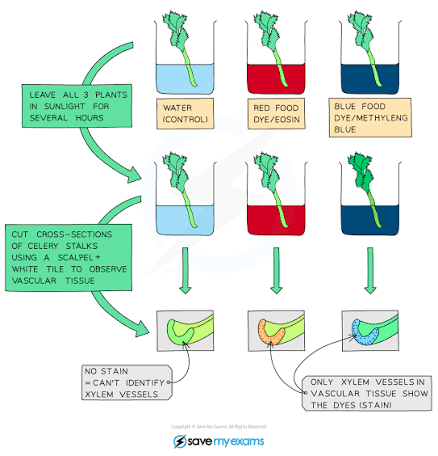
Investigation: Water Pathway Using Stain
Purpose
- Trace water movement through root to stem
Method
- Cut stem of plant (e.g., celery, daffodil)
- Place in water with red dye/stain
- Observe over time
- Cut across stem at different heights
- Observe stained vessels
Results
- Xylem vessels show red staining.
- Phloem does not stain.
- This supports the conclusion that xylem transports water.
Transpiration
Definition and Mechanism
Transpiration is the loss of water vapour from leaves to the atmosphere.
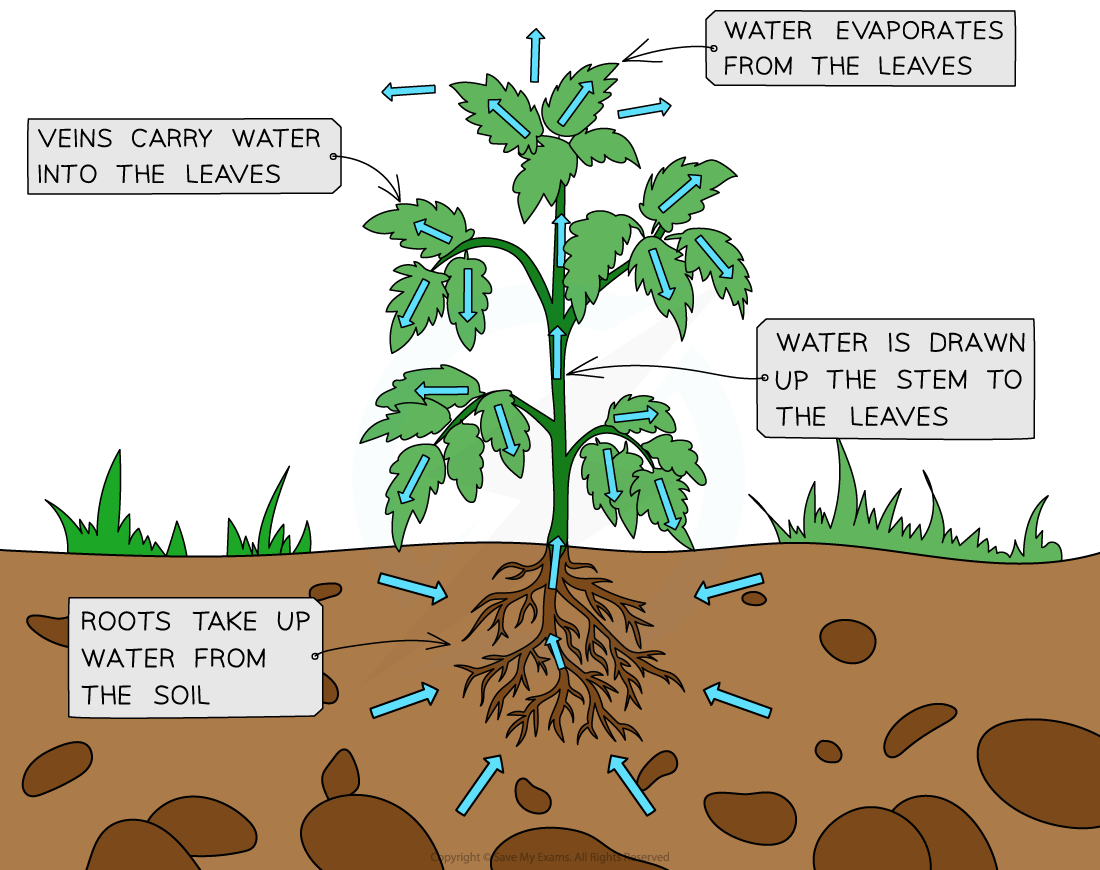
Process
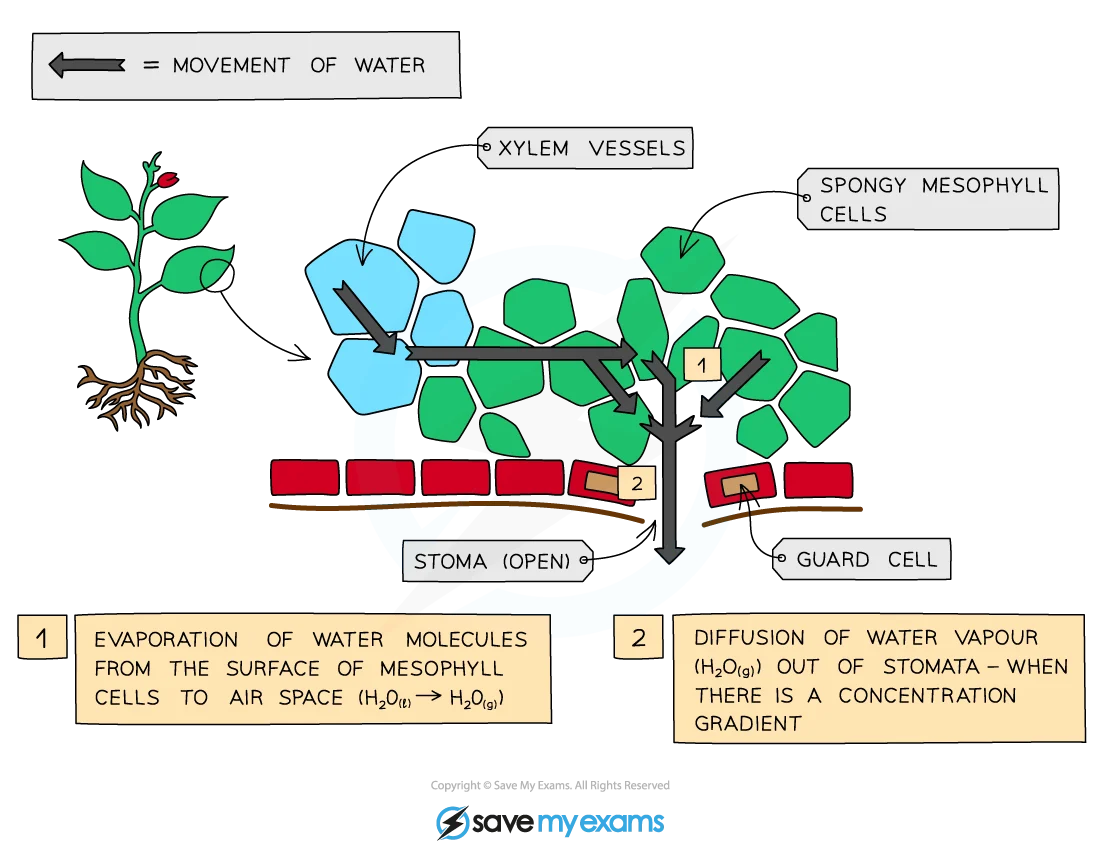
- Water evaporates from mesophyll cell surfaces into air spaces
- Water vapour diffuses through stomata to outside air
- Water vapour concentration is higher inside leaf than outside air
Stomata and Water Loss
Stomata Structure
- Pores on leaf surface (mostly on lower epidermis)
- Regulated by guard cells
- Open for CO₂ entry, O₂ exit, and water vapour exit
Factors Affecting Transpiration Rate
| Factor | Effect | Explanation |
|---|---|---|
| Temperature | Higher temperature = faster rate | Increased kinetic energy, more evaporation |
| Wind Speed | Higher wind speed = faster rate | Removes water vapour, maintains concentration gradient |
| Humidity | Lower humidity = faster rate | Larger concentration gradient between leaf and air |
| Light intensity — Enrichment | Higher light can increase the rate | Stomata may open more for CO₂ uptake |
Investigation: temperature and wind speed
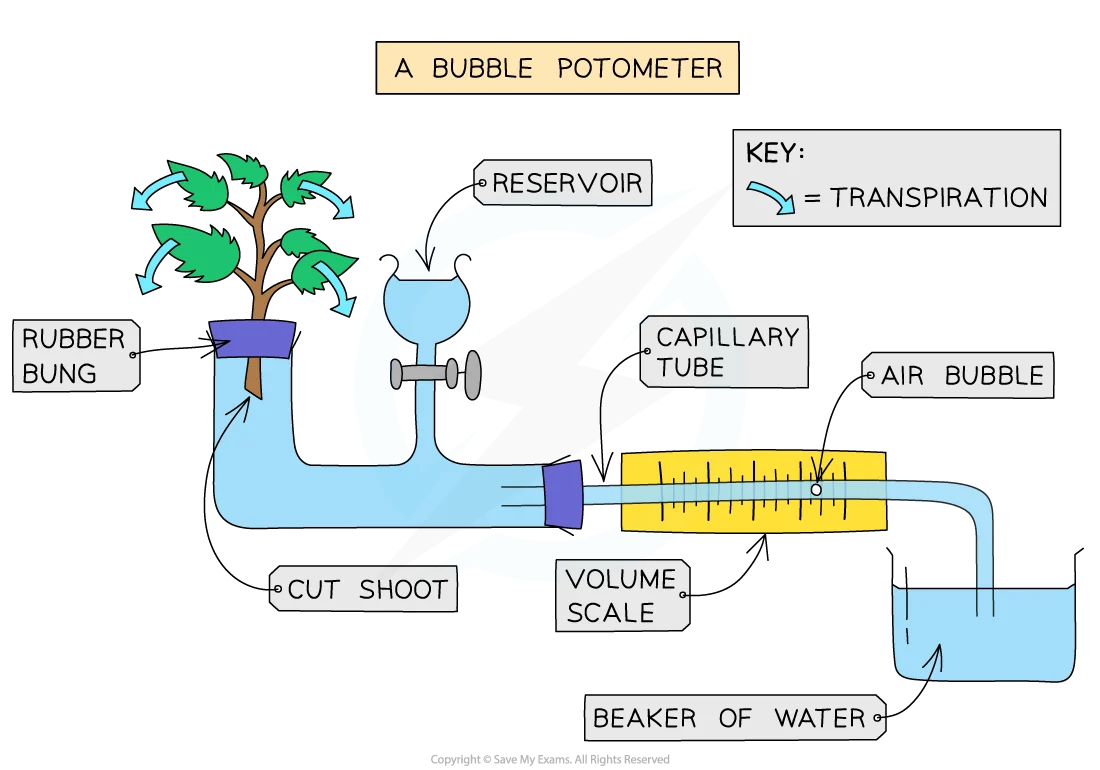
A potometer estimates transpiration rate by measuring water uptake by a leafy shoot.
- Cut a leafy shoot under water and fit it into a sealed potometer.
- Remove air bubbles and check that the apparatus does not leak.
- Change one factor, such as temperature or wind speed, while keeping leaf area, light intensity, humidity, shoot length, and time constant.
- Measure the distance moved by an air bubble in a fixed time, or calculate water uptake per unit time.
- Repeat each condition and calculate a mean rate.
A higher temperature or wind speed should usually increase water uptake and estimated transpiration rate. Wind removes moist air near the leaf, maintaining a water-vapour concentration gradient. A potometer measures water uptake, which is used as an estimate of transpiration rather than a direct measurement of water-vapour loss.
Extended Understanding
Transpiration Pull
- Water evaporates from mesophyll cells creating negative pressure
- Creates tension pulling water up xylem from roots
- Water molecules stick together via cohesion (hydrogen bonds)
- Forms continuous column of water from roots to leaves
Water Vapour Loss Relation
- Air spaces in spongy mesophyll hold water vapour
- Stomata provide exit pathway
- Rate depends on stomatal opening and environmental conditions.
Wilting
- Occurs when plant loses water faster than it can absorb
- Cells lose turgor pressure
- Plant becomes limp
- Can be temporary (recoverable) or permanent (damaged)
Translocation
Definition
Translocation is the movement of sucrose and amino acids in phloem from sources to sinks.
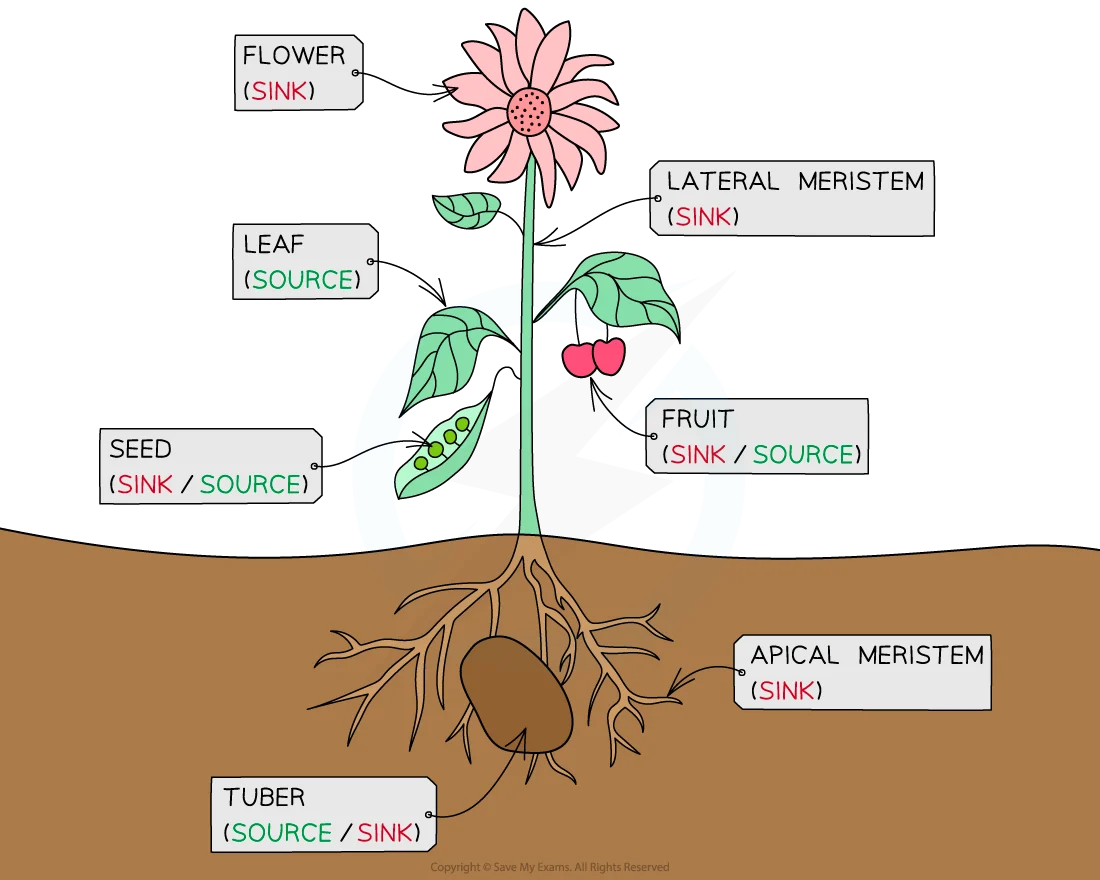
Sources and Sinks
Sources
- Organs that produce or export organic substances
- Examples: Mature leaves (photosynthesis), storage organs breaking down reserves
Sinks
- Organs that consume or store organic substances
- Examples: Growing shoot tips, root tips, developing fruits, storage roots
Movement in Phloem
Loading (at source)
- Sucrose produced in leaves during photosynthesis
- Sucrose actively transported into companion cells
- Moves into sieve tube elements
- Lowers water potential in sieve tube
- Water enters by osmosis from xylem
- Creates high pressure pushing sap down phloem
Translocation
- Mass flow of sap from sources to sinks.
- Driven by pressure differences.
Unloading (at sink)
- Sucrose actively transported out of sieve tube
- Water potential increases
- Water leaves by osmosis
- Sap volume decreases
Sources and Sinks Dynamics Over Time
Daytime
- Leaves are sources (photosynthesis produces sucrose)
- Growing tissues are sinks (consuming sucrose for growth)
Nighttime
- Leaves may become sinks (using stored reserves)
- Storage organs may become sources (releasing stored sucrose)
Seasonal Changes
- Spring: Roots are sources (mobilizing stored food).
- Summer: Leaves are primary sources.
- Autumn: Storage organs become sinks (accumulating reserves).
Summary Table: Xylem vs Phloem
| Feature | Xylem | Phloem |
|---|---|---|
| Substances Transported | Water, mineral ions | Sucrose, amino acids |
| Direction | Roots → Leaves | Sources → Sinks |
| Cell Type | Dead cells | Living cells |
| Energy Required | No | Yes (for loading/unloading) |
| Structure | Hollow tubes with lignin | Sieve tubes with companion cells |
| Function | Water/mineral uptake, support | Food distribution |
Enrichment: practical applications
Agriculture
Irrigation Management
- Understanding transpiration helps optimize watering
- Water lost through transpiration must be replaced
- Drought conditions reduce transpiration rate
Fertilizer Use
- Nitrate ions absorbed by root hairs support protein production
- Phloem transports these amino acids to growing tissues
- Proper nutrient balance affects plant growth
Greenhouse Growing
- Temperature and humidity control affects transpiration
- Higher temperature increases transpiration rate
- Humidity control prevents excessive water loss
Glossary
| Term | Definition |
|---|---|
| Xylem | Tissue transporting water and minerals from roots |
| Phloem | Tissue transporting sugars and amino acids |
| Root hair cells | Specialized epidermal cells for water uptake |
| Transpiration | Loss of water vapour from leaves |
| Mesophyll | Inner leaf tissue where evaporation occurs |
| Stomata | Pores on leaf surface for gas exchange |
| Guard cells | Cells controlling stomatal opening |
| Translocation | Movement of food in phloem from sources to sinks |
| Source | Organ exporting organic substances |
| Sink | Organ consuming or storing organic substances |
| Transpiration pull | Tension pulling water up xylem |
| Cohesion | Water molecules sticking together |
| Wilting | Loss of turgor causing limp plant |