Reproduction produces new organisms. Asexual reproduction uses one parent and produces genetically identical offspring. Sexual reproduction involves fusion of nuclei from two gametes, producing a genetically different offspring.
Asexual and sexual reproduction
Asexual reproduction
Asexual reproduction needs one parent and no fusion of gamete nuclei. Offspring are genetically identical to the parent and to one another, except for mutations. Examples include:
- Binary fission in some single-celled organisms
- Budding in yeast
- Runners producing new plantlets in plants such as strawberries
- Bulbs, tubers, or stem cuttings producing new plants
Advantages in a stable environment:
- One parent can reproduce, so finding a mate is unnecessary.
- Reproduction can be rapid and produce many offspring.
- All offspring retain successful adaptations.
Disadvantages in a changing environment:
- Little or no genetic variation means a disease or environmental change may affect all offspring.
- A harmful mutation can be copied into many offspring.
Asexual reproduction is useful in crop production because many plants with desirable features can be produced quickly and consistently. However, a crop with little variation may be vulnerable to one disease or change in conditions.
Sexual reproduction
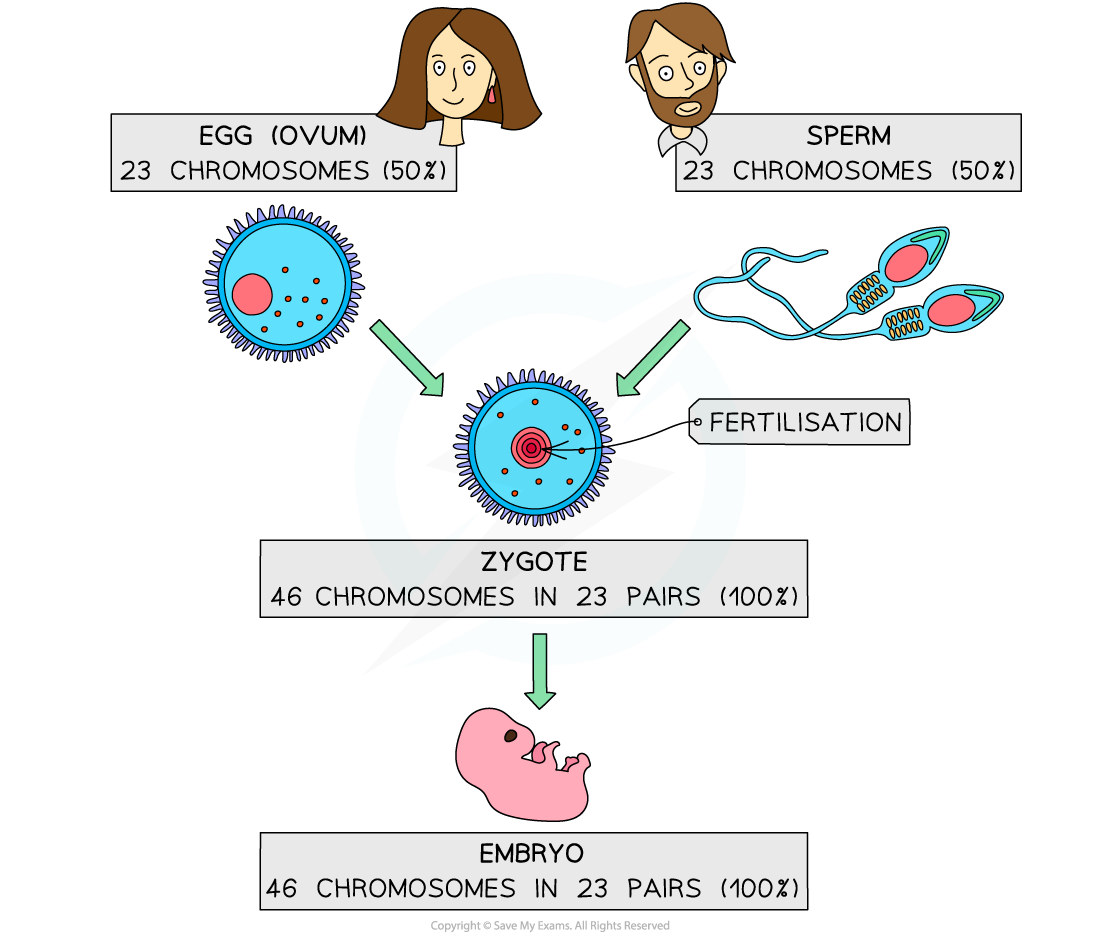
Sexual reproduction involves meiosis producing haploid gametes. At fertilisation, the haploid nuclei of two gametes fuse to form a diploid zygote. The zygote develops into a genetically different offspring.
Advantages:
- Genetic variation may allow some offspring to survive disease or environmental change.
- Variation supports adaptation of populations over generations.
Disadvantages:
- A mate is usually needed.
- Reproduction is slower and uses more energy.
- Some offspring may inherit less suitable combinations of alleles.
Sexual reproduction is useful in wild populations facing changing conditions. In crop production, variation can produce unwanted features, so farmers may prefer asexual reproduction for uniform crops.
Reproduction in flowering plants
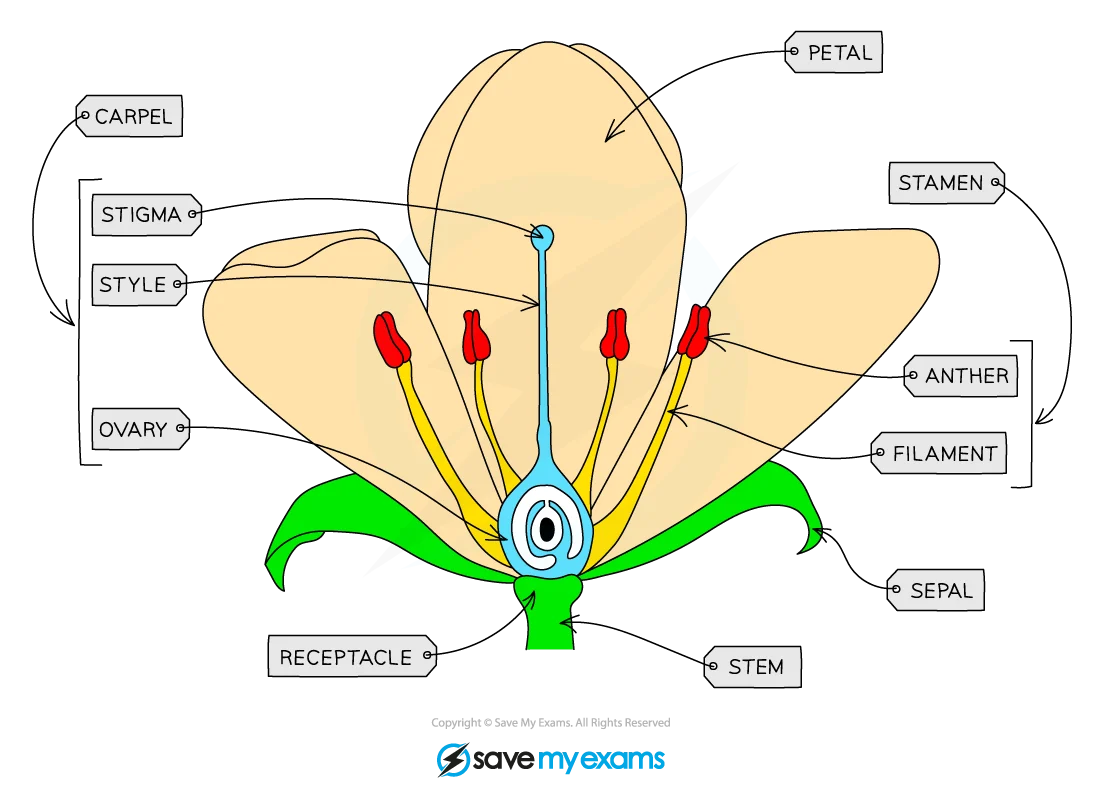
Flower structures and functions
| Structure | Function |
|---|---|
| Sepal | Protects the flower when it is a bud |
| Petal | Attracts insect pollinators |
| Stamen | Male reproductive part; made of filament and anther |
| Filament | Holds the anther in position |
| Anther | Produces pollen grains containing male nuclei |
| Carpel | Female reproductive part; made of stigma, style, and ovary |
| Stigma | Receives pollen; surface is suitable for pollen to stick |
| Style | Connects stigma to ovary; pollen tube grows through it |
| Ovary | Contains ovules |
| Ovule | Contains the female nucleus; becomes a seed after fertilisation |
Pollination is the transfer of pollen from anther to stigma. It is not fertilisation.
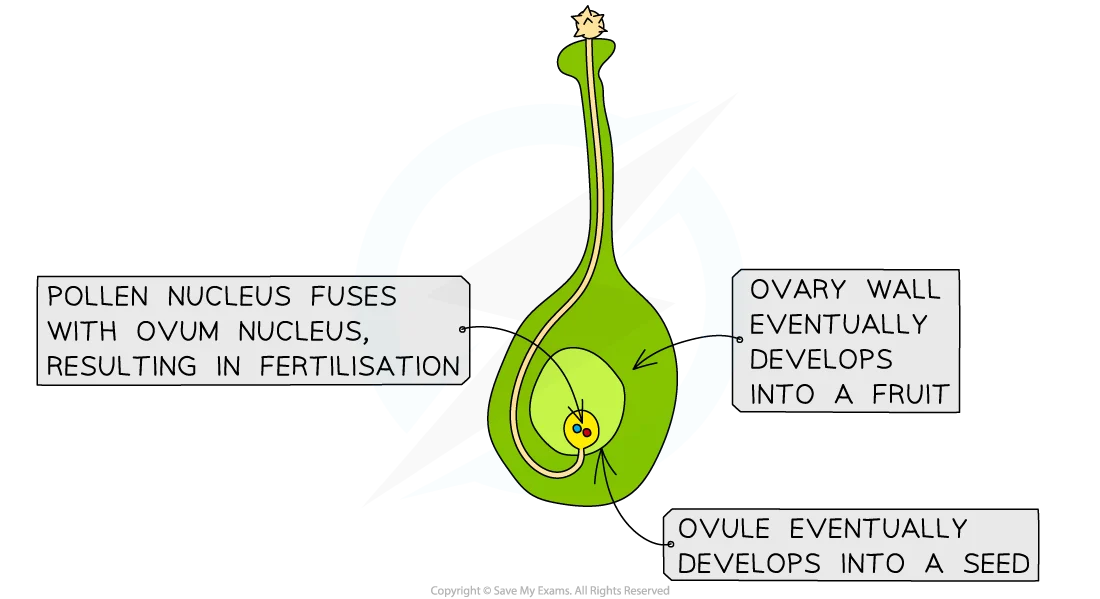
Fertilisation occurs later, when a pollen nucleus fuses with an ovule nucleus.
Self-pollination transfers pollen to the stigma of the same flower or another flower on the same plant. It is reliable when pollinators are scarce but produces less genetic variation.
Cross-pollination transfers pollen between flowers on different plants of the same species. It usually produces more genetic variation and may improve response to environmental change, but depends on pollinators or suitable wind conditions.
Insect and wind pollination
| Feature | Insect-pollinated flower | Wind-pollinated flower |
|---|---|---|
| Petals | Large or conspicuous; may attract insects | Small or absent; attraction is unnecessary |
| Pollen | Fewer grains; larger and sticky/rough so they attach to insects | Many grains; small, light, and easily carried by air |
| Anthers | Usually inside the flower | Exposed so pollen is released into air |
| Stigma | Inside flower | Exposed and often large or feathery to trap pollen |
After a pollen grain lands on a suitable stigma, it germinates. A pollen tube grows down through the style to an ovule. The male nucleus travels through the tube and fuses with the ovule nucleus. The fertilised ovule becomes a seed.
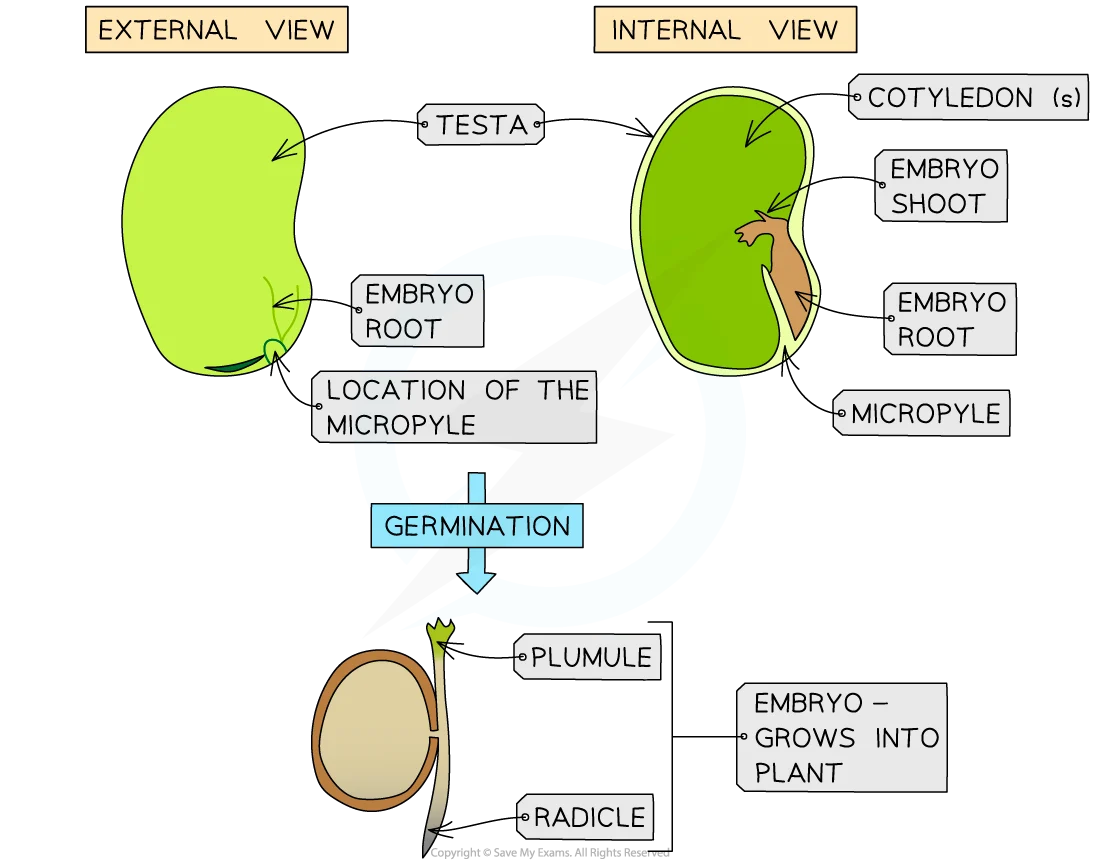
Seed germination
Germination is the beginning of growth from a seed. Seeds require:
- Water to activate enzymes and swell the seed.
- Oxygen for aerobic respiration, which releases energy for growth.
- A suitable temperature for enzyme-controlled reactions.
Human reproduction
Reproductive organs
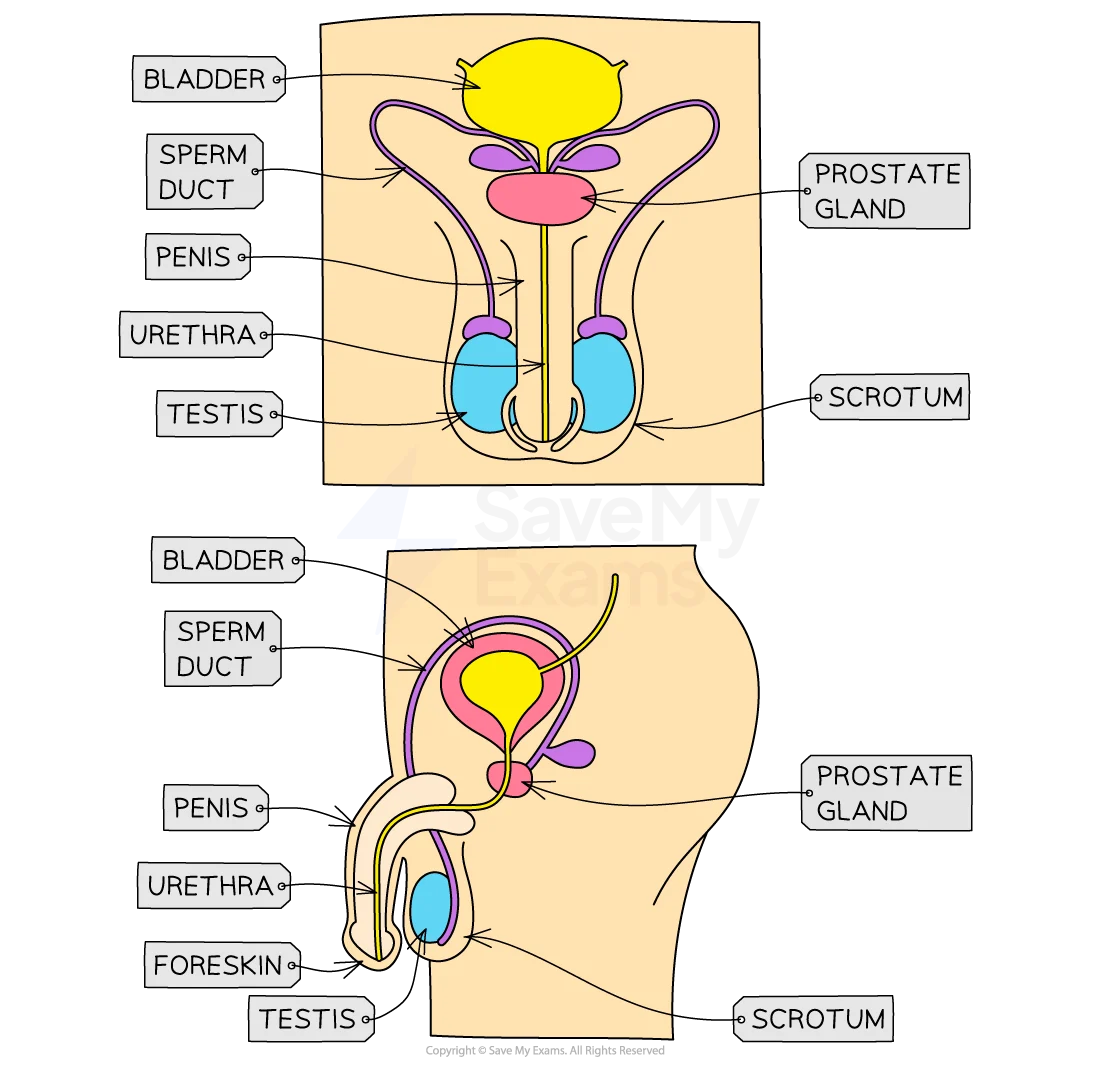
| Male structure | Function |
|---|---|
| Testes | Produce sperm and testosterone |
| Scrotum | Holds testes outside the body |
| Sperm ducts | Carry sperm from testes |
| Prostate gland | Adds fluid to sperm to form semen |
| Urethra | Carries semen and urine out of the body |
| Penis | Transfers semen into the vagina |
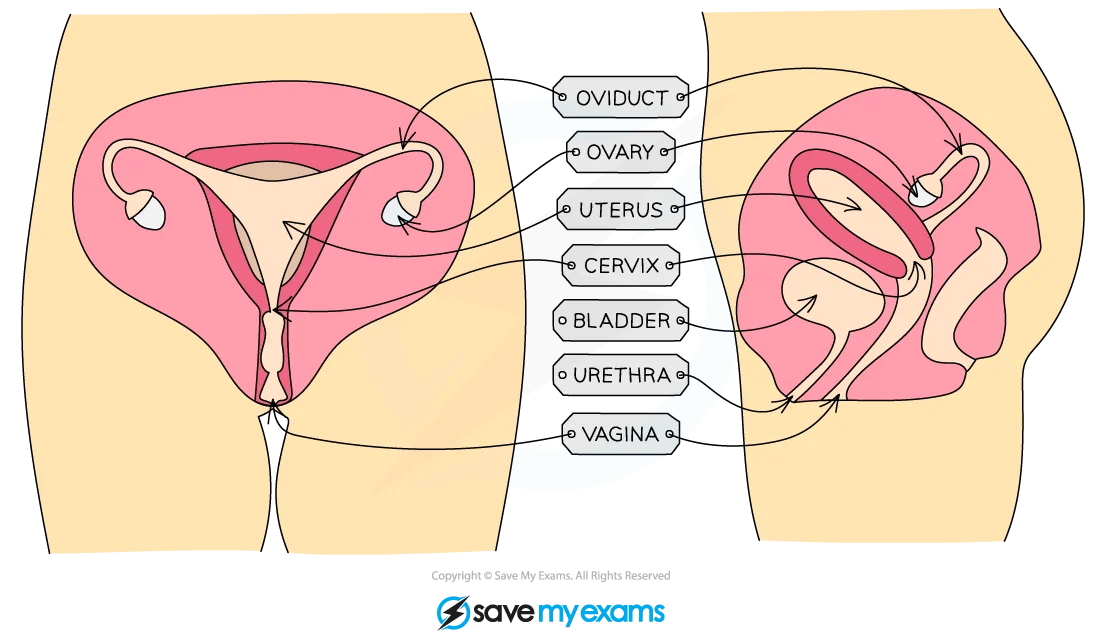
| Female structure | Function |
|---|---|
| Ovaries | Produce ova (egg cells), oestrogen, and progesterone |
| Oviducts | Carry ova; usual site of fertilisation |
| Uterus | Muscular organ where embryo develops |
| Cervix | Narrow opening between uterus and vagina |
| Vagina | Receives penis and sperm; birth canal |
Cell Adaptations
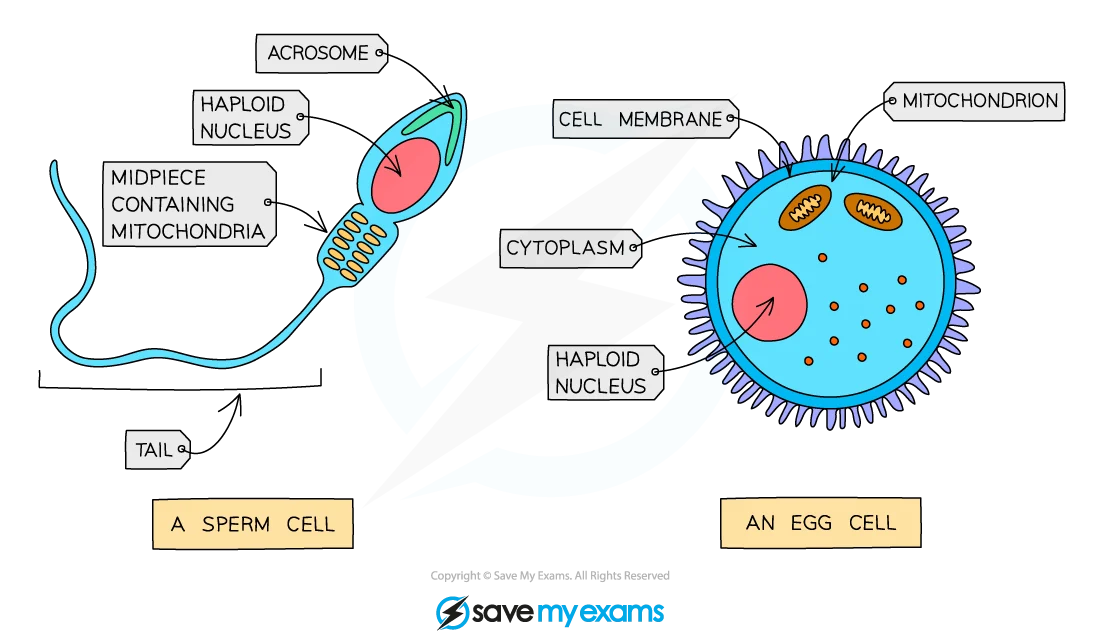
Sperm adaptations: a flagellum/tail propels the cell; many mitochondria release energy for movement; an acrosome contains enzymes that help the sperm penetrate the egg cell’s jelly coat.
Egg-cell adaptations: a large cell contains an energy store; its jelly coat changes after fertilisation to help prevent entry of additional sperm.
| Feature | Sperm cell | Egg cell |
|---|---|---|
| Size | Small | Large |
| Structure | Flagellum; acrosome; little cytoplasm | Large cytoplasm with energy store; jelly coat |
| Movement | Motile | Not actively motile |
| Number | Produced in very large numbers | Usually one released per cycle |
During human fertilisation, a sperm nucleus fuses with an egg nucleus in an oviduct. The resulting diploid zygote divides by mitosis, forms an embryo, and implants in the lining of the uterus.
Pregnancy and fetal development
The embryo develops in the uterus. The placenta is the exchange organ between maternal blood and fetal blood. It allows glucose, amino acids, oxygen, and other useful substances to pass to the fetus, and allows carbon dioxide and urea to pass to the mother for removal. Maternal and fetal blood do not normally mix directly.
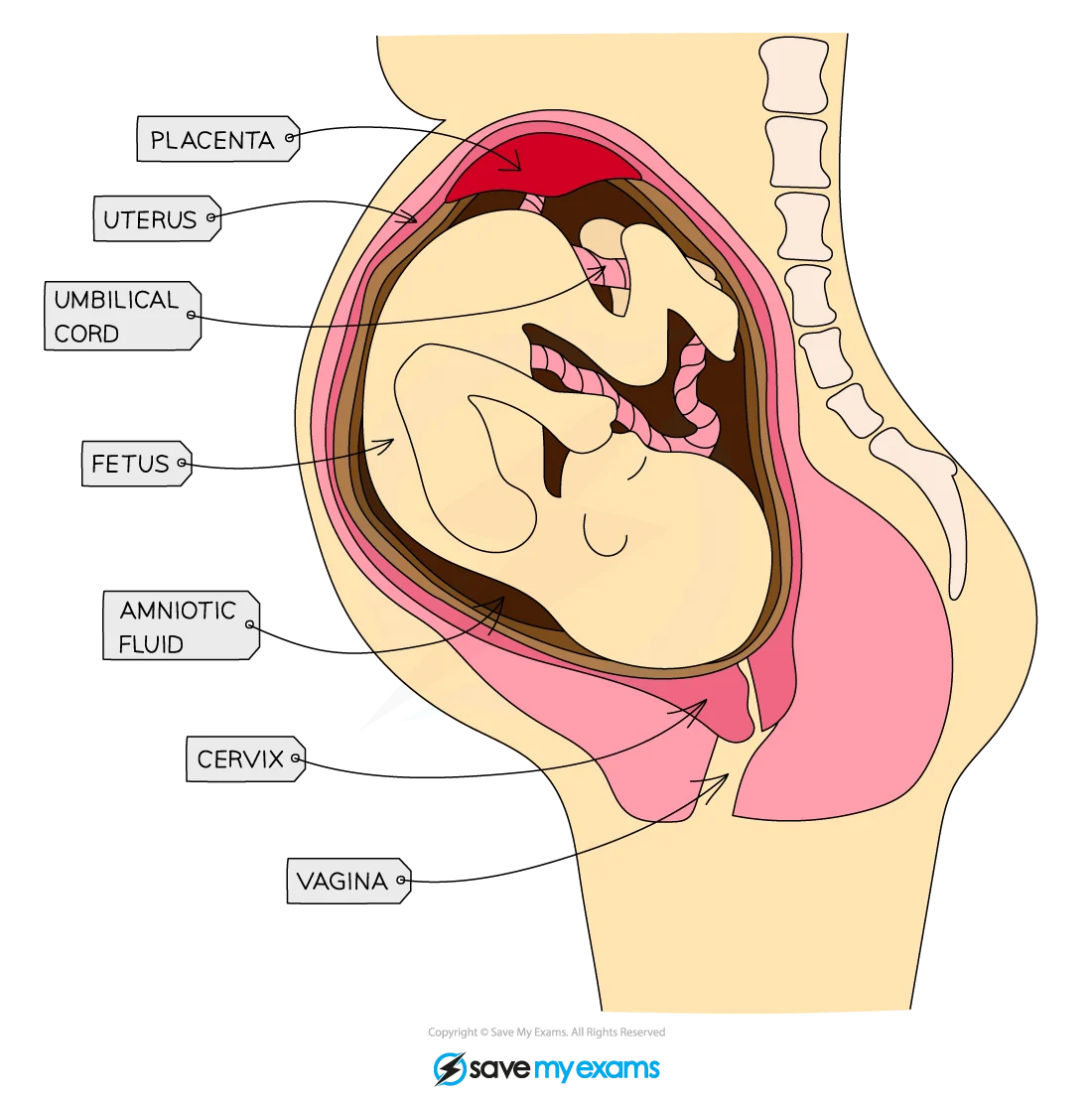
The umbilical cord connects fetus to placenta and contains blood vessels carrying substances between them. The fetus is surrounded by an amniotic sac containing amniotic fluid, which cushions it against mechanical shock. Some pathogens and toxins can cross the placenta and harm the fetus.
Puberty
Puberty is the period when a child’s body becomes sexually mature and able to reproduce. Hormones released into the blood cause changes in the reproductive organs and the development of secondary sexual characteristics. These changes prepare the body for production of gametes and, in females, for possible pregnancy.
- Testosterone, produced by the testes, stimulates sperm production and causes male secondary sexual characteristics. These include growth of the penis and testes, growth of facial and body hair, a deeper voice, and increased muscle development.
- Oestrogen, produced by the ovaries, causes female secondary sexual characteristics and helps control the menstrual cycle. These include breast development, growth of body hair, widening of the hips, and maturation of the reproductive organs. Menstruation begins when the uterus lining starts undergoing the regular changes of the menstrual cycle.
Hormones act as chemical messengers: they travel in the blood to target organs and change how cells work. This is why a small amount of hormone can coordinate changes in several parts of the body at the same time.
Menstrual cycle
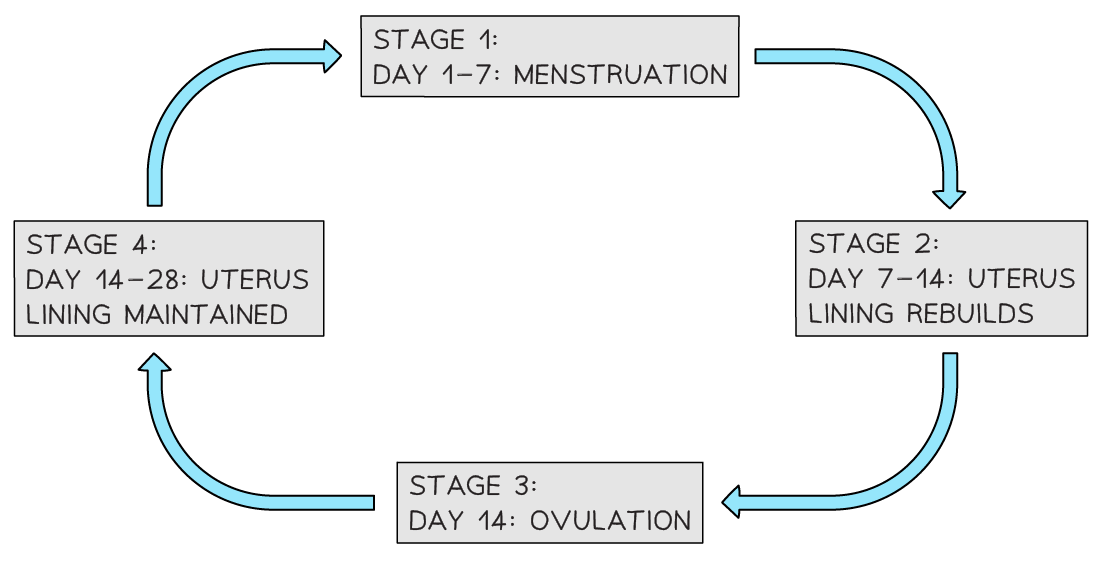
The menstrual cycle is a repeating sequence of changes in the ovaries and uterus. It prepares an egg for possible fertilisation and builds up the uterus lining so that a developing embryo can implant and receive support. If fertilisation and implantation do not occur, hormone levels fall and the lining is shed during menstruation, allowing a new cycle to begin.
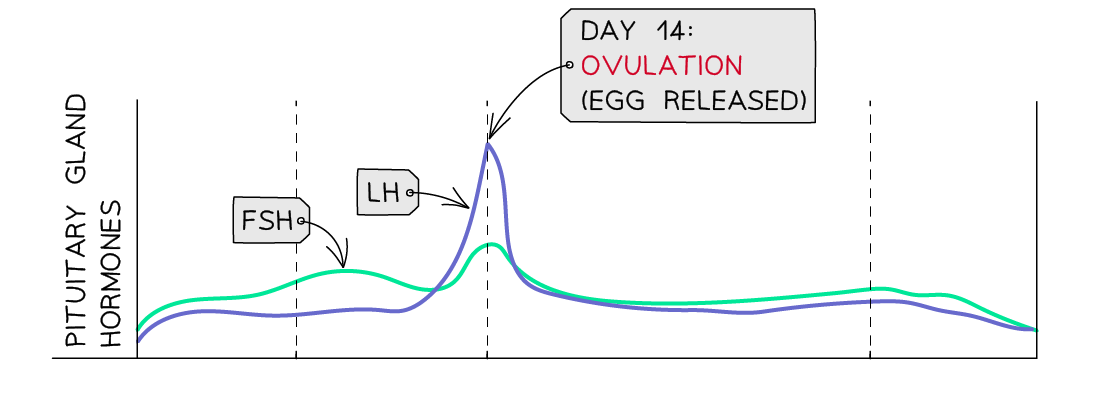
FSH (follicle-stimulating hormone) and LH (luteinising hormone) are released by the pituitary gland and act on the ovaries:
- FSH stimulates an ovarian follicle to develop. The developing follicle produces oestrogen. FSH release decreases as oestrogen concentration rises.
- LH causes ovulation when its concentration rises sharply. It also causes the remains of the follicle to develop into a structure that produces progesterone.
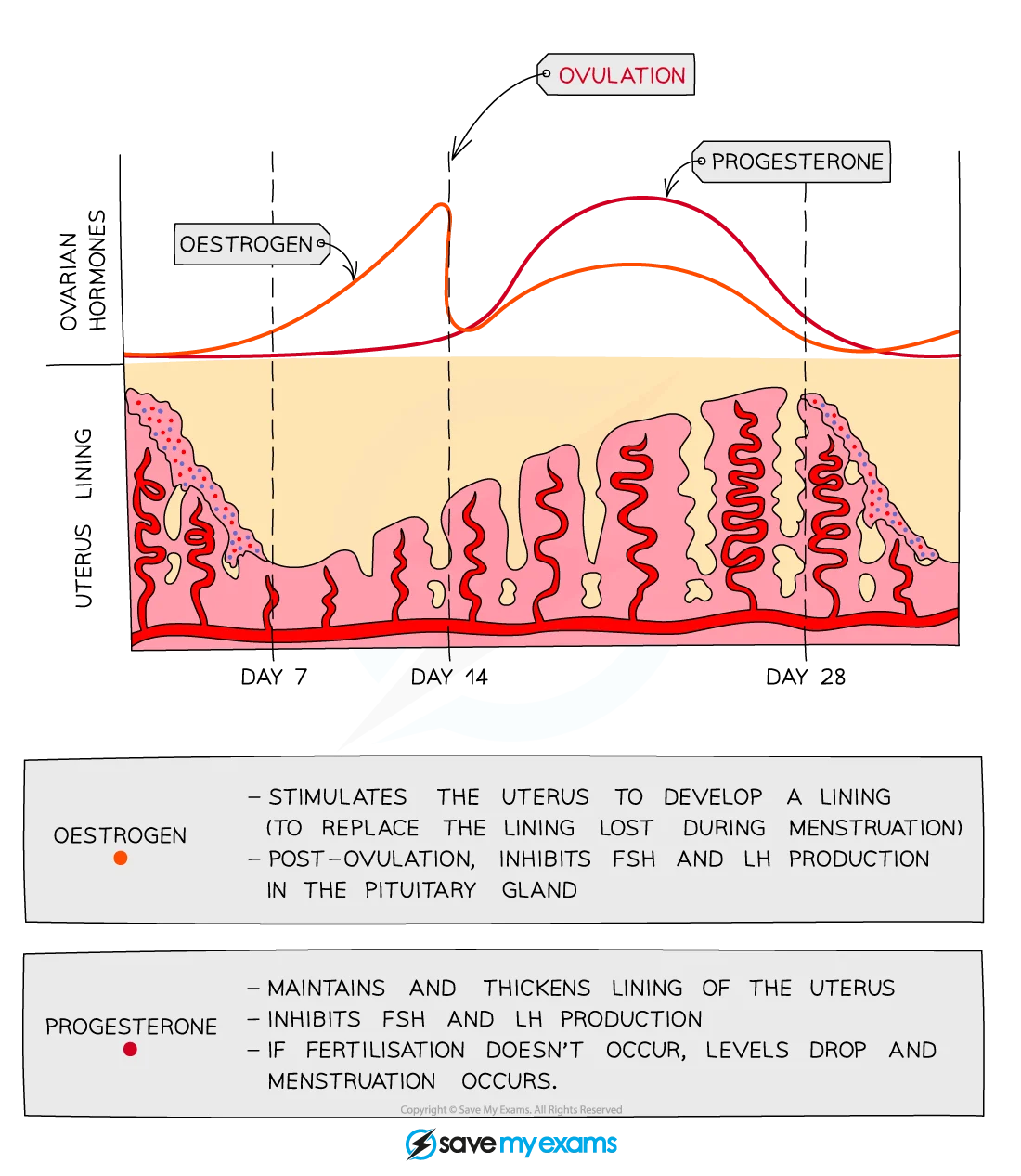
The menstrual cycle involves changes in an ovary and the uterus:
- FSH, released by the pituitary gland, stimulates an ovarian follicle to develop. The follicle produces oestrogen.
- Oestrogen causes the uterus lining to thicken after menstruation. Rising oestrogen reduces FSH release and stimulates an LH surge.
- The LH surge causes ovulation and development of the post-ovulation follicle into a progesterone-producing structure.
- The post-ovulation follicle produces progesterone, which maintains the uterus lining and inhibits FSH and LH release.
- If fertilisation does not occur, oestrogen and progesterone levels fall. The uterus lining breaks down, causing menstruation, and FSH begins another cycle.
- During pregnancy, the placenta produces progesterone and oestrogen. These maintain the uterus lining and prevent a new menstrual cycle.
Sexually transmitted infections
A sexually transmitted infection (STI) is an infection transmitted through sexual contact. HIV is an STI-causing virus; it can lead to AIDS, which weakens immune responses.
HIV can spread through unprotected sexual intercourse, infected blood, contaminated needles, or from an infected mother to her child. Spread can be controlled by:
- using condoms or avoiding sexual contact with an infected person;
- testing, tracing, and treating infections;
- screening donated blood;
- using sterile needles and never sharing needles; and
- reducing transmission from mother to child through medical care.
Key terms
| Term | Meaning |
|---|---|
| Asexual reproduction | Production of genetically identical offspring from one parent |
| Sexual reproduction | Fusion of gamete nuclei producing genetically different offspring |
| Gamete | Haploid sex cell, such as sperm or egg |
| Zygote | Diploid cell formed at fertilisation |
| Pollination | Transfer of pollen from anther to stigma |
| Fertilisation | Fusion of nuclei from gametes |
| Haploid | Having one set of chromosomes |
| Diploid | Having two sets of chromosomes |
| STI | Infection transmitted through sexual contact |