Solids, liquids and gases
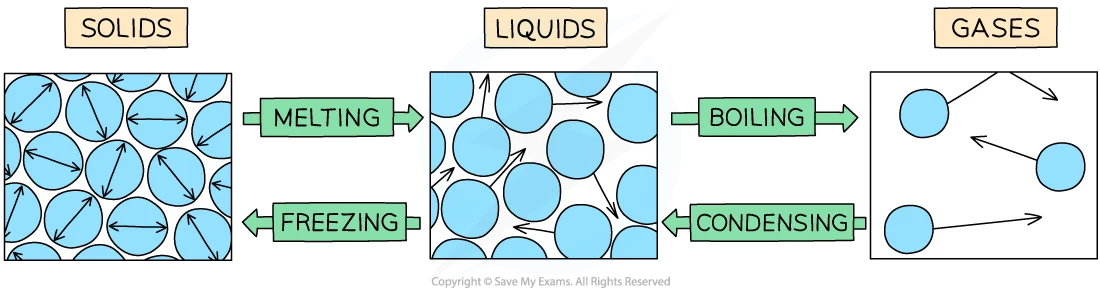
| State | Arrangement and separation | Motion | Macroscopic properties |
|---|---|---|---|
| Solid | Particles closely packed in a regular arrangement | Vibrate about fixed positions | Fixed shape and volume; almost incompressible |
| Liquid | Particles close together in an irregular arrangement | Move and slide past one another | Fixed volume; takes container shape; almost incompressible |
| Gas | Particles far apart in a random arrangement | Move rapidly and randomly in all directions | No fixed shape or volume; easily compressed; low density |
These descriptions apply to particles, not necessarily individual atoms. A particle may be an atom, molecule, or ion.
Changes of state
- Melting: $\text{solid} \rightarrow \text{liquid}$.
- Boiling: $\text{liquid} \rightarrow \text{gas}$ throughout the liquid at its boiling point.
- Evaporation: $\text{liquid} \rightarrow \text{gas}$ at the surface, below the boiling point.
- Freezing: $\text{liquid} \rightarrow \text{solid}$.
- Condensation: $\text{gas} \rightarrow \text{liquid}$.
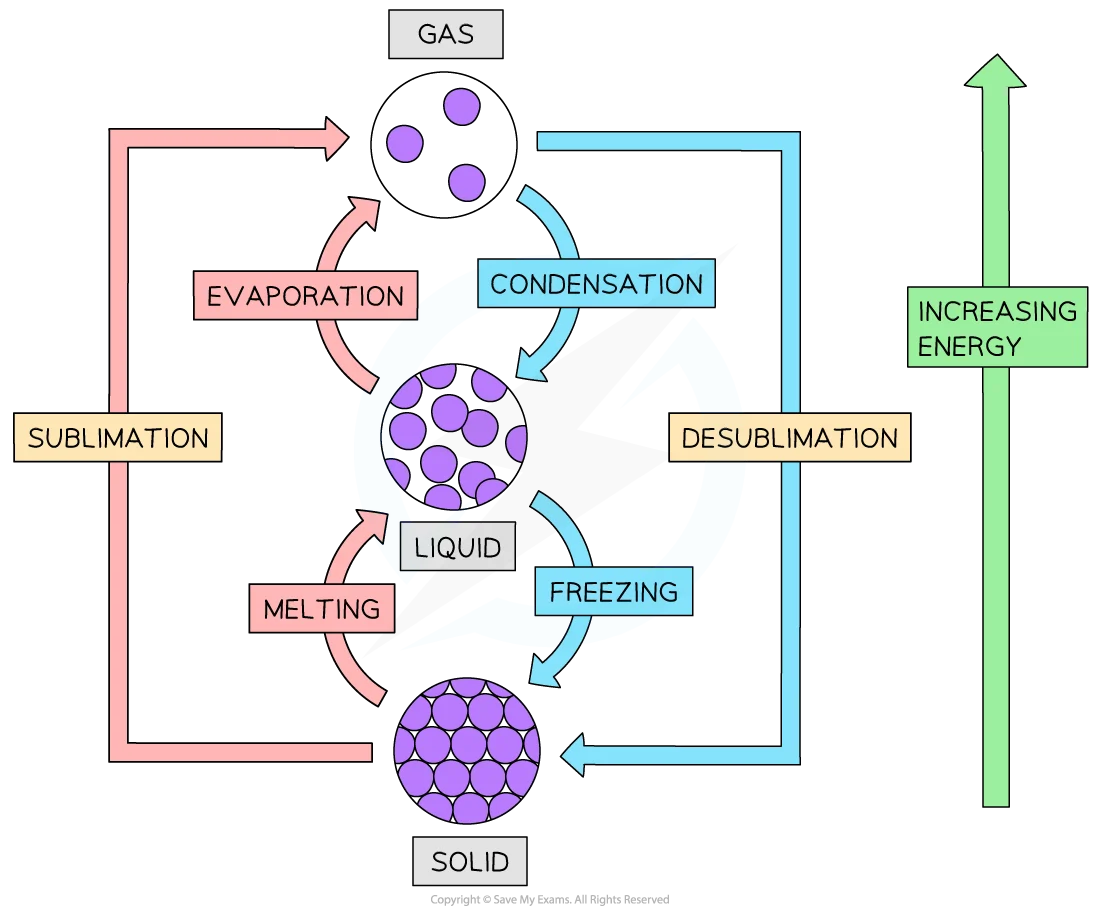
During heating, particles gain kinetic energy until attractions between particles are overcome. During cooling, particles lose kinetic energy and attractions bring them closer together. The covalent bonds inside molecules are not broken during an ordinary change of state.
On a heating or cooling curve, temperature stays constant during melting, boiling, freezing, or condensation. Energy supplied during melting or boiling is used to overcome attractions rather than increase average kinetic energy. During freezing or condensation, energy is released as attractions form.
Gases: temperature, pressure and volume
At constant pressure, increasing temperature increases particle kinetic energy. Particles move faster and hit the container walls more often and harder. The gas expands until its pressure returns to the fixed value. In kelvin units, this is represented by $V \propto T$.
At constant temperature, increasing pressure pushes particles into a smaller volume. The particles are closer together, so collisions with the container walls occur more frequently. This is represented by $V \propto \frac{1}{P}$.
Always convert Celsius to kelvin before comparing gas temperatures:
$$T(\mathrm K)=T(^\circ\mathrm C)+273$$
Worked example. A gas has volume $200\ \mathrm{cm^3}$ at constant pressure and its kelvin temperature doubles. Its volume also doubles:
$$V_2 = 200 \times 2 = 400\ \mathrm{cm^3}$$
A change from $20\ ^\circ\mathrm C$ to $40\ ^\circ\mathrm C$ does not double the volume because the temperatures are $293\ \mathrm K$ and $313\ \mathrm K$. The volume ratio is $313/293$.
Diffusion
Diffusion is the net movement of particles from a region of higher concentration to a region of lower concentration. It occurs because particles move constantly and randomly. Diffusion continues until particles are evenly distributed.
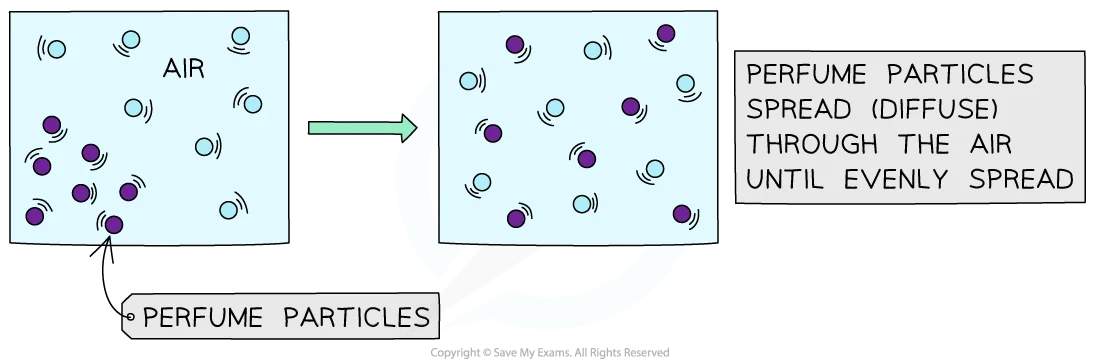
Higher temperature increases diffusion rate because particles have greater kinetic energy. At the same temperature, lighter particles have a greater average speed than heavier particles, so they spread through a space faster.
A gas with lower relative molecular mass diffuses faster than a gas with higher relative molecular mass. For example, ammonia, $M_r = 17$, diffuses faster than hydrogen chloride, $M_r = 36.5$.