Electrolysis
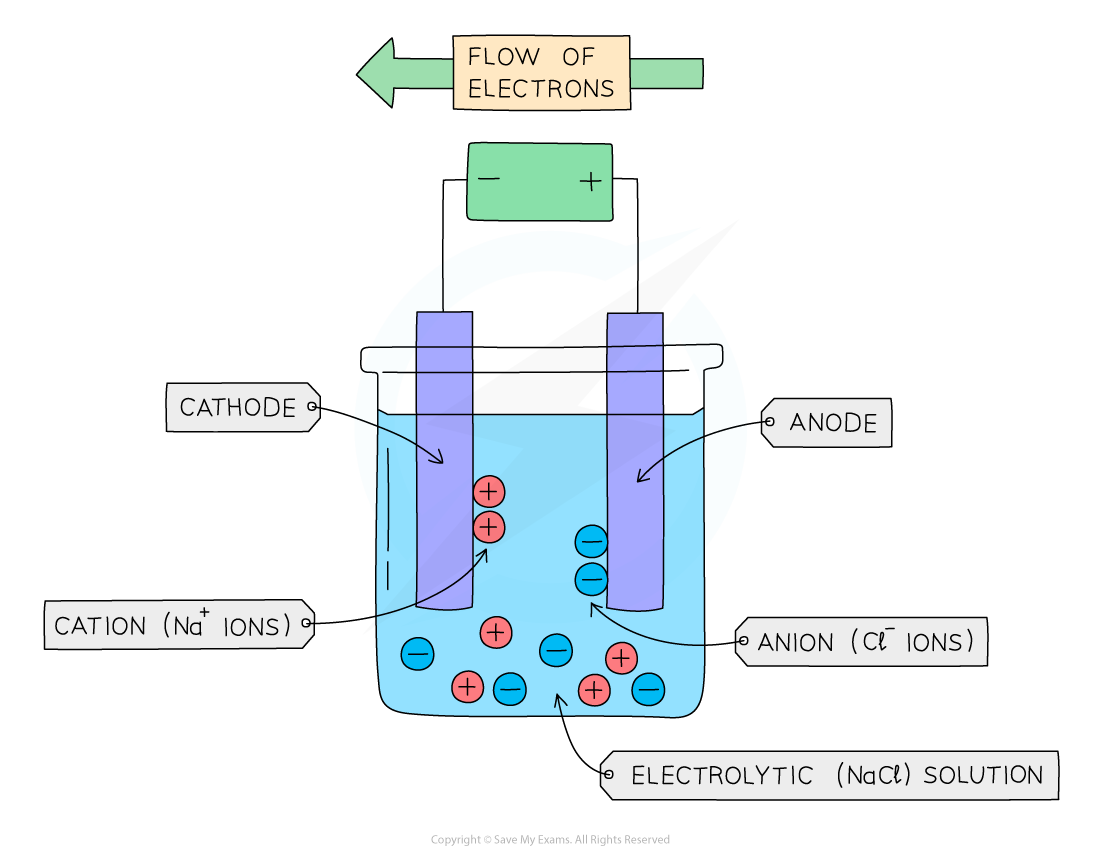
Electrolysis is the decomposition of an ionic compound, molten or aqueous, by an electric current. The electrolyte contains mobile ions.
- Cathode: negative electrode in an electrolytic cell; reduction occurs.
- Anode: positive electrode in an electrolytic cell; oxidation occurs.
- Cations move to the cathode and gain electrons.
- Anions move to the anode and lose electrons.
- In general, a metal or hydrogen forms at the cathode; a non-metal other than hydrogen forms at the anode.
- Electrons move through the external circuit; ions move through the electrolyte.
Core examples
Molten lead(II) bromide
Ions present are $\mathrm{Pb^{2+}}$ and $\mathrm{Br^-}$. At the cathode, grey lead forms:
$$\mathrm{Pb^{2+}+2e^- \rightarrow Pb}$$
At the anode, reddish-brown bromine gas forms:
$$\mathrm{2Br^- \rightarrow Br_2+2e^-}$$
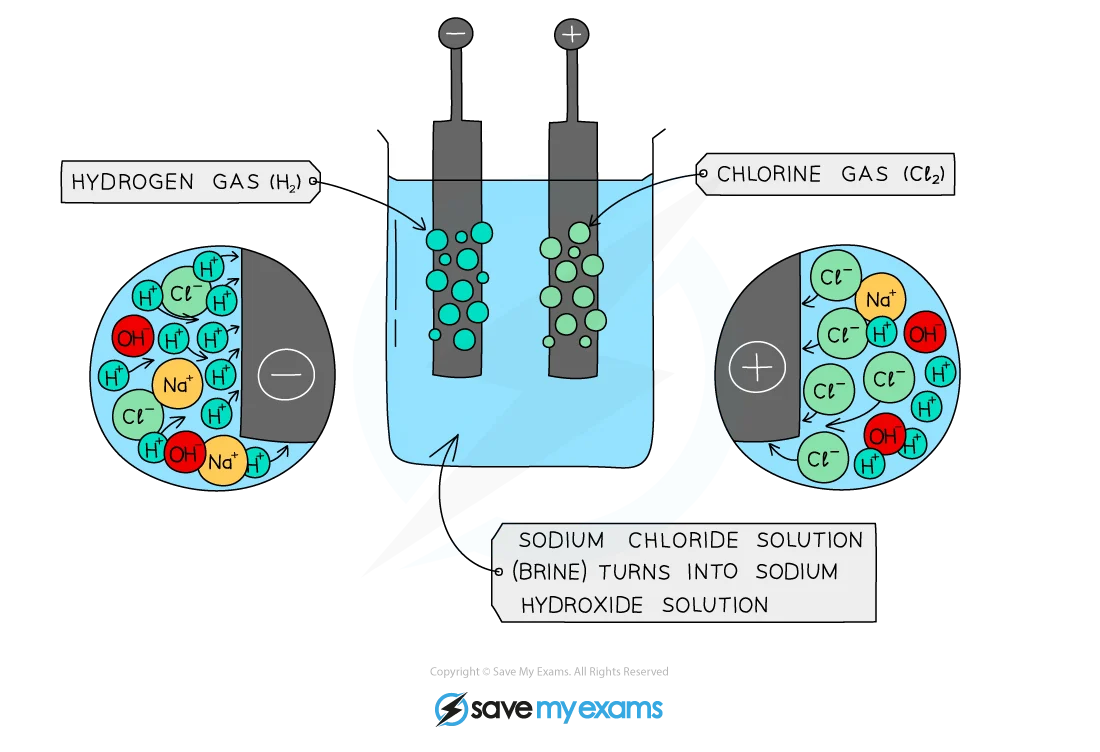
Concentrated aqueous sodium chloride
At the cathode, hydrogen bubbles form:
$$\mathrm{2H^+ +2e^- \rightarrow H_2}$$
At the anode, pale green chlorine gas forms and bleaches damp litmus:
$$\mathrm{2Cl^- \rightarrow Cl_2+2e^-}$$
In aqueous solutions, the ions from water must also be considered. In a molten binary compound, only the ions from the compound are present.
Electroplating
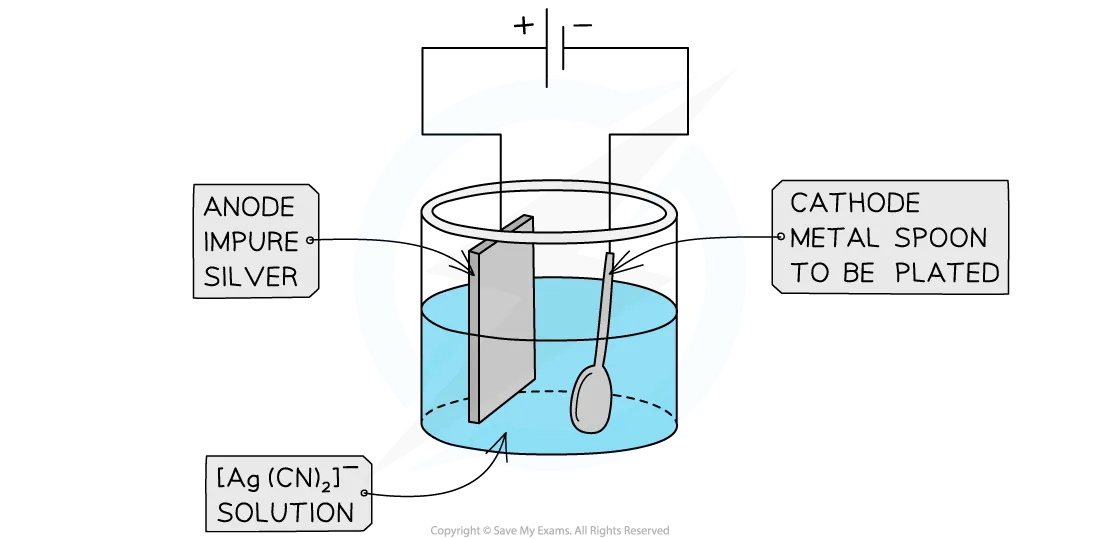
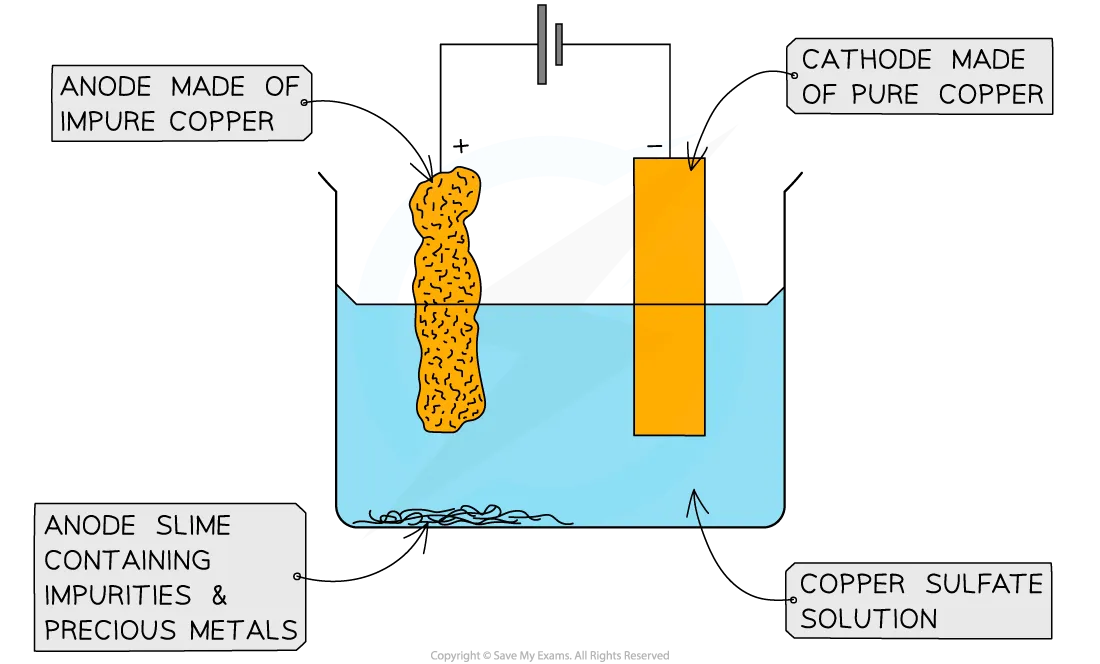
Electroplating improves appearance and protects against corrosion. The object is the cathode, the plating metal is the anode, and the electrolyte is a soluble salt of the plating metal. Metal ions gain electrons at the object:
$$\mathrm{M^{n+}+ne^- \rightarrow M}$$
The anode dissolves to replace metal ions in solution.
Aqueous copper(II) sulfate
With inert graphite electrodes:
- Cathode: copper forms as a pink-brown coating.
$$\mathrm{Cu^{2+}+2e^- \rightarrow Cu}$$
- Anode: oxygen bubbles form.
$$\mathrm{2H_2O \rightarrow O_2+4H^+ +4e^-}$$
The blue solution becomes paler as copper(II) ions are removed.
With copper electrodes:
- Cathode: copper is deposited.
- Anode: copper dissolves.
$$\mathrm{Cu \rightarrow Cu^{2+}+2e^-}$$
Copper transfers from anode to cathode, so the solution remains approximately the same concentration.
Aqueous halides
For an aqueous halide solution with inert electrodes:
| Solution | Cathode product and observation | Anode product and observation |
|---|---|---|
| Concentrated chloride, bromide, or iodide | Hydrogen bubbles; hydrogen gives a squeaky pop | Halogen forms: chlorine is pale green and bleaches damp litmus; bromine is red-brown; iodine gives a brown solution or purple vapour |
| Dilute chloride, bromide, or iodide | Hydrogen bubbles; hydrogen gives a squeaky pop | Oxygen bubbles; oxygen relights a glowing splint |
In a concentrated solution of a halide, the halide ion is usually discharged at the anode:
$$\mathrm{2X^- \rightarrow X_2+2e^-}$$
In a dilute solution, hydroxide ions are discharged and oxygen forms:
$$\mathrm{4OH^- \rightarrow O_2+2H_2O+4e^-}$$
At the cathode, water or hydrogen ions are reduced to hydrogen. The equation $\mathrm{2H^+ +2e^- \rightarrow H_2}$ represents this hydrogen formation in the aqueous solution.
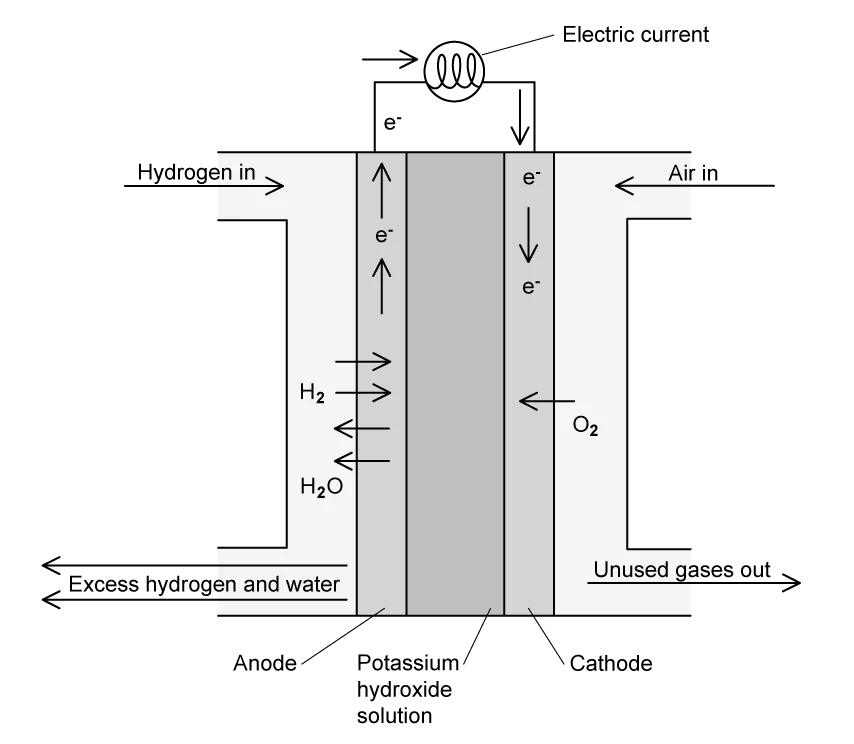
Hydrogen–oxygen fuel cells
A hydrogen–oxygen fuel cell produces electricity from hydrogen and oxygen. Its only chemical product at the cell is water:
$$\mathrm{2H_2+O_2 \rightarrow 2H_2O}$$
| Feature | Hydrogen–oxygen fuel cell | Gasoline engine |
|---|---|---|
| Products at point of use | Water only | Carbon dioxide, carbon monoxide, nitrogen oxides, and particulates may form |
| Efficiency | Generally higher | Lower because much energy is lost as heat |
| Fuel storage | Hydrogen is difficult to store safely | Liquid gasoline is easier to store |
| Infrastructure | Fewer refuelling stations | Extensive existing network |
| Environmental issue | Hydrogen production may cause pollution | Fossil-fuel use produces greenhouse gases and pollutants |
Fuel cells therefore have clean point-of-use products and potential efficiency advantages, but storage, cost, infrastructure, and hydrogen production remain disadvantages.