Formulae and equations
A molecular formula gives the actual number of atoms in one molecule. A formula for an ionic compound gives the simplest whole-number ratio of ions. Formulae can be deduced from models, diagrams, or ion charges.
To deduce an ionic formula, balance total positive and negative charge. For example, $\mathrm{Mg^{2+}}$ needs two $\mathrm{Cl^-}$ ions, giving $\mathrm{MgCl_2}$. Two $\mathrm{Al^{3+}}$ ions and three $\mathrm{O^{2-}}$ ions give $\mathrm{Al_2O_3}$.
Common elemental formulae include $\mathrm{H_2}$, $\mathrm{N_2}$, $\mathrm{O_2}$, $\mathrm{F_2}$, $\mathrm{Cl_2}$, $\mathrm{Br_2}$, and $\mathrm{I_2}$. The noble gases are monatomic.
Word and symbol equations must be balanced and include state symbols: $(s)$ solid, $(l)$ liquid, $(g)$ gas, and $(aq)$ aqueous solution.
Example:
$$\mathrm{Mg(s)+2HCl(aq) \rightarrow MgCl_2(aq)+H_2(g)}$$
An ionic equation includes only particles that change. For precipitation:
$$\mathrm{Ag^+(aq)+Cl^-(aq) \rightarrow AgCl(s)}$$
Relative masses
$A_r$ is the weighted mean mass of an atom relative to one-twelfth of a carbon-12 atom. $M_r$ is the sum of the relative atomic masses in a molecule. Relative formula mass is used for ionic compounds.
Worked example.
$$M_r(\mathrm{CaCO_3})=40.1+12.0+(3 \times 16.0)=100.1$$
Moles and particles
The mole is the unit for amount of substance. The Avogadro constant is $6.02 \times 10^{23}\ \mathrm{mol^{-1}}$.
$$n=\frac{m}{M}$$
$$m=nM$$
$$N=n \times 6.02 \times 10^{23}$$
where $n$ is amount in moles, $m$ is mass in grams, and $M$ is molar mass in $\mathrm{g,mol^{-1}}$.
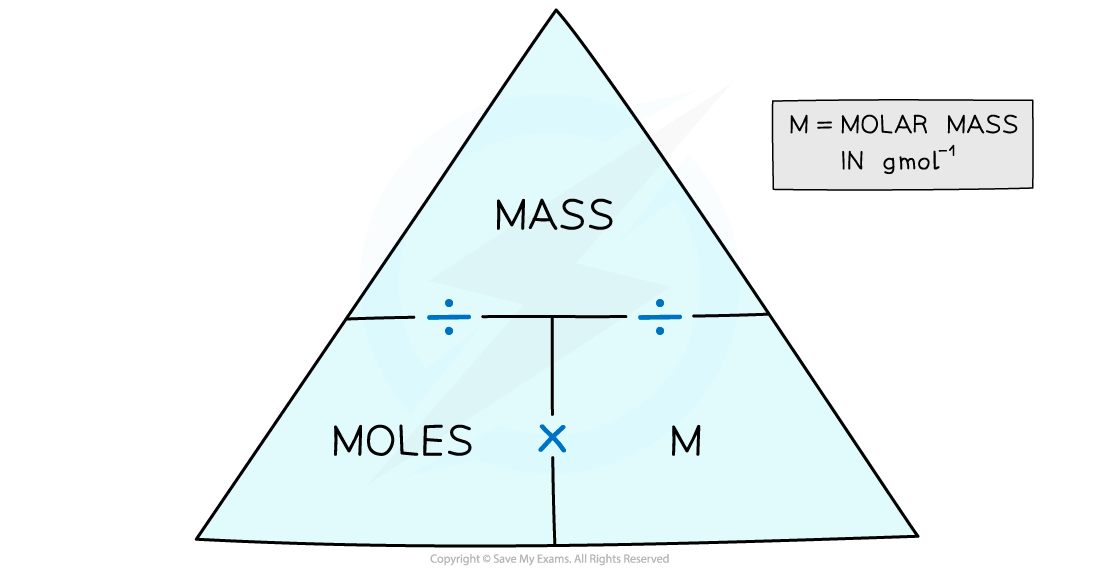
Worked example. Find the amount of substance in $5.85\ \mathrm{g}$ of sodium chloride. $M(\mathrm{NaCl})=58.5\ \mathrm{g,mol^{-1}}$.
$$n=\frac{5.85}{58.5}=0.100\ \mathrm{mol}$$
The number of formula units is:
$$N=0.100 \times 6.02 \times 10^{23}=6.02 \times 10^{22}$$
Reacting masses and limiting reactants
Use the balanced equation to obtain the mole ratio. Convert the known quantity to moles, apply the ratio, then convert to the requested quantity.
Worked example.
$$\mathrm{CaCO_3 \rightarrow CaO+CO_2}$$
One mole of calcium carbonate produces one mole of carbon dioxide. $10.0\ \mathrm{g}$ of calcium carbonate gives:
$$n(\mathrm{CaCO_3})=\frac{10.0}{100.1}=0.0999\ \mathrm{mol}$$
Therefore $n(\mathrm{CO_2})=0.0999\ \mathrm{mol}$ and, at r.t.p.:
$$V=0.0999 \times 24=2.40\ \mathrm{dm^3}$$
For a limiting-reactant question, calculate the possible product from each reactant. The reactant producing the smaller amount is the limiting reactant.
Worked limiting-reactant example.
$$\mathrm{N_2+3H_2 \rightarrow 2NH_3}$$
Suppose $1.00\ \mathrm{mol}$ of $\mathrm{N_2}$ reacts with $2.00\ \mathrm{mol}$ of $\mathrm{H_2}$. The nitrogen could produce $2.00\ \mathrm{mol}$ of ammonia, but the hydrogen could produce only:
$$2.00 \times \frac{2}{3}=1.33\ \mathrm{mol\ NH_3}$$
Hydrogen is limiting. It produces $1.33\ \mathrm{mol}$ of ammonia, while $1.00-2.00/3=0.333\ \mathrm{mol}$ of nitrogen remains.
Gas volumes and concentration
At room temperature and pressure, one mole of gas occupies $24\ \mathrm{dm^3}$.
$$V=n \times 24$$
For solutions:
$$c=\frac{n}{V}$$
where $c$ is in $\mathrm{mol,dm^{-3}}$ and $V$ is in $\mathrm{dm^3}$. Mass concentration is measured in $\mathrm{g,dm^{-3}}$.
$$c_{\mathrm{mol}}=\frac{c_{\mathrm{g}}}{M}$$
Always convert $\mathrm{cm^3}$ to $\mathrm{dm^3}$ by dividing by $1000$.
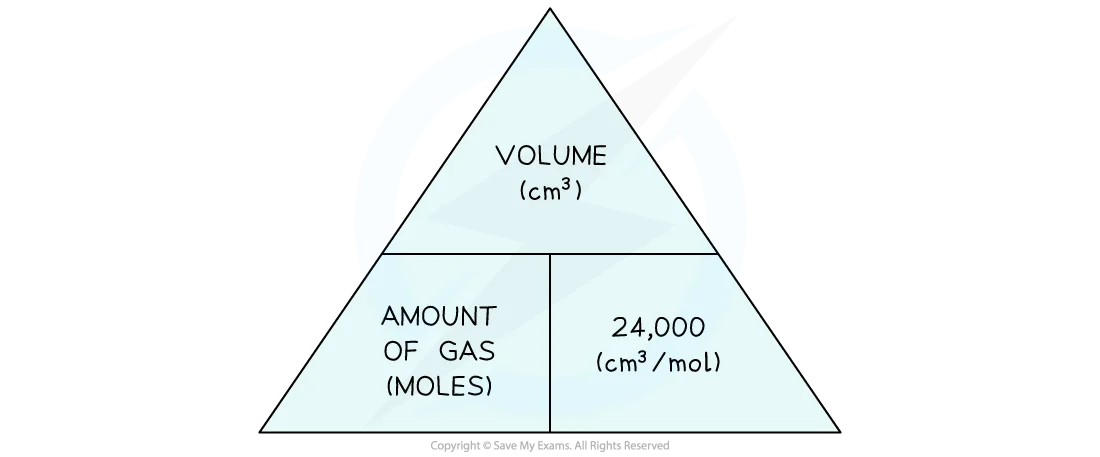
Worked molar-concentration example. $0.0200\ \mathrm{mol}$ dissolved in $250\ \mathrm{cm^3}=0.250\ \mathrm{dm^3}$ gives:
$$c=\frac{0.0200}{0.250}=0.0800\ \mathrm{mol,dm^{-3}}$$
Worked mass-concentration example. $5.00\ \mathrm{g}$ of sodium chloride in $250\ \mathrm{cm^3}=0.250\ \mathrm{dm^3}$ gives:
$$c=\frac{5.00}{0.250}=20.0\ \mathrm{g,dm^{-3}}$$
Its molar concentration is:
$$\frac{20.0}{58.5}=0.342\ \mathrm{mol,dm^{-3}}$$
Titrations
Use a volumetric pipette to transfer a known volume, add indicator, and deliver the other solution from a burette. Repeat until your results are consistent. Use the balanced equation to find the moles.
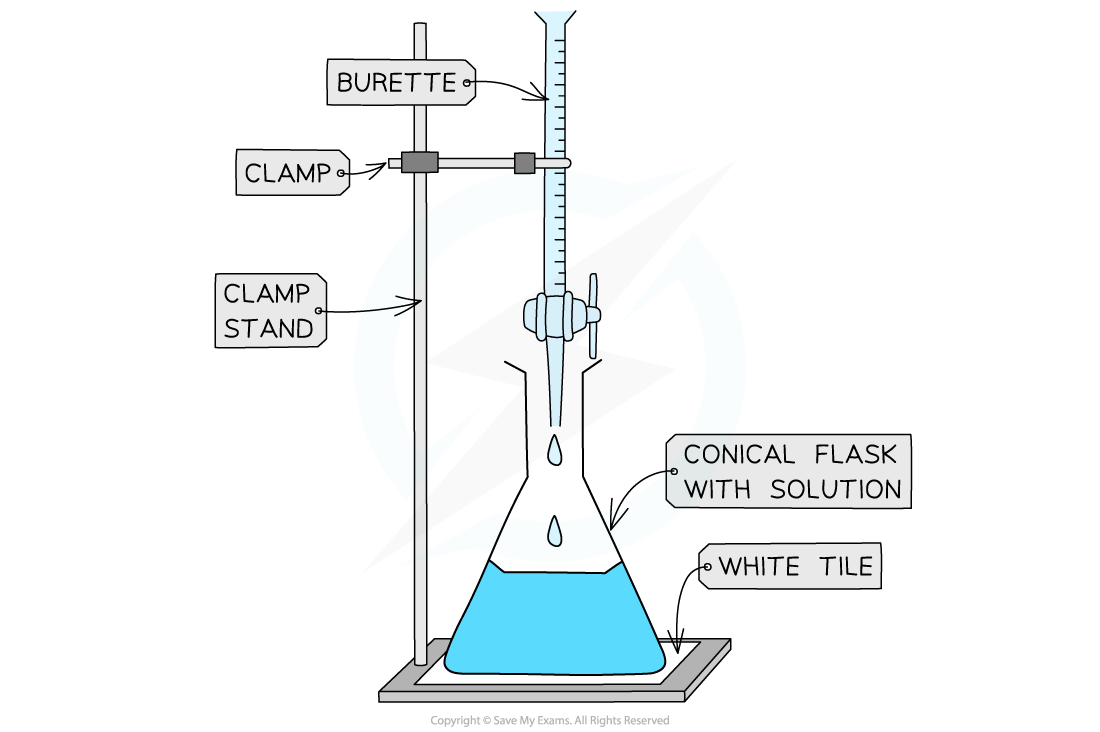
Worked example. $25.0\ \mathrm{cm^3}$ of sodium hydroxide reacts with $20.0\ \mathrm{cm^3}$ of $0.100\ \mathrm{mol,dm^{-3}}$ hydrochloric acid:
$$\mathrm{HCl+NaOH \rightarrow NaCl+H_2O}$$
$$n(\mathrm{HCl})=0.100 \times 0.0200=0.00200\ \mathrm{mol}$$
The ratio is $1:1$, so $n(\mathrm{NaOH})=0.00200\ \mathrm{mol}$.
$$c(\mathrm{NaOH})=\frac{0.00200}{0.0250}=0.0800\ \mathrm{mol,dm^{-3}}$$
Empirical and molecular formulae
For an empirical formula:
- convert each mass or percentage to moles
- divide by the smallest value
- multiply to obtain whole numbers.
For a molecular formula, divide the actual $M_r$ by the empirical-formula mass then multiply all the numbers in the formula by that whole number.
Empirical and molecular formula worked example
A compound contains $40.0\%$ carbon, $6.7\%$ hydrogen, and $53.3\%$ oxygen. Assume a $100\ \mathrm{g}$ sample:
$$n(\mathrm C)=\frac{40.0}{12.0}=3.33,\quad n(\mathrm H)=\frac{6.7}{1.0}=6.7,\quad n(\mathrm O)=\frac{53.3}{16.0}=3.33$$
Divide by the smallest value, $3.33$, to obtain the ratio $1:2:1$.
The empirical formula is $\mathrm{CH_2O}$.
If the compound has $M_r=180$, and $M_r(\mathrm{CH_2O})=30$, the multiplier is $180/30=6$, so the molecular formula is $\mathrm{C_6H_{12}O_6}$.
Yield, composition and purity
$$\text{percentage yield}=\frac{\text{actual yield}}{\text{theoretical yield}} \times 100$$
$$\text{percentage composition}=\frac{\text{mass of element in one formula unit}}{M_r} \times 100$$
$$\text{percentage purity}=\frac{\text{mass of pure substance}}{\text{mass of sample}} \times 100$$
Worked examples. If $8.0\ \mathrm{g}$ of pure product is obtained when the theoretical yield is $10.0\ \mathrm{g}$:
$$\text{percentage yield}=\frac{8.0}{10.0} \times 100=80%$$
For calcium carbonate, $M_r=100.1$ and the calcium contribution is $40.1$:
$$\text{percentage calcium}=\frac{40.1}{100.1} \times 100=40.1%$$
If an impure $8.0\ \mathrm{g}$ sample contains $6.4\ \mathrm{g}$ of the pure substance:
$$\text{percentage purity}=\frac{6.4}{8.0} \times 100=80%$$
Show units at every stage and round only at the final answer.