Scatter Diagrams and Correlation
1. Bivariate Data
Bivariate data consists of pairs of values for two different variables recorded for the same subject.
- Example: Height and weight of students.
- The goal is to determine if there is a relationship (correlation) between the two variables.
2. Scatter Diagrams
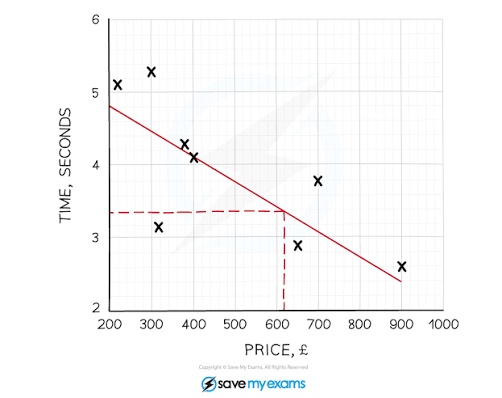
A scatter diagram plots bivariate data on a Cartesian plane.
- X-axis: Independent variable.
- Y-axis: Dependent variable.
- Each pair $(x, y)$ is plotted as a single point.

3. Correlation
Correlation describes the strength and direction of the relationship between variables.
Types of Correlation
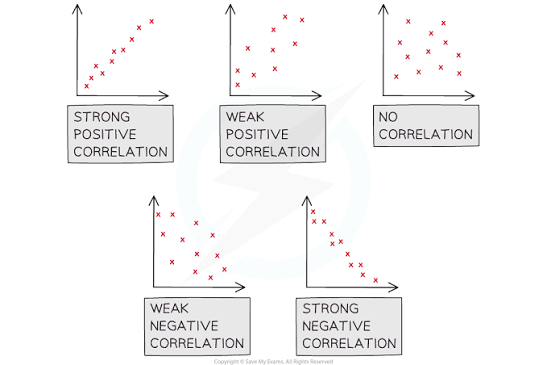
- Positive Correlation: As $x$ increases, $y$ tends to increase. Points trend upwards from left to right.
- Negative Correlation: As $x$ increases, $y$ tends to decrease. Points trend downwards from left to right.
- Zero Correlation: No apparent relationship between $x$ and $y$. Points are scattered randomly.
Strength
- Strong: Points lie very close to a straight line.
- Weak: Points are widely spread but still show a general trend.
4. Line of Best Fit
A line of best fit is a straight line drawn through the center of the data points to represent the overall trend.
Drawing the Line
- The line should have roughly an equal number of points above and below it.
- It should follow the direction of the correlation.
Using the Line for Predictions (Interpolation and Extrapolation)
- Interpolation: Estimating a value within the range of the data set. Generally more reliable.
- Extrapolation: Estimating a value outside the range of the data set. Less reliable as the trend may change.
Process:
- Find the $x$-value on the axis.
- Move vertically to the line of best fit.
- Move horizontally to the $y$-axis to read the predicted value.