Energy, Work and Power
Energy stores and transfers
Energy stores are kinetic, gravitational potential, chemical, elastic, nuclear, electrostatic, and internal (thermal). Energy is transferred between stores by:
- mechanical work;
- electrical work;
- heating;
- waves, including light and sound.
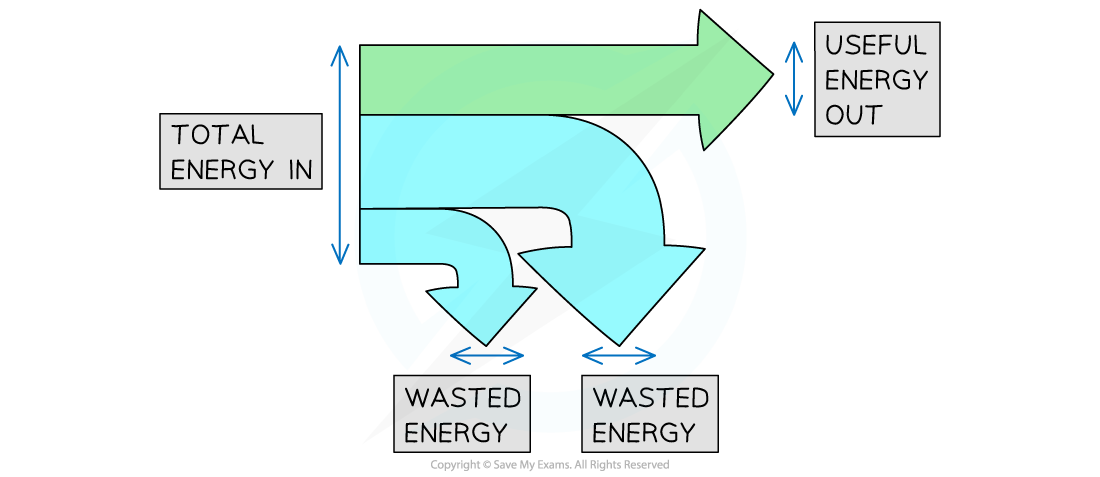
Energy is conserved: it is not created or destroyed. Use a flow diagram to show the starting store, useful output, and wasted transfers. A Sankey diagram shows the relative sizes of useful and wasted energy transfers.
Kinetic and Gravitational Potential Energy formulae:
$$ E_k=\frac12mv^2,\qquad \Delta E_p=mg\Delta h $$
Worked examples:
A 2.0 kg object falls through 5.0 m.
Its gravitational potential energy decrease is $2.0\times9.8\times5.0=98\text{ J}$.
If 80 J becomes kinetic energy, the remaining 18 J is transferred to internal energy and sound.
A 4.0 kg object moving at 5.0 m/s has $E_k=\frac12\times4.0\times5.0^2=50\text{ J}$.
Work
Mechanical or electrical work done is energy transferred. For a force acting through a distance in its direction:
$$ W=Fd=\Delta E $$
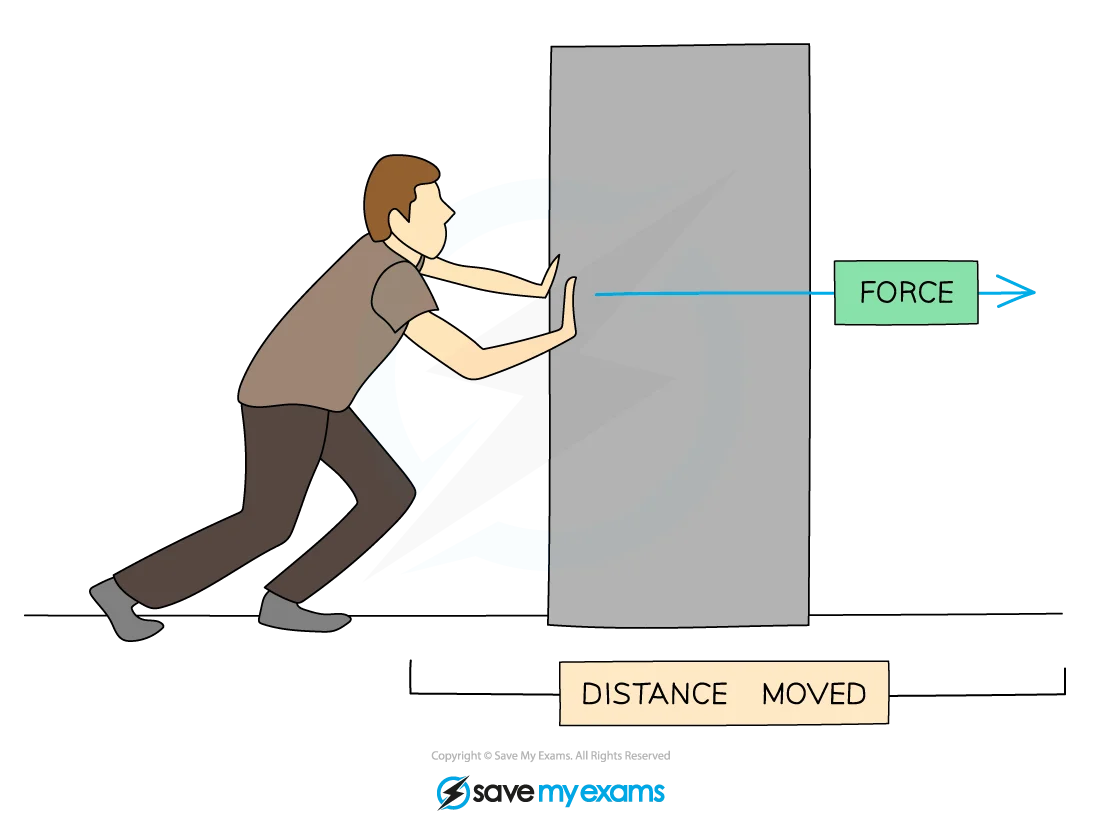
Worked example: A 5.0 kg bag is lifted 2.0 m. Its weight is $5.0\times9.8=49\text{ N}$, so work done is $49\times2.0=98\text{ J}$. This transfers energy to the bag’s gravitational potential store.
Energy resources
Solar radiation is the main source of energy, except for geothermal, nuclear, and tidal resources. Nuclear fusion in the Sun releases the radiation. Research aims to use fusion as a large-scale energy source on Earth.
| Resource | Main advantages | Main disadvantages |
|---|---|---|
| Fossil fuels | Reliable, controllable, high energy output | Finite; carbon dioxide and other pollution |
| Biofuels | Renewable if replanted; can use organic waste | Land and food competition; pollution when burned |
| Waves | Renewable; no fuel during operation | Intermittent and limited to suitable coasts |
| Tides | Renewable and predictable | Few suitable sites; environmental effects |
| Hydroelectric | Renewable, controllable, reliable | Floods land and changes river ecosystems |
| Geothermal | Renewable and reliable | Limited suitable locations |
| Nuclear fission | Reliable, large-scale output; low carbon dioxide during operation | Finite fuel, radioactive waste, accident risk |
| Solar cells/panels | Renewable; no fuel or direct pollution during operation | Intermittent; depends on sunlight and area |
| Wind | Renewable; no fuel during operation | Intermittent; needs suitable sites |
Compare resources using renewability, availability, reliability, scale, and environmental effects. Enrichment: exact efficiencies and energy-density figures depend on technology and are not required here.
In a conventional power station:
- A boiler transfers energy to water, producing steam.
- A turbine changes the steam’s energy into rotation.
- A generator changes rotation into electrical energy.
For hydroelectricity, falling water turns the turbine. Wind turns turbine blades. Solar cells transfer radiation directly to electrical energy; solar panels contain many solar cells.
Efficiency and power
Efficiency compares useful output with total input:
$$ \text{efficiency}=\frac{\text{useful energy output}}{\text{total energy input}}\times100% $$
It can also be calculated using power:
$$ \text{efficiency}=\frac{\text{useful power output}}{\text{total power input}}\times100% $$
Worked example: A device receives 500 J and gives 125 J of useful output. Its efficiency is $125/500\times100=25%$. If its input power is 800 W and useful output power is 200 W, efficiency is $200/800\times100=25%$.
Power is the rate of energy transfer or work done:
$$ P=\frac{W}{t}=\frac{\Delta E}{t} $$
The unit is the watt, $1\text{ W}=1\text{ J/s}$.
Worked example: A motor transfers 3600 J in 12 s. Its power is $3600/12=300\text{ W}$.
Energy input equals useful stored energy plus wasted transfers. Wasted energy is often transferred to the surroundings by heating or sound; it is not destroyed.