Forces
Mass and weight
Mass is the quantity of matter in an object. Weight is the gravitational force acting on its mass.
Gravitational field strength is:
$$ g=\frac{W}{m},\qquad W=mg $$
Near Earth, $g\approx9.8\text{ N/kg}=9.8\text{ m/s}^2$.
- A balance compares masses by comparing weights.
- A spring balance measures weight.
- Weight changes with gravitational field strength; mass does not.
Worked example: A $2.0\text{ kg}$ object weighs $W=2.0\times9.8=19.6\text{ N}$.
Density and floating
Density is mass per unit volume:
$$ \rho=\frac{m}{V} $$
Measuring density
- Liquid: measure a known mass with a balance and its volume with a measuring cylinder, then calculate $\rho=m/V$.
- Regular solid: measure mass and dimensions, calculate volume, then use $\rho=m/V$.
- Irregular solid: fully submerge it and measure the increase in water volume. That increase is the object’s volume.
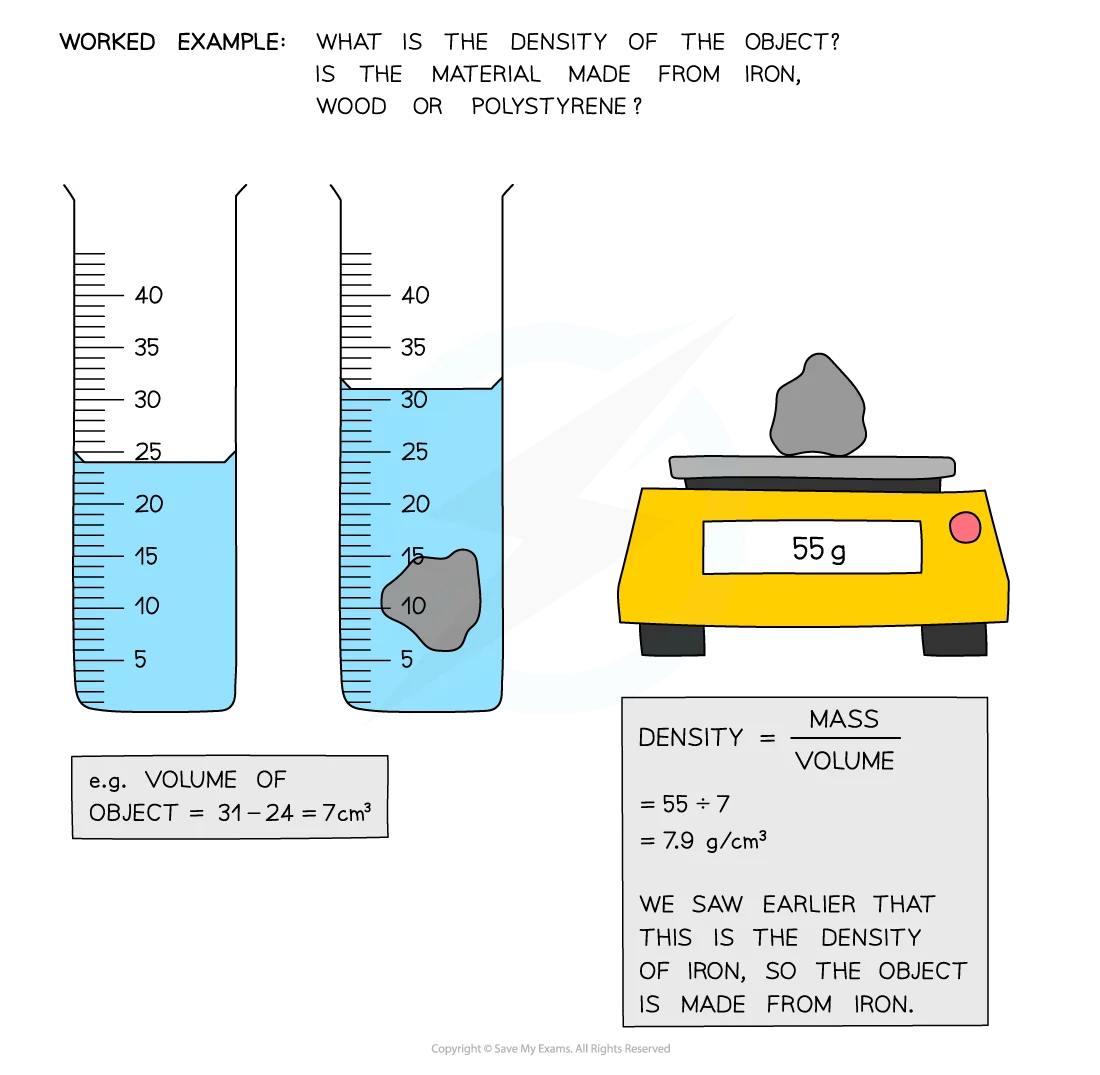
Worked example: A solid of mass $240\text{ g}$ displaces $80\text{ cm}^3$ of water. Its density is $240/80=3.0\text{ g/cm}^3$, so it sinks in water.
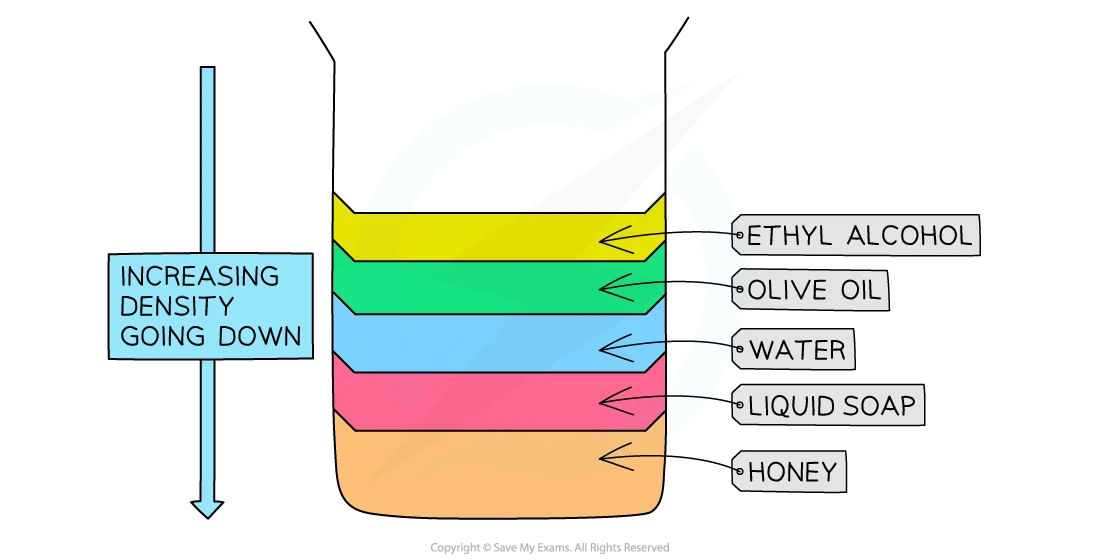
An object floats when its average density is less than or equal to the fluid density. If two liquids do not mix, the less dense liquid floats on the denser liquid.
Effects of forces
A force can change an object’s:
- size or shape;
- speed;
- direction of motion.
Resultant forces and Newton’s first law
A resultant force is the vector sum of all forces. For forces along one straight line, add forces in one direction and subtract forces in the opposite direction.
Newton’s first law says that an object remains at rest or moves with constant speed in a straight line unless a resultant force acts. A resultant force changes velocity, either by changing speed, direction, or both.
Friction and drag
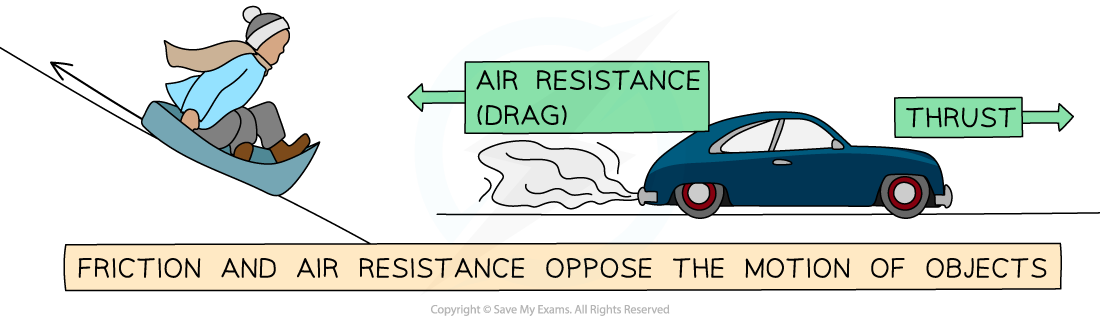
- Solid friction acts between surfaces and opposes relative motion. It transfers energy to thermal energy, causing heating.
- Drag is friction in a liquid or gas. As a falling object speeds up, drag increases.
- Terminal velocity occurs when drag equals weight. The resultant force and acceleration are then zero, so the object moves at constant speed.
Springs and load–extension graphs
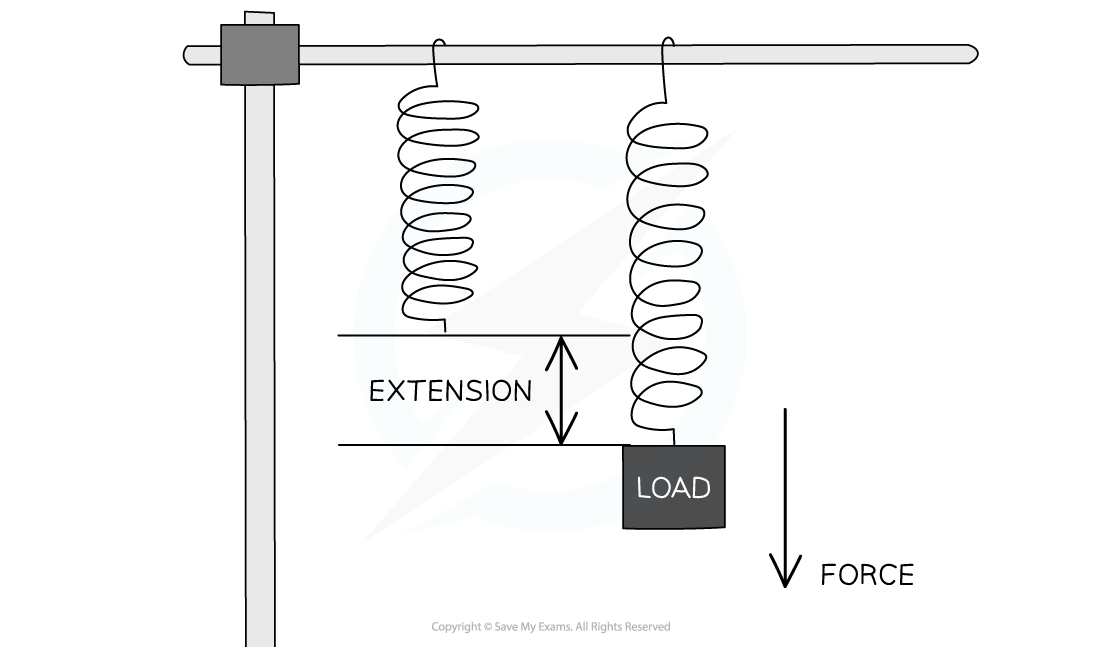
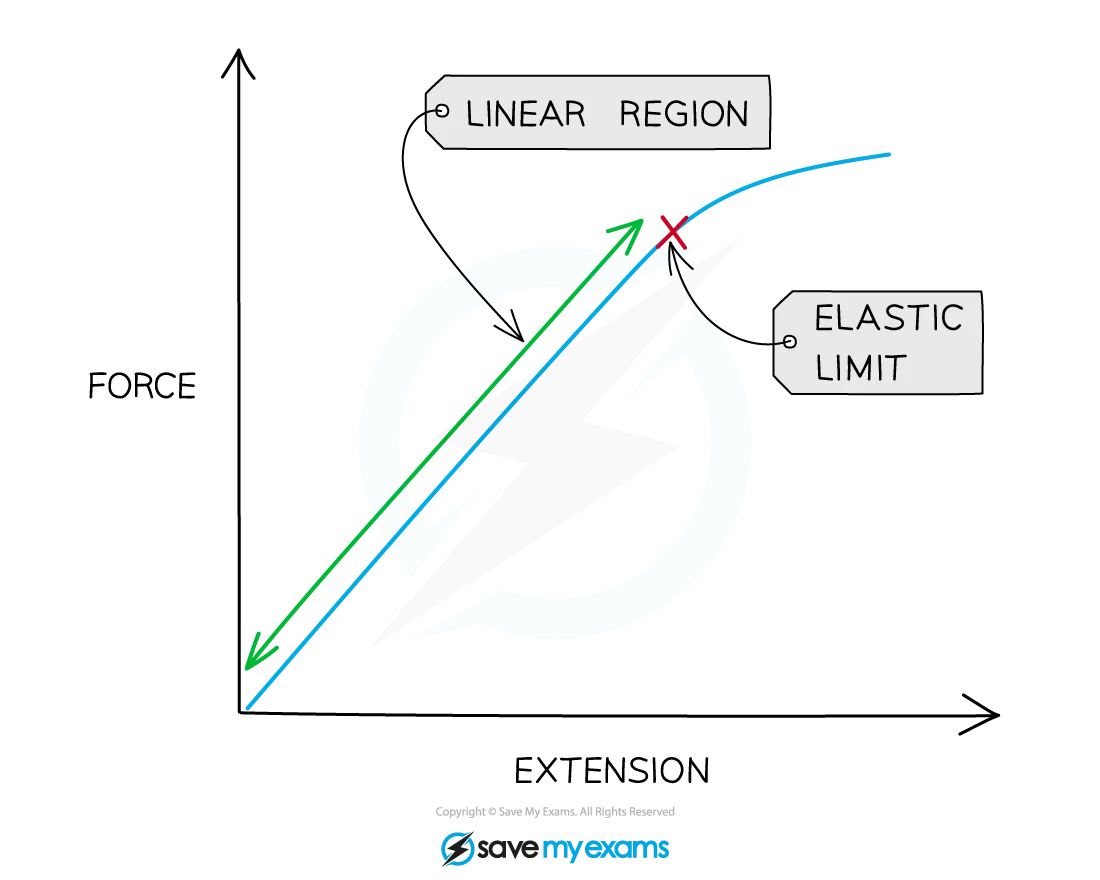
For a spring or elastic solid, plot extension on the horizontal axis and load on the vertical axis. A straight line through the origin shows that load is proportional to extension. Its gradient is the spring constant:
$$ k=\frac{F}{x} $$
Worked example: A load of $6.0\text{ N}$ produces an extension of $0.030\text{ m}$, so $k=6.0/0.030=200\text{ N/m}$.
The limit of proportionality is where the graph stops being straight. Beyond this point, extension is no longer proportional to load and the material may deform permanently.
Newton’s second law
On the Supplement, when force and acceleration are in the same direction:
$$ F=ma $$
Worked example: A resultant force of $12\text{ N}$ acts on a $3.0\text{ kg}$ trolley, so $a=12/3.0=4.0\text{ m/s}^2$.
Circular Motion
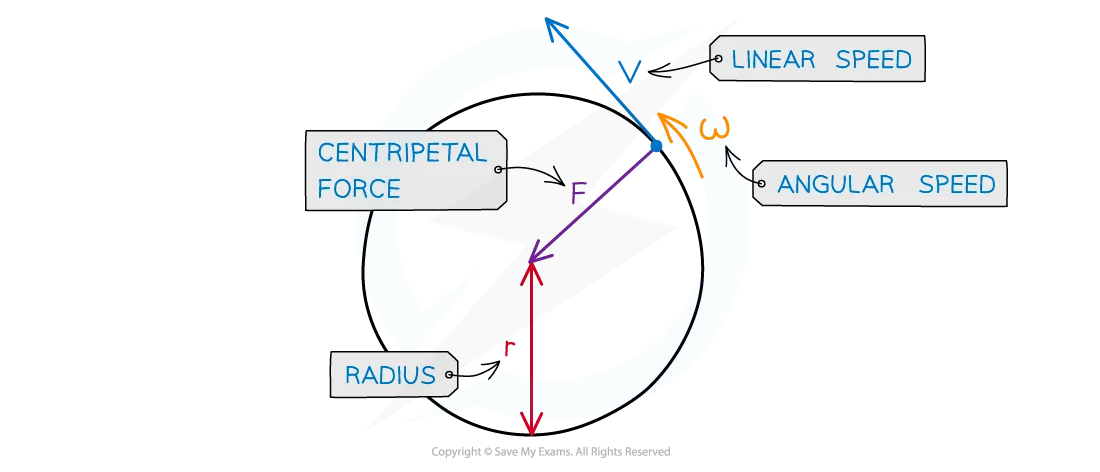 In circular motion, the force is perpendicular to the instantaneous direction of motion and changes the object’s direction.
- At fixed mass and radius, greater force gives greater speed.
- At fixed mass and speed, greater force gives a smaller radius.
- At fixed speed and radius, a greater mass requires a greater force.
Turning effects of forces
Moments
The moment of a force about a pivot is:
$$ \text{moment}=F\times d $$
Here, $d$ is the perpendicular distance from the pivot.
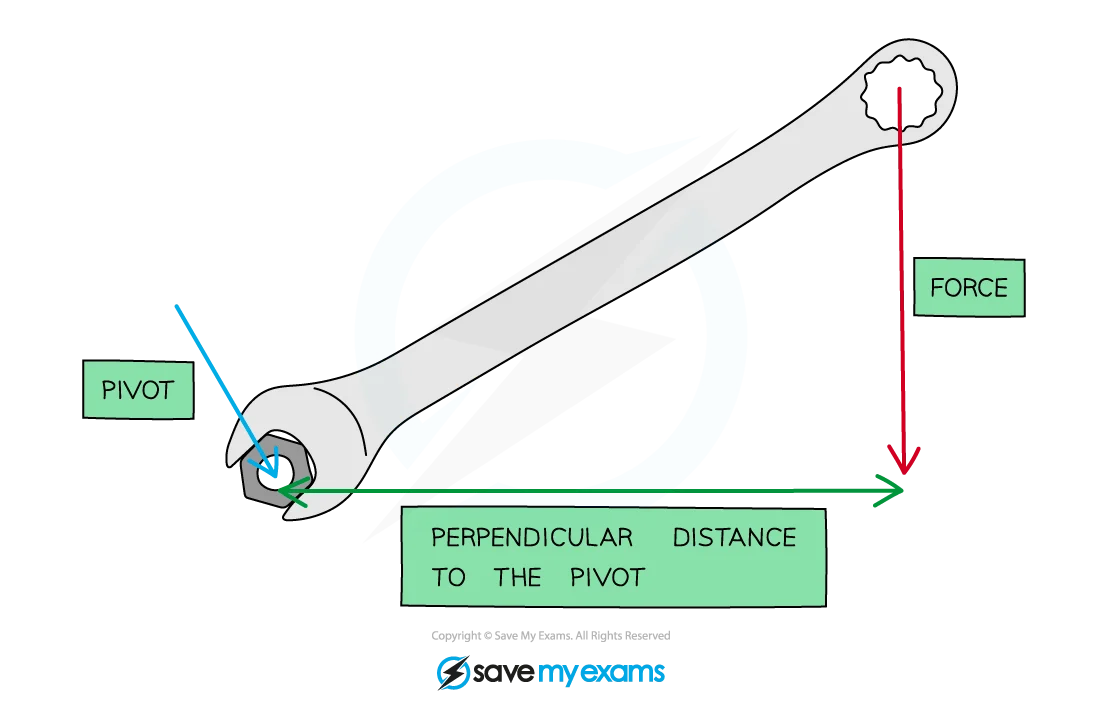
Worked example: A $20\text{ N}$ force acts $0.30\text{ m}$ from a pivot. Its moment is $20\times0.30=6.0\text{ N m}$. A balancing force at $0.20\text{ m}$ must be $6.0/0.20=30\text{ N}$.
Equilibrium
An object is in equilibrium when:
- clockwise moments equal anticlockwise moments;
- the resultant force is zero;
- the resultant moment is zero.
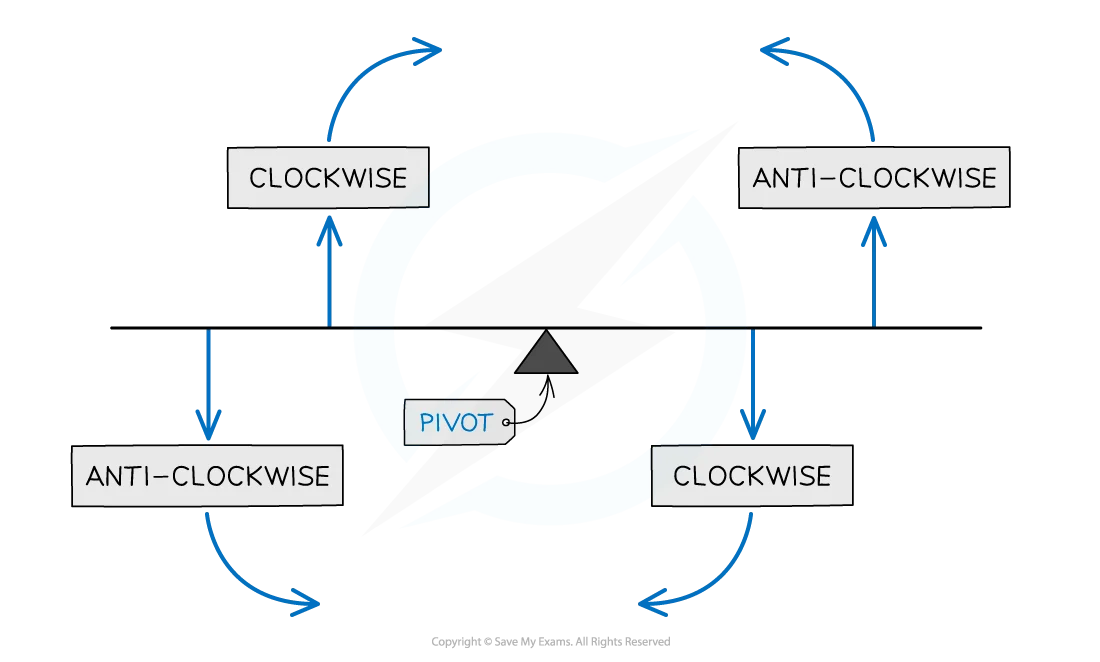
The principle of moments applies to one or multiple forces on either side of a pivot.
Equilibrium experiment: Place a beam on a pivot and hang known loads on both sides. Measure each perpendicular distance and adjust a load or distance until the beam is level. Calculate clockwise and anticlockwise moments; agreement demonstrates no resultant moment.
Centre of gravity and stability
The centre of gravity is the point through which the whole weight of an object may be considered to act.
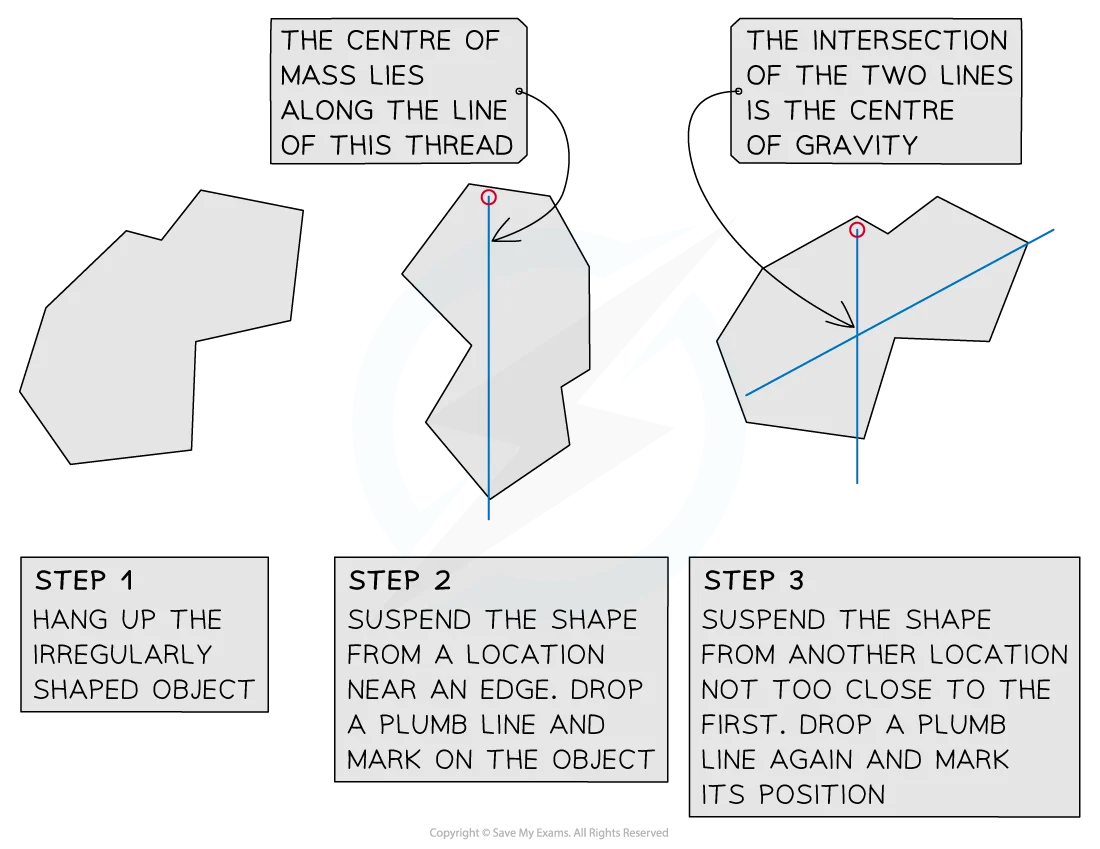
To find the centre of gravity of an irregular lamina:
- Suspend the lamina from one point.
- Hang a plumb line from the same point and mark its vertical line.
- Repeat from another point.
- The intersection of the lines is the centre of gravity.
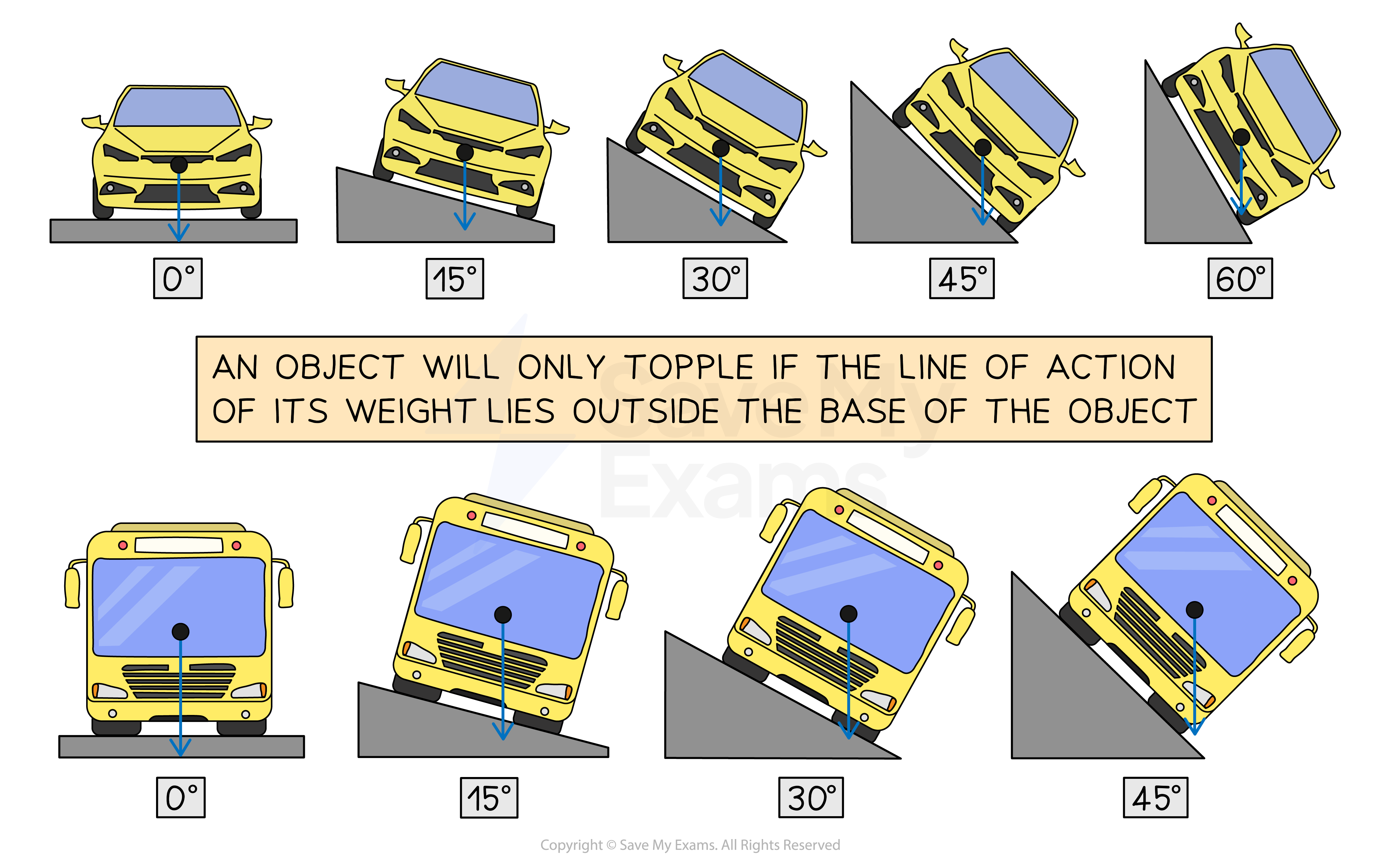
A low centre of gravity and a wide base increase stability. An object topples when the line of action of its weight falls outside its base.
What momentum means
Momentum describes how much motion an object has. A heavy object or a fast-moving object has more momentum and is harder to stop. Momentum has the same direction as velocity, so it is a vector.
$$ p=mv $$
- $p$ is momentum, measured in $\text{kg m/s}$;
- $m$ is mass, measured in kilograms;
- $v$ is velocity, measured in $\text{m/s}$.
A stationary object has zero momentum. Doubling mass or velocity doubles momentum.
Impulse and change in momentum
An impulse is the effect of a force acting for a time. It changes an object’s momentum.
In the equation below, $F$ is the resultant force and $\Delta t$ is the time for which it acts. $\Delta p$ means “final momentum minus initial momentum”.
$$ F\Delta t=\Delta p $$
Impulse is measured in newton-seconds, which is equivalent to $\text{kg m/s}$. For the same change in momentum, increasing the stopping time reduces the average force. This explains why safety features such as airbags and crumple zones reduce injury forces.
Conservation of momentum
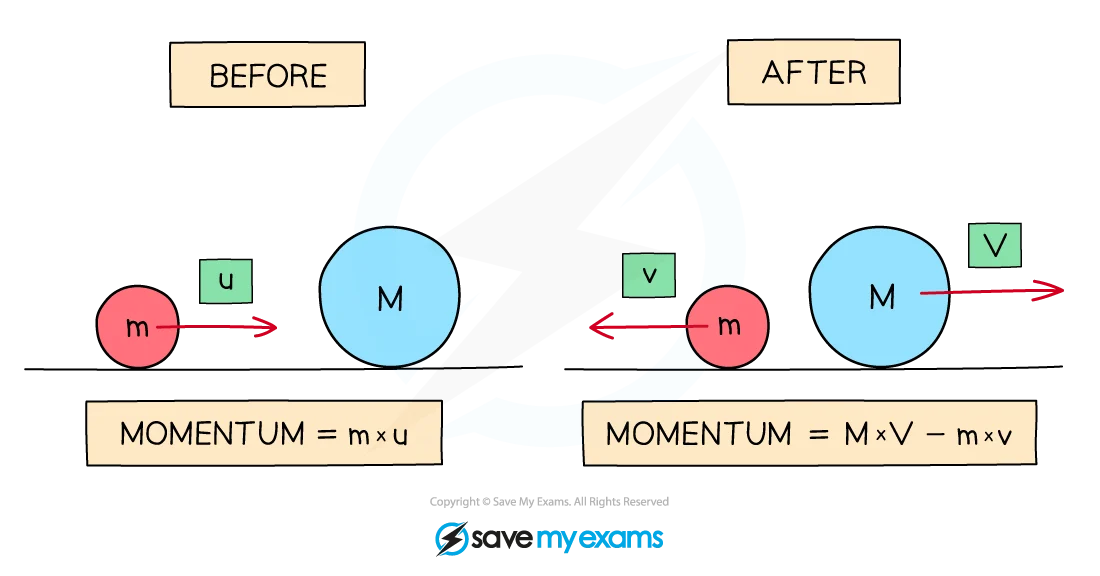
In an isolated one-dimensional system, there is no external resultant force. Total momentum before an interaction equals total momentum after it. Choose one direction as positive; momentum in the opposite direction is negative.
For example, if two objects collide, add their signed momenta before the collision and set this equal to the total signed momentum afterwards.
Worked example: A $2.0\text{ kg}$ trolley moves at $4.0\text{ m/s}$ to the right and hits a stationary $1.0\text{ kg}$ trolley. They stick together. Take right as positive:
$$ \text{momentum before}=(2.0\times4.0)+(1.0\times0)=8.0\text{ kg m/s} $$
If their common final velocity is $v$:
$$ (2.0+1.0)v=8.0 $$
$$ v=\frac{8.0}{3.0}=2.67\text{ m/s to the right} $$
The total momentum is $8.0\text{ kg m/s}$ before and after the collision. Kinetic energy may transfer to sound, heating, and deformation when objects stick together; only momentum conservation is used here.
Force and momentum
Resultant force is the rate at which momentum changes:
$$ F=\frac{\Delta p}{\Delta t} $$
A large force changes momentum quickly. The same change spread over a longer time produces a smaller average force.
Worked example:
A $2.0\text{ kg}$ trolley moving at $3.0\text{ m/s}$ has initial momentum $p=2.0\times3.0=6.0\text{ kg m/s}$.
If it stops in $0.50\text{ s}$: $$\Delta p=0-6.0=-6.0\text{ kg m/s}$$.
Therefore $F=-6.0/0.50=-12\text{ N}$;
the negative sign means the force acts opposite to the original motion.
Pressure
Pressure is force per unit area:
$$ p=\frac{F}{A} $$
The same force produces greater pressure on a smaller area. A sharp nail produces high pressure at its tip; wide snowshoes reduce pressure on snow.
In a liquid, pressure increases with depth and density. The Supplement relationship is:
$$ \Delta p=\rho g\Delta h $$
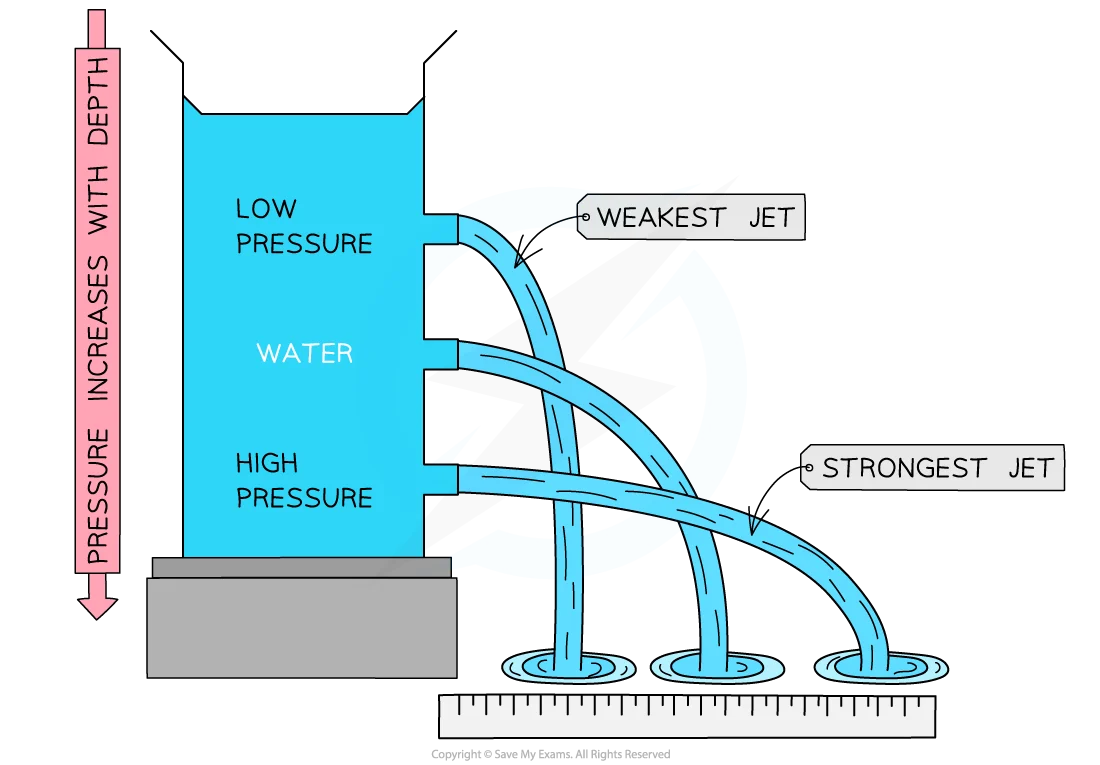
Worked example: At a depth increase of $5.0\text{ m}$ in water,
$\Delta p=1000\times9.8\times5.0=49,000\text{ Pa}$.