1. Kinetic particle model of matter
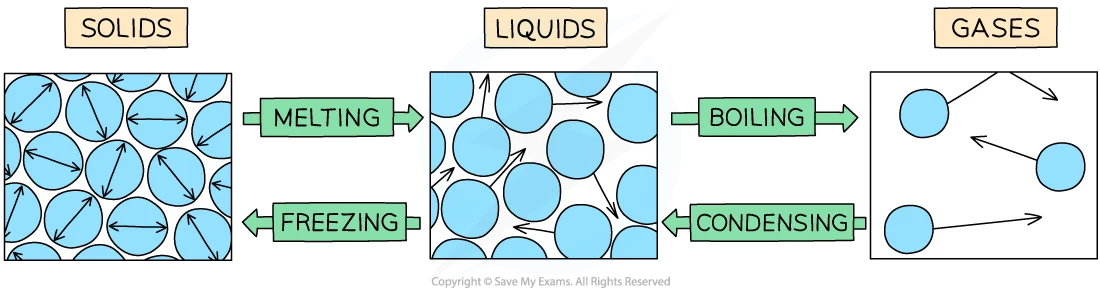
All matter is made of tiny particles. Their arrangement, separation and motion explain the properties of each state.
| State | Arrangement and separation | Motion and properties |
|---|---|---|
| Solid | Particles closely packed in a regular arrangement | Vibrate about fixed positions; fixed shape and volume; difficult to compress |
| Liquid | Particles close together but irregularly arranged | Move and slide past one another; fixed volume but no fixed shape; difficult to compress |
| Gas | Particles far apart with no regular arrangement | Move rapidly and randomly; no fixed shape or volume; easy to compress |
Temperature and internal motion
Temperature measures the average kinetic energy of particles. Increasing temperature makes particles move faster on average. Absolute zero is approximately $-273^\circ\text{C}$ or $0\text{ K}$, the lowest possible temperature and the point of minimum particle motion in the particle model.
Gas pressure
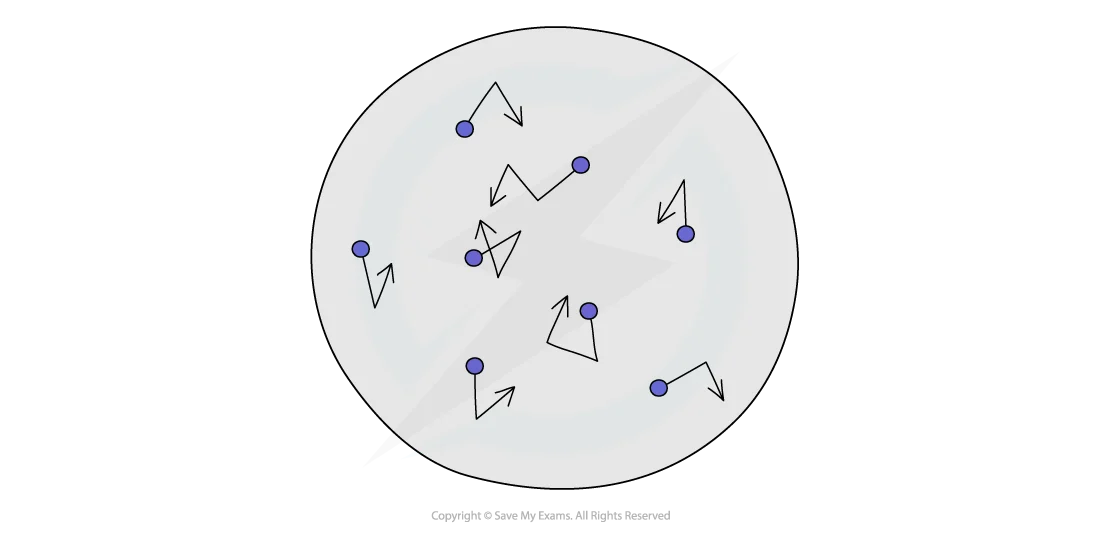
Gas particles collide with container walls. Each collision exerts a force; the total force per unit area produces pressure:
$$ p=\frac{F}{A} $$
Pressure increases when particles:
- move faster and collide more forcefully;
- collide with the walls more frequently;
- become more numerous in the same volume.
At constant volume, increasing temperature increases pressure because particles move faster. At constant temperature, decreasing volume increases pressure because collisions with the walls become more frequent.
Supplement: Applying a force can change the spacing and motion of particles, especially during compression or expansion. Do not say that individual particles are compressed; the spaces between particles change.
Brownian motion
Brownian motion is the random movement of visible microscopic particles, such as smoke particles, caused by unequal collisions with invisible, rapidly moving molecules. It is evidence that matter contains moving particles.
Absolute temperature and Boyle’s law
Convert Celsius temperature to kelvin using:
$$ T(\text{K})=\theta(^{\circ}\text{C})+273 $$
Worked example:
$$ 25^\circ\text{C}=25+273=298\text{ K} $$
For a fixed mass of gas at constant temperature:
$$ pV=\text{constant}\qquad\text{or}\qquad p_1V_1=p_2V_2 $$
Worked example: A gas has pressure $100\text{ kPa}$ and volume $60\text{ cm}^3$. Its volume becomes $30\text{ cm}^3$ at constant temperature.
$$ 100\times60=p_2\times30 $$
$$ p_2=200\text{ kPa} $$
Always state the condition: Boyle’s law requires constant temperature and fixed mass of gas.
2. Thermal properties and temperature
Thermal expansion
Heating increases particle vibration or motion. The average separation between particles increases, so the substance expands. Cooling produces contraction. Expansion is usually smallest in solids, greater in liquids and greatest in gases:
$$ \text{solid} < \text{liquid} < \text{gas} $$
Applications and consequences include expansion gaps in bridges and railway tracks, expansion joints in concrete, liquid-in-glass thermometers, and movement of a bimetallic strip. Overhead cables are installed with some slack because they contract in cold conditions and expand in hot conditions.
Specific heat capacity
Specific heat capacity, $c$, is the energy required to raise the temperature of $1\text{ kg}$ of a substance by $1^\circ\text{C}$ or $1\text{ K}$:
$$ c=\frac{\Delta E}{m\Delta\theta} $$
Units are $\text{J kg}^{-1}\text{ K}^{-1}$. Rearrange when necessary:
$$ \Delta E=mc\Delta\theta $$
A substance with high $c$ needs more energy for the same temperature rise. Water has a high specific heat capacity, so it heats and cools relatively slowly.
Worked example: A $2.0\text{ kg}$ block absorbs $8,000\text{ J}$ and its temperature rises by $10^\circ\text{C}$.
$$ c=\frac{8,000}{2.0\times10}=400\text{ J kg}^{-1}\text{ K}^{-1} $$
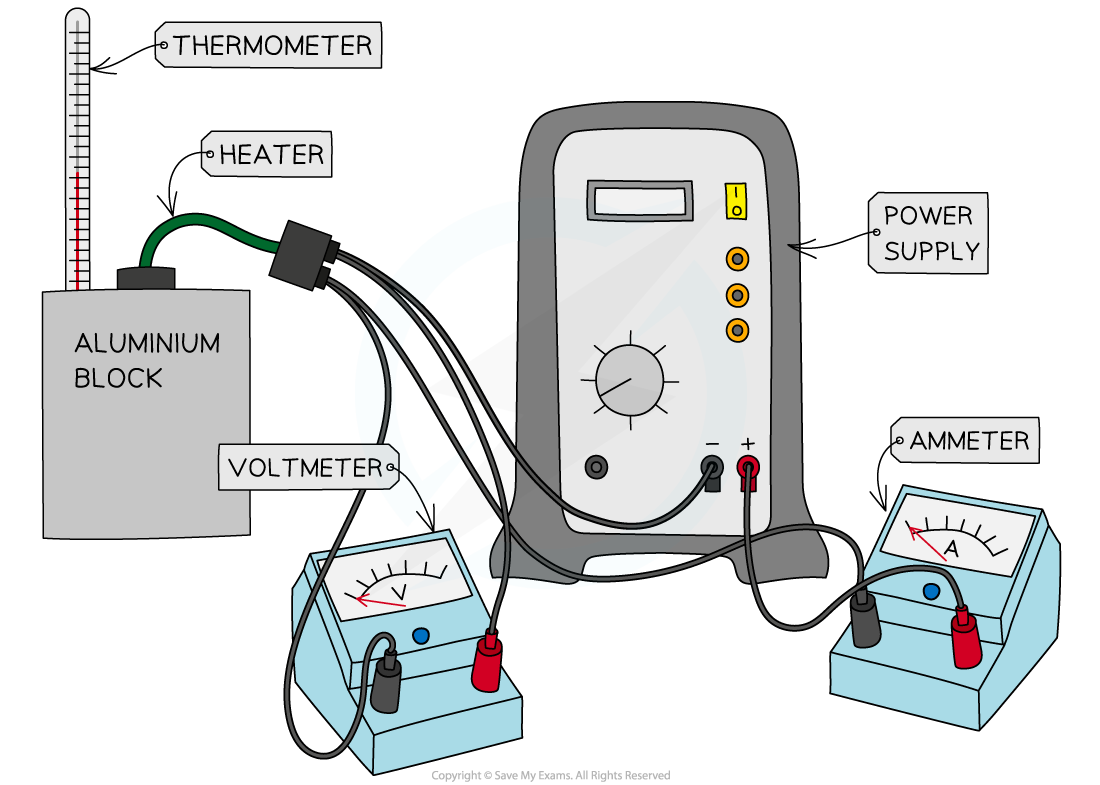
Measuring specific heat capacity: Heat a known mass electrically, measure the energy supplied and record the temperature rise. Use $c=\Delta E/(m\Delta\theta)$. For a liquid, stir to keep its temperature uniform. Insulate the container, measure temperature accurately and reduce heat loss. For an electrical heater, energy supplied can be found from $E=VIt$, if voltage, current and time are measured.
Melting, boiling and evaporation
During melting, boiling, condensing and solidifying, energy transfer changes the arrangement and separation of particles. Temperature remains constant during the change of state because energy is used to change the state rather than increase average kinetic energy.
At standard atmospheric pressure:
- water melts at $0^\circ\text{C}$;
- water boils at $100^\circ\text{C}$.
| Boiling | Evaporation |
|---|---|
| Occurs throughout the liquid | Occurs at the surface |
| Occurs at the boiling point for the pressure | Can occur at any temperature |
| Bubbles form throughout the liquid | No bubbles form throughout the liquid |
| Usually rapid | Usually slower |
Evaporation occurs when the most energetic particles escape from the liquid surface. The remaining particles have lower average kinetic energy, so the liquid cools. Evaporation increases with:
- higher temperature;
- greater surface area;
- faster air movement, which removes vapour above the liquid.
An object in contact with an evaporating liquid cools because energy is transferred from the object to the liquid and then carried away by escaping particles.
3. Transfer of thermal energy
| Transfer | How energy moves | Medium required? | Typical example |
|---|---|---|---|
| Conduction | Particles transfer energy to neighbouring particles; free electrons also transfer energy in metals | Matter required | Metal pan handle becoming hot |
| Convection | Moving fluid carries thermal energy | Liquid or gas required | Water circulating while heated |
| Radiation | Infrared electromagnetic waves transfer energy | No; travels through a vacuum | Energy from the Sun reaching Earth |
Conduction
Good thermal conductors transfer energy quickly. Metals conduct well because vibrating ions transfer energy and free electrons move through the metal. Poor conductors, or insulators, transfer energy slowly. Gases and liquids are generally poor conductors because their particles are farther apart. Some solids have intermediate conductivity: they conduct better than good insulators but worse than metals.
Convection
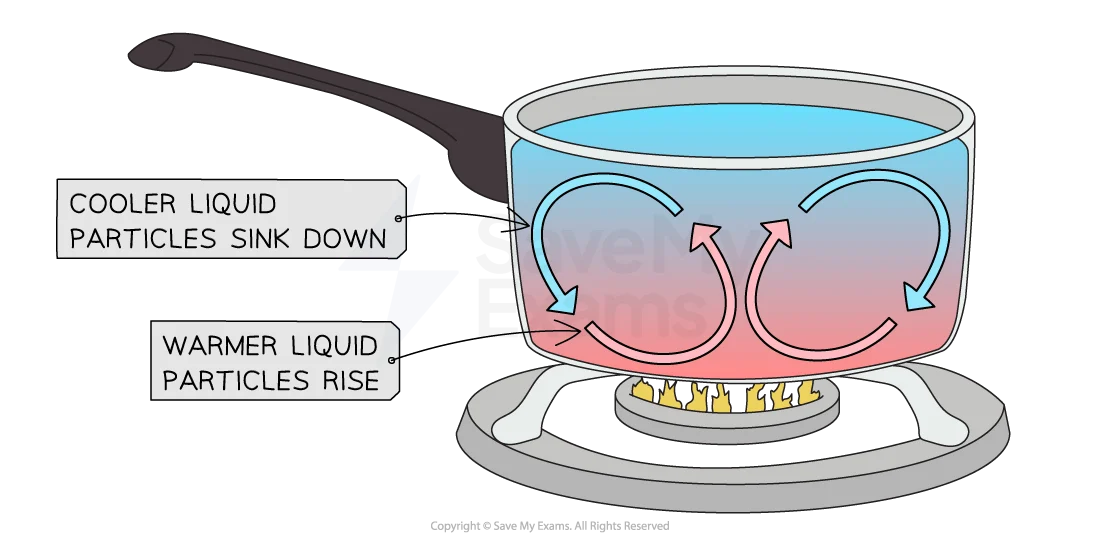
Convection occurs in liquids and gases. When part of a fluid is heated, its particles move farther apart. The same mass occupies a larger volume, so its density decreases and it rises. Cooler, denser fluid sinks to replace it. Repeated rising and sinking forms a convection current.
Practical demonstration: Place a small crystal of potassium manganate(VII) in water in a beaker. Heat the water below the crystal. The coloured water rises above the heater and cooler water sinks, showing the convection current. Do not describe convection in a solid: solids do not flow.
Radiation
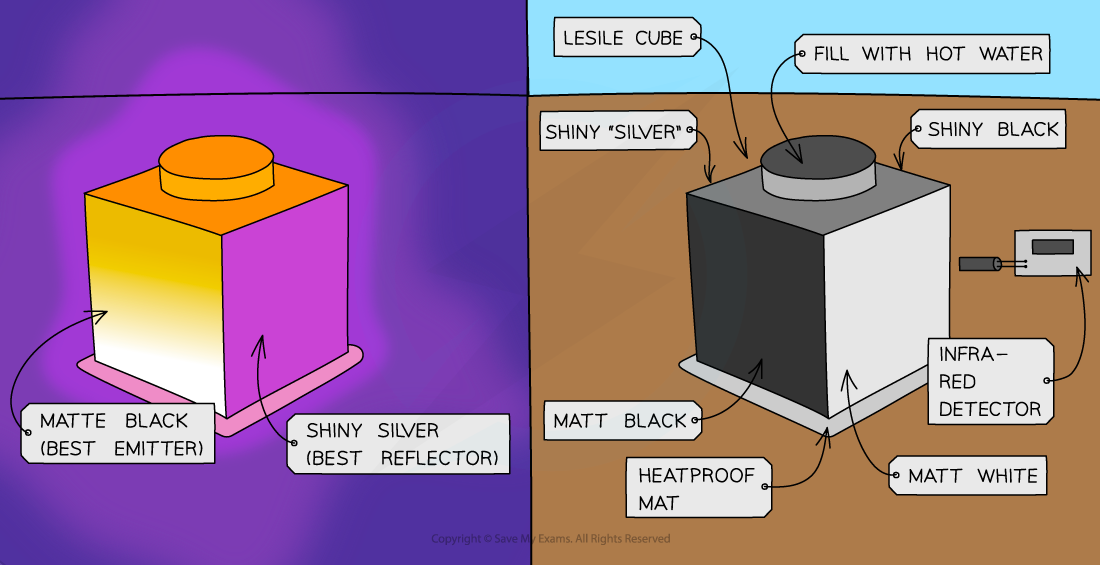
All objects emit infrared radiation. Hotter objects emit radiation at a greater rate. Emission rate also increases with surface area. Infrared radiation does not need a medium and can travel through a vacuum.
- Dull, dark surfaces are good absorbers and good emitters.
- Shiny, light surfaces are poor absorbers and poor emitters and reflect more radiation.
If an object remains at constant temperature, its rate of emission equals its rate of absorption. If absorption is greater than emission, the object warms. If emission is greater than absorption, it cools. Earth’s average temperature depends on a balance between incoming solar radiation and outgoing infrared radiation.
Infrared experiment: Use identical metal cans or surfaces with different finishes. Place equal amounts of hot water in them and measure temperature change, or expose them equally to an infrared source. A dull black surface absorbs and emits more effectively than a shiny surface. Control the starting temperature, water mass, distance and exposure time.
4. Applications and exam explanations
- Pan: Energy reaches the metal by radiation and convection from the flame and gases. Conduction transfers energy through the metal to the food. A metal handle may be fitted with an insulating material.
- Room heating: Air near a heater warms, expands and becomes less dense. It rises while cooler, denser air sinks. This creates convection currents that distribute energy through the room.
- Fire: Conduction transfers energy through solid fuel; convection transfers energy through hot gases; radiation transfers infrared energy to nearby surfaces.
- Car radiator: Engine coolant carries energy by convection to the radiator. Conduction transfers energy through the radiator metal, and the large surface area allows convection and radiation to the surroundings.
- Enrichment — thermal imaging: Detectors receive infrared radiation and form an image from differences in emission. It can reveal temperature patterns without visible light.
Common exam traps
- Use kelvin for absolute temperature; never use $-273$ as a kelvin temperature.
- State constant volume, constant temperature or fixed mass when explaining gas relationships.
- Do not say particles expand when heated; their average separation increases.
- Do not confuse evaporation with boiling.
- Convection occurs in fluids, not solids.
- Radiation does not require air or any other medium.
- High specific heat capacity means more energy is needed per kilogram per degree, not that an object cannot lose heat.