Waves
Wave basics
Waves transfer energy without transferring matter overall.
Wave features
- A wavefront joins points in the same phase.
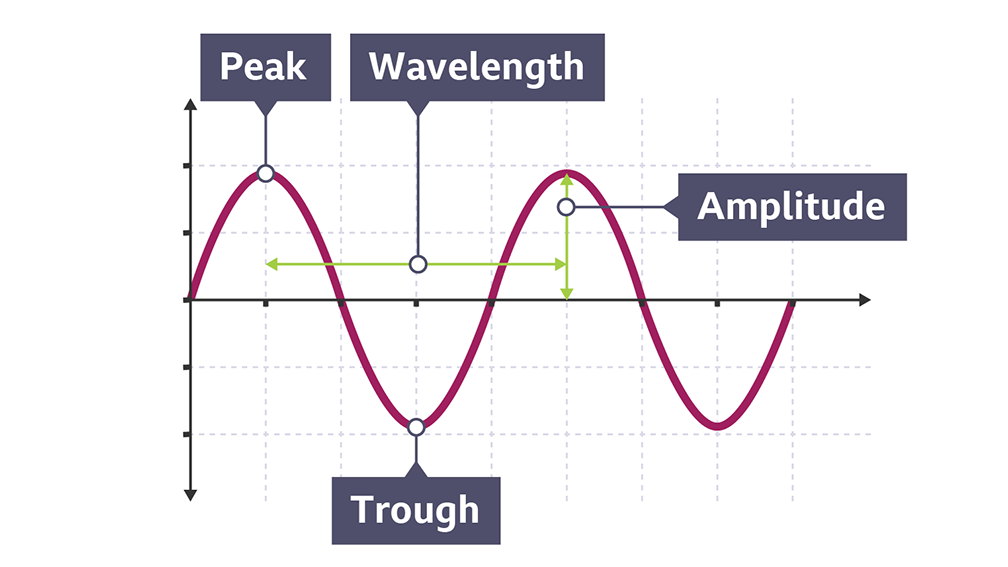
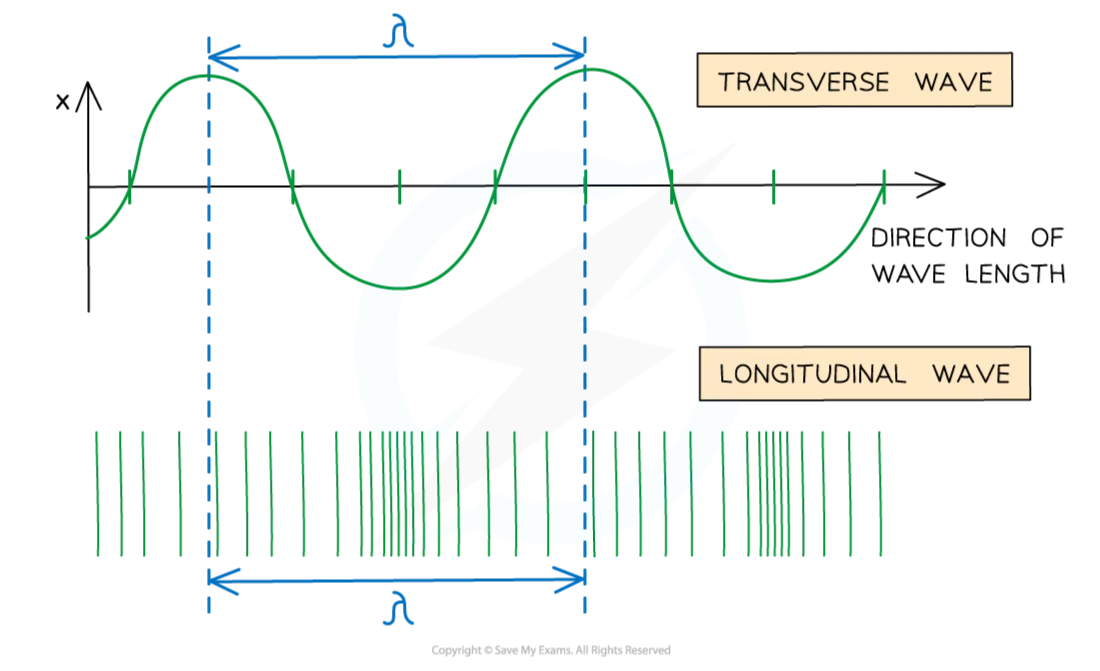
- Wavelength $\lambda$ is the distance between matching points on successive waves.
- Frequency $f$ is the number of waves passing a point per second, measured in hertz.
- Amplitude is the maximum displacement from the rest position.
- A crest is the highest point of a transverse wave; a trough is the lowest point.
Wave speed is calculated using:
$$ v=f\lambda $$
Worked example: If $f=2.0\text{ Hz}$ and $\lambda=1.5\text{ m}$, then $v=2.0\times1.5=3.0\text{ m/s}$.
Transverse and longitudinal waves
A transverse wave vibrates perpendicular to its direction of travel. Examples include electromagnetic waves, water waves, and seismic S-waves.
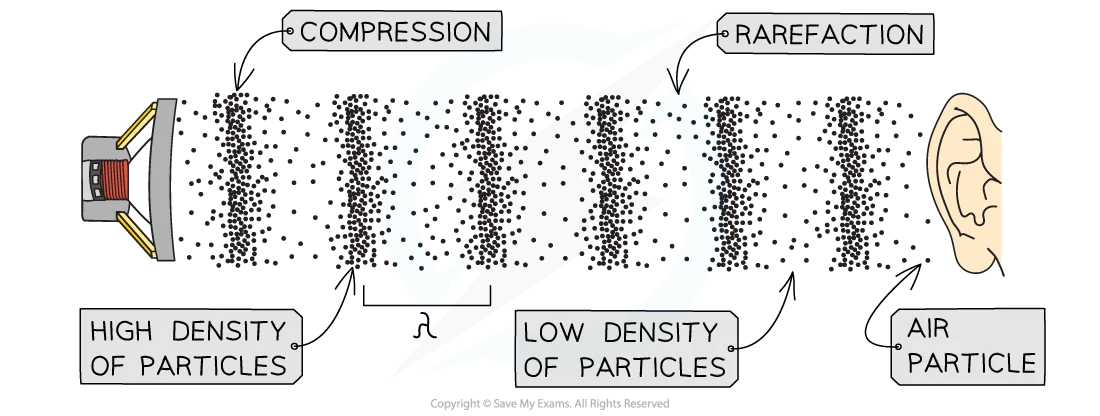
A longitudinal wave vibrates parallel to its direction of travel. Examples include sound and seismic P-waves. Longitudinal waves contain compressions and rarefactions.
Wave behaviours
-
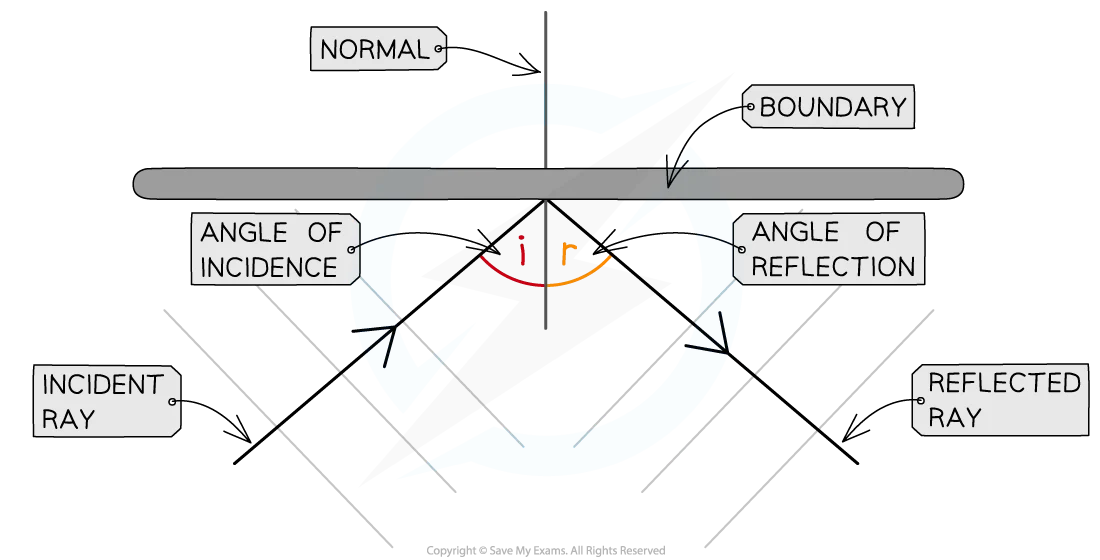
Reflection: a wave bounces back from a boundary.
-
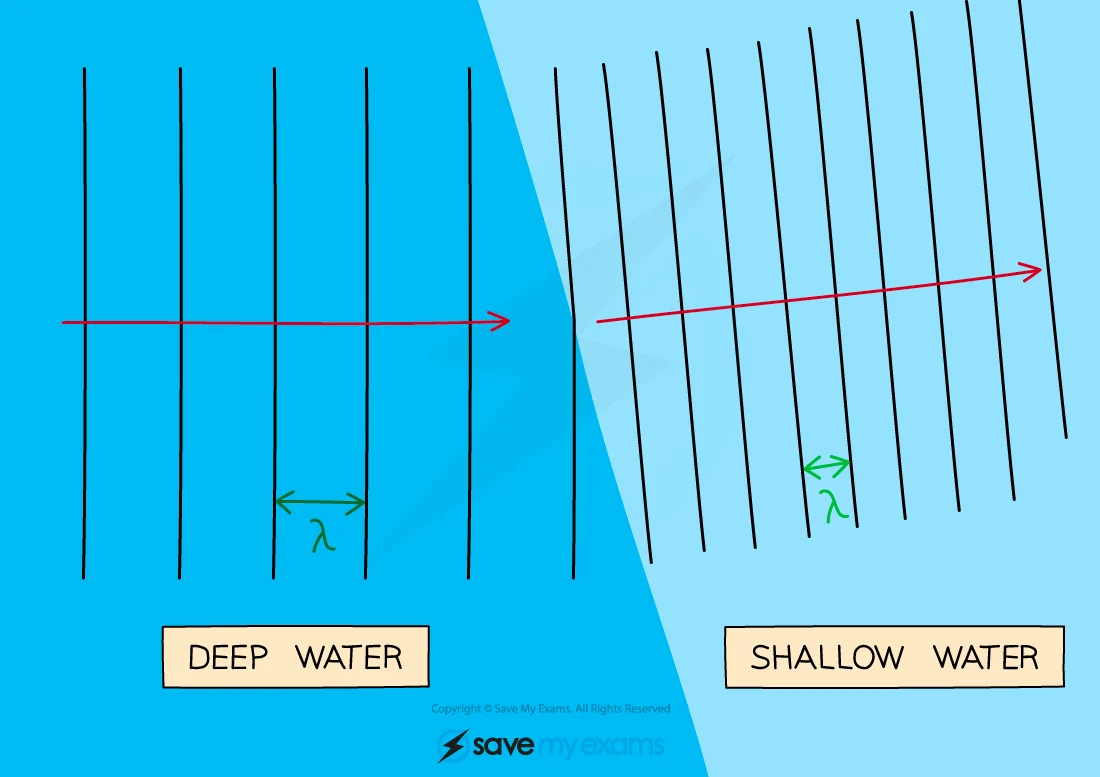
Refraction: a wave changes direction because its speed changes at a boundary.
-
Diffraction: a wave spreads through a gap or around an edge.
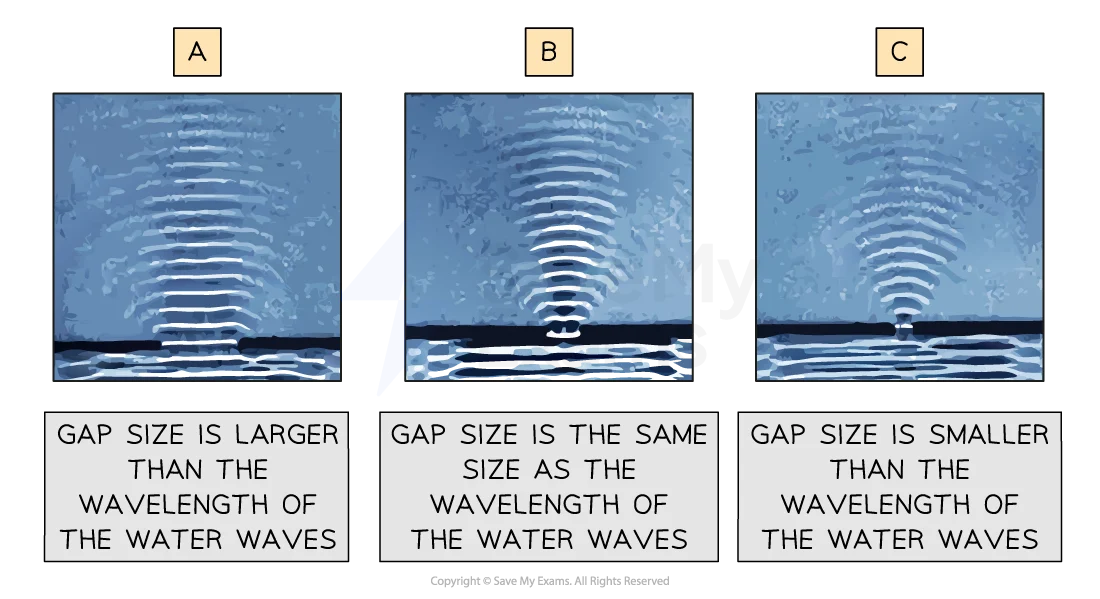
A ripple tank can demonstrate all three. Change the water depth to show refraction; use a gap or edge to show diffraction. Diffraction is greatest when the gap is similar in size to the wavelength. A longer wavelength or smaller gap gives greater spreading. At an edge, longer wavelengths spread more.
Light
Reflection
The normal is a line perpendicular to the surface. Measure both angles from the normal:
$$ i=r $$
A plane mirror forms an image that is:
- virtual and upright;
- the same size as the object;
- the same distance behind the mirror as the object is in front.
To construct the image, draw a perpendicular from the object to the mirror, mark an equal distance behind the mirror, and extend reflected rays backwards. The image cannot be projected onto a screen.
Refraction
When light enters a medium where it travels more slowly, it bends towards the normal. When it speeds up, it bends away from the normal. Trace rays through a transparent block to measure the angles and observe the emergent ray.
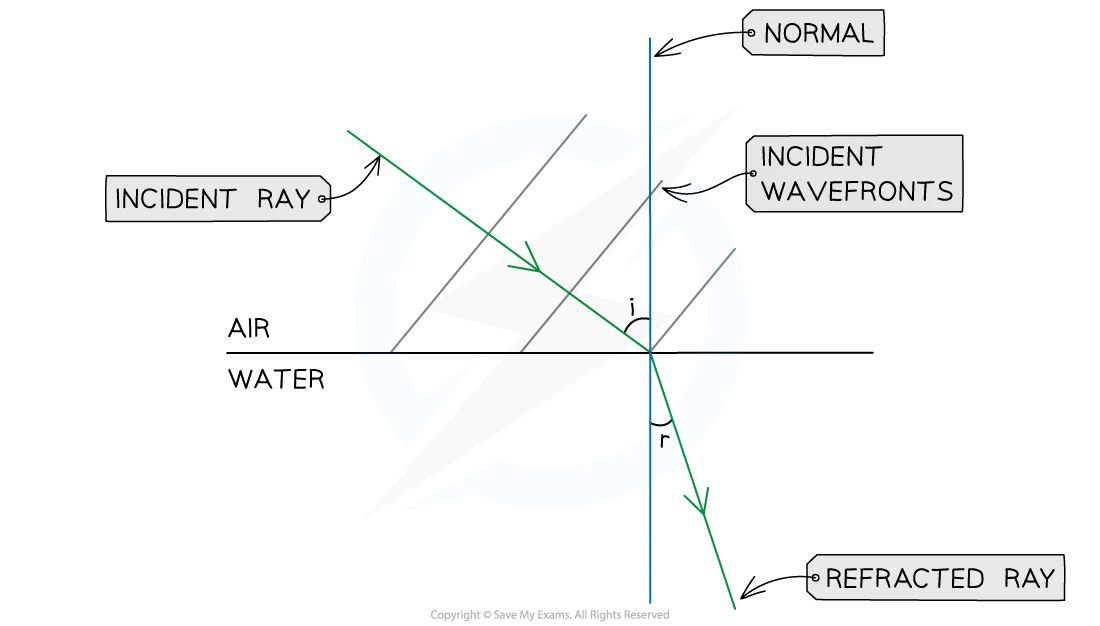
Refractive index is the ratio of the speed of light in vacuum to its speed in a medium:
$$ n=\frac{c}{v} $$
For light entering a medium from air:
$$ n=\frac{\sin i}{\sin r} $$
Worked example: For glass with $n=1.5$ and $i=45^\circ$:
$$ \sin r=\frac{\sin45^\circ}{1.5}=0.471, \qquad r\approx28^\circ $$
Critical angle and total internal reflection
The critical angle is the angle of incidence in the denser medium that produces a refracted ray along the boundary. For a denser medium to air:
$$ n=\frac{1}{\sin c} $$
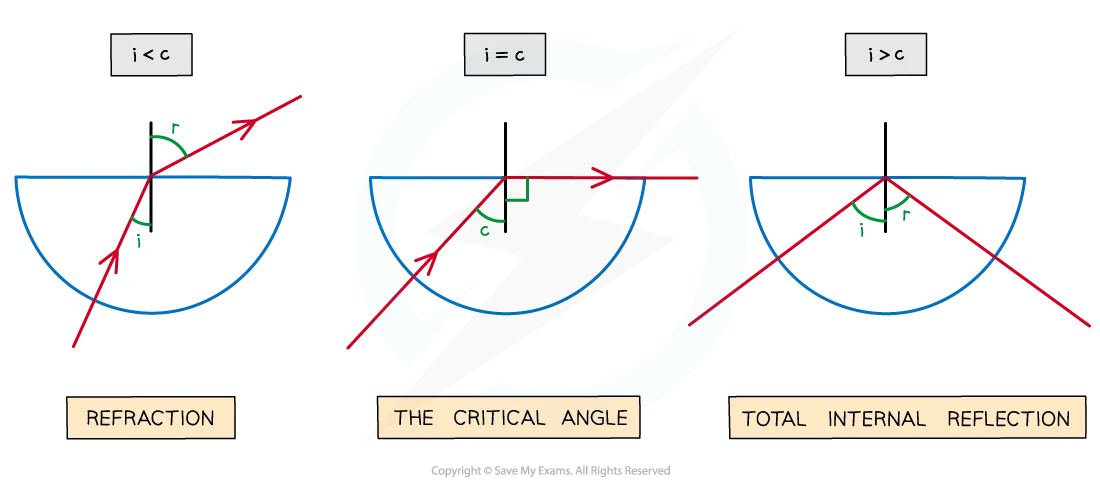
If the angle of incidence is greater than $c$, total internal reflection occurs. For glass with $n=1.5$, $c=\sin^{-1}(1/1.5)\approx42^\circ$. An incidence angle of $50^\circ$ therefore produces total internal reflection. Optical fibres use this effect.
Thin lenses
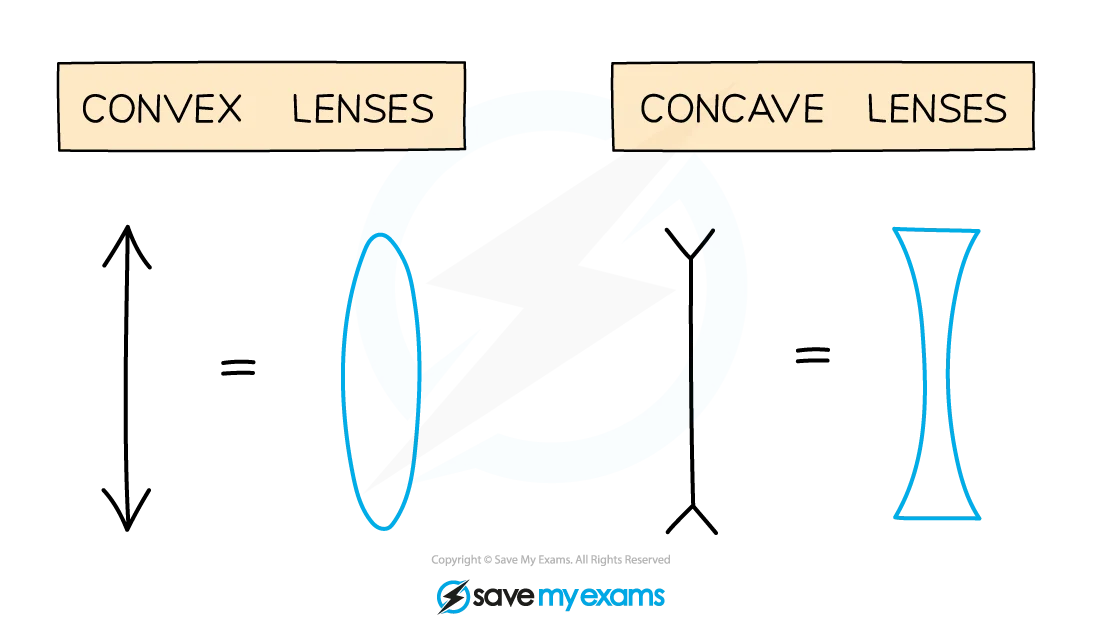
A converging (convex) lens brings parallel rays towards a principal focus. A diverging (concave) lens spreads parallel rays; backward extensions of the rays meet at a virtual focus.
- The principal axis passes through the optical centre and principal focus.
- Focal length is the distance from the optical centre to the principal focus.
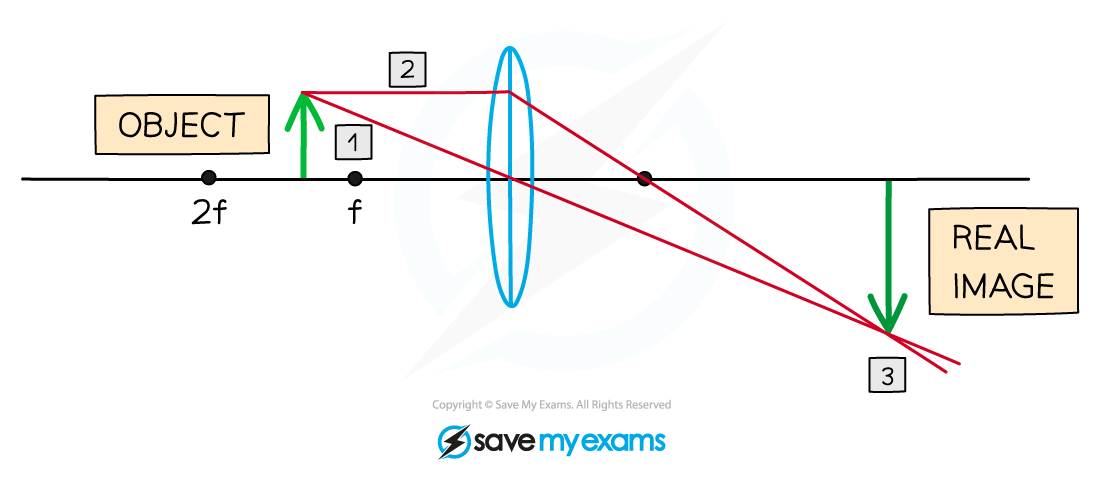
For a converging-lens ray diagram:
- A ray parallel to the principal axis passes through the focus after the lens.
- A ray through the optical centre continues nearly undeviated.
- A ray through the focus emerges parallel to the axis.
A converging lens can form a real, inverted image on a screen. Depending on object distance, the image may be enlarged or diminished. With the object inside the focal length, it forms an enlarged, upright, virtual image and acts as a magnifying glass. A diverging lens forms a diminished, upright, virtual image. Converging lenses correct long-sightedness; diverging lenses correct short-sightedness.
Dispersion
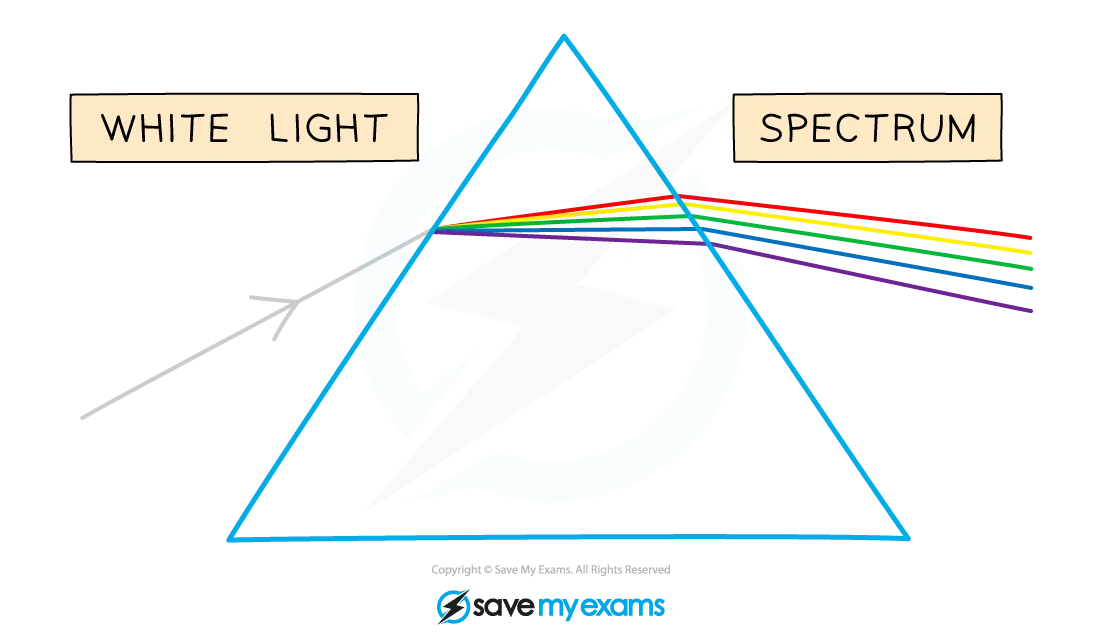
A glass prism disperses white light because different frequencies refract by different amounts. From lowest frequency/longest wavelength to highest frequency/shortest wavelength, the visible spectrum is:
red → orange → yellow → green → blue → indigo → violet.
Monochromatic light has one frequency.
Electromagnetic spectrum
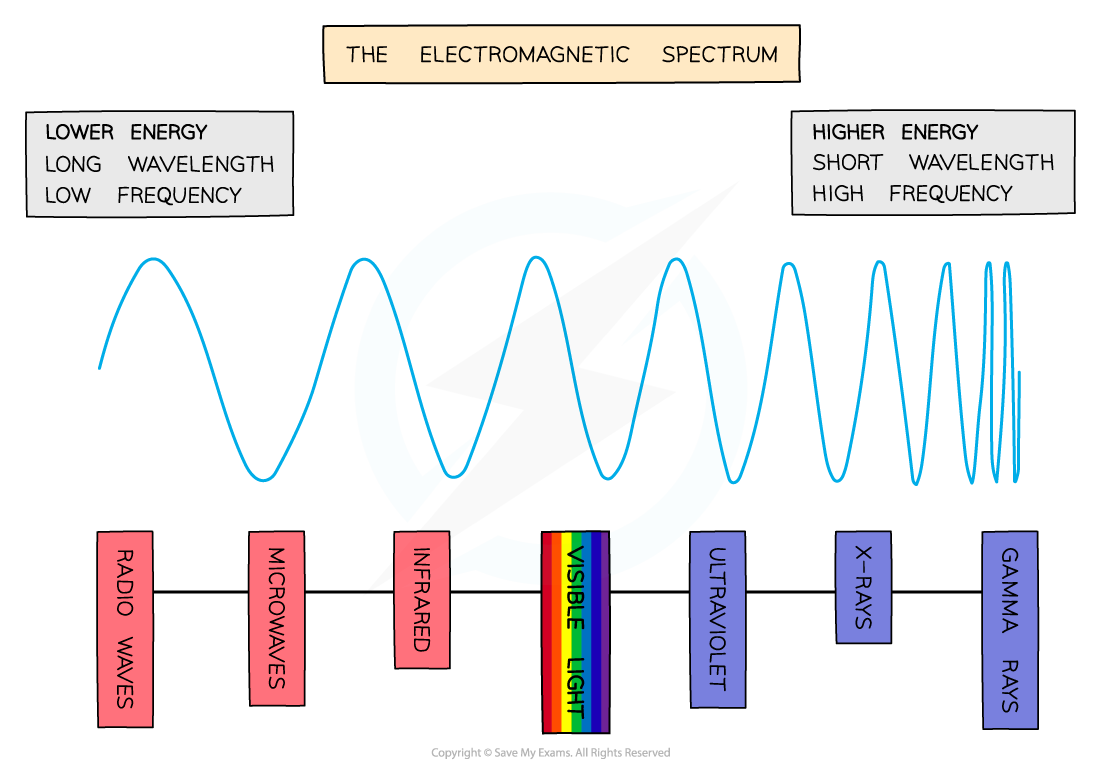
All electromagnetic waves are transverse and travel at $3.0\times10^8\text{ m/s}$ in vacuum.
Order
From lowest frequency and longest wavelength to highest frequency and shortest wavelength:
radio → microwaves → infrared → visible → ultraviolet → X-rays → gamma rays.
Uses and hazards
| Region | Uses and hazards |
|---|---|
| Radio | TV, radio, astronomy, RFID, and Bluetooth; can pass through walls. |
| Microwaves | Satellites, mobile phones, and ovens; can cause internal heating. |
| Infrared | Grills, remote controls, intruder alarms, thermal imaging, and optical fibres; intense sources burn skin. |
| Visible | Vision, photography, and illumination. |
| Ultraviolet | Security marking, bank-note checking, and water sterilisation; damages cells and eyes and can cause skin cancer. |
| X-rays | Medical and security scanning; ionising cell damage and mutations. |
| Gamma | Food/equipment sterilisation and cancer diagnosis/treatment; ionising cell damage and mutations. |
Communication
Satellite links use microwaves for low-orbit and geostationary satellites. Mobile and wireless systems use microwaves because they penetrate walls and need relatively short aerials. Optical fibres use visible or infrared light because glass is transparent and they support high data rates.
Analogue signals vary continuously. Digital signals use discrete values and can be regenerated, improving transmission rate, range, and quality. Sound can be transmitted as either analogue or digital data.
Sound
Sound properties
Sound is produced by a vibrating source. It is longitudinal and requires a medium, so it cannot travel through a vacuum. Sound travels fastest in solids, then liquids, then gases. Its speed in air is about $330\text{–}350\text{ m/s}$.
- Greater amplitude means greater loudness.
- Greater frequency means higher pitch.
- Human hearing is approximately $20\text{ Hz}$ to $20,000\text{ Hz}$.
- An echo is reflected sound.
- Ultrasound has a frequency above $20\text{ kHz}$.
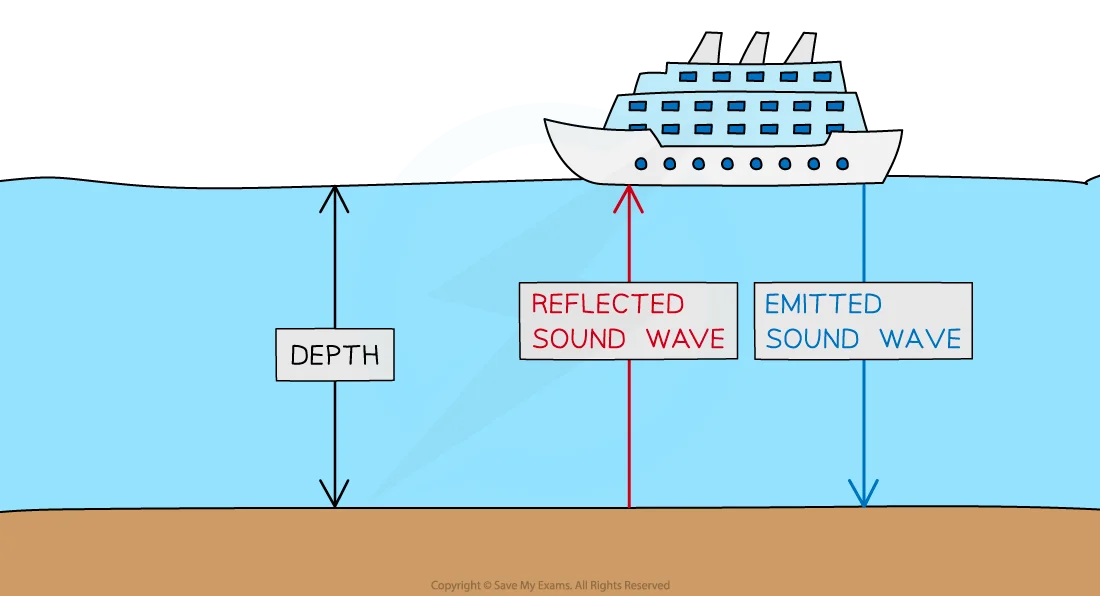
Ultrasound is used for non-destructive testing, medical scanning, and sonar.
Measuring the speed of sound
Place a microphone or observer a measured distance $d$ from a large wall. Make a sharp sound and measure the time $t$ for the echo. Repeat and average the measurements. The sound travels to the wall and back, so:
$$ v=\frac{2d}{t} $$
Worked example: For $d=170\text{ m}$ and $t=1.0\text{ s}$, $v=2(170)/1.0=340\text{ m/s}$.