Electricity
Charge and electric fields
What is charge?
Electric charge is a property of matter. It is not the same as current: charge is the quantity, while current is the flow of charge.
There are two types:
- positive charge;
- negative charge.
Like charges repel. Unlike charges attract.
Charging by friction
When two insulating materials are rubbed together, electrons transfer from one material to the other:
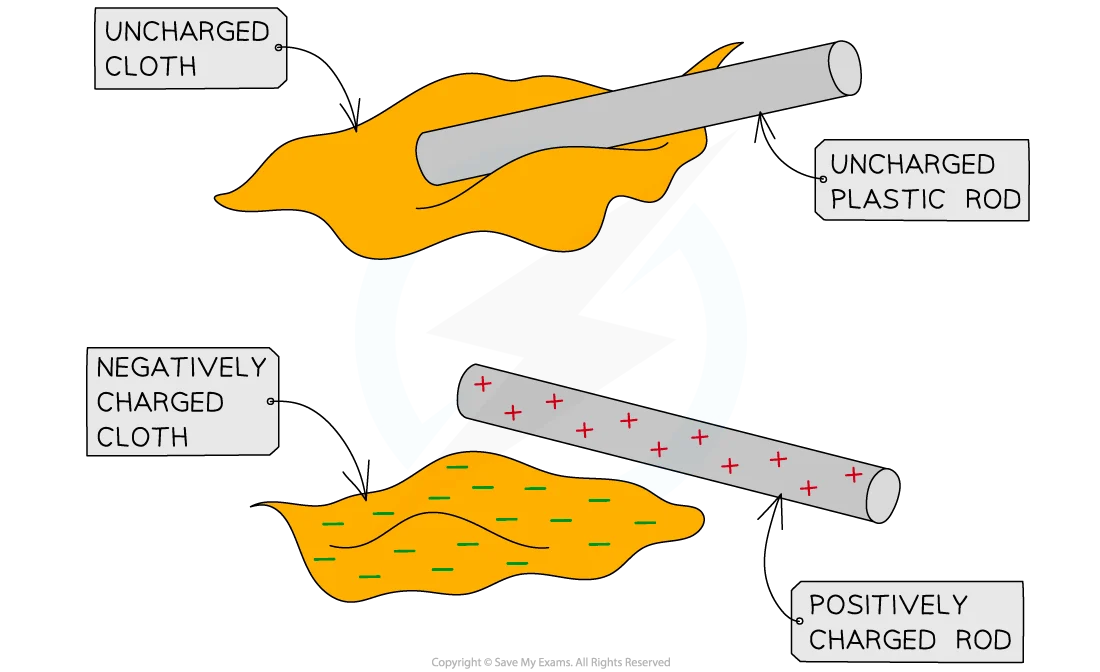
- an object that loses electrons becomes positively charged;
- an object that gains electrons becomes negatively charged.
The electrons are transferred, not created. An electroscope detects charge: its leaves or pointer move apart because like charges repel.
Conductors and insulators
A conductor contains charge carriers that can move. Metals conduct because they contain free electrons. An insulator holds its electrons tightly, so charge remains in the region where it was placed.
To test a material, place it in a simple circuit with a cell and lamp. If the lamp lights, the material completes the circuit and conducts. If the lamp stays off, the material is an insulator or a poor conductor.
Electric fields
An electric field is a region where a charged object experiences a force. Field direction means the direction of force on a positive charge.
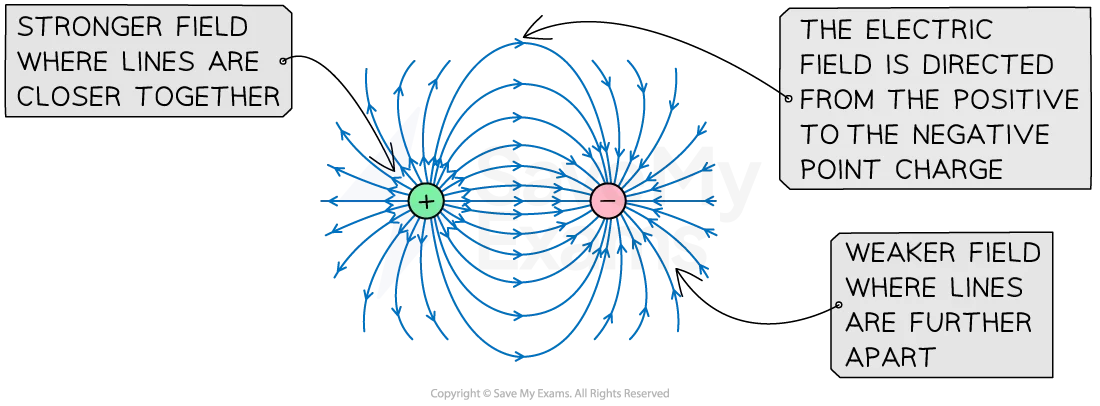
Common field patterns are:
- lines pointing away from a positive point charge and towards a negative point charge;
- radial lines outside a charged conducting sphere;
- straight, parallel lines between oppositely charged parallel plates.
Closer field lines represent a stronger field. Key idea: charges can attract or repel without touching because their electric fields interact.
Current
Electric current is the rate of flow of charge:
$$ I=\frac{Q}{t} $$
where $I$ is in amperes, $Q$ in coulombs, and $t$ in seconds. An ammeter is connected in series.
Worked example: If $12\text{ C}$ passes an ammeter in $4.0\text{ s}$,
$$ I=12/4.0=3.0\text{ A}. $$
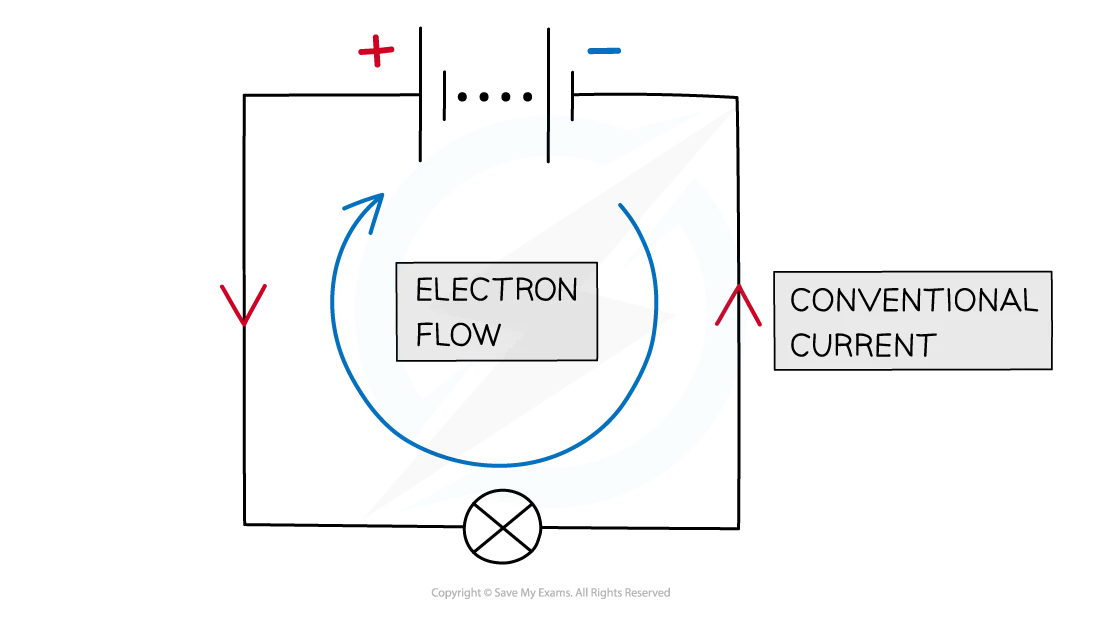
Conventional current is from positive to negative through the external circuit; electrons in a metal move from negative to positive. Direct current (d.c.) has one direction. Alternating current (a.c.) repeatedly reverses direction.
E.m.f. and potential difference
Force pushing the charge through a circuit
The e.m.f. of a source is the electrical work done by the source per unit charge. The potential difference across a component is the work done per unit charge passing through that component. Both are measured in volts:
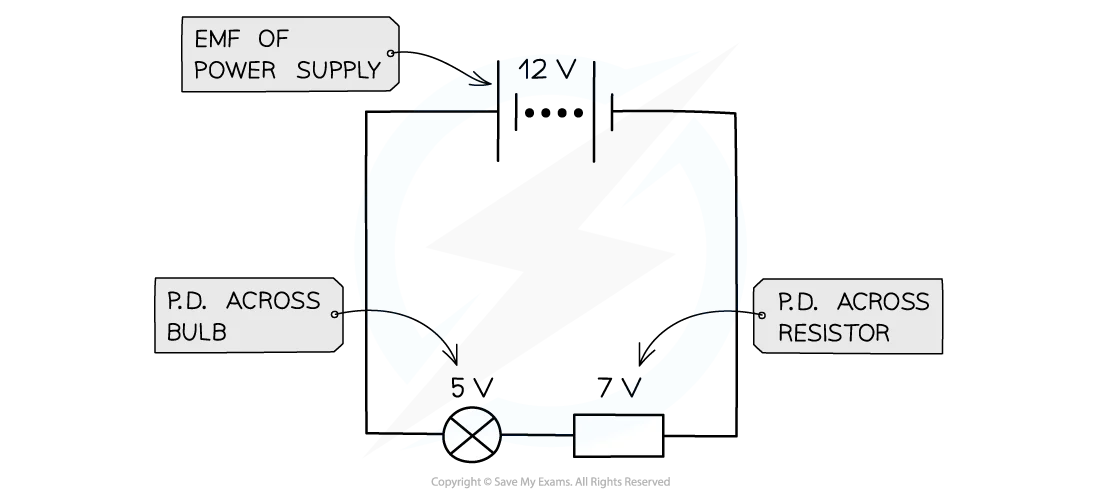
$$ E=\frac{W}{Q},\qquad V=\frac{W}{Q} $$
A voltmeter is connected in parallel with the source or component being measured.
Worked example: A source transfers $18\text{ J}$ to $3.0\text{ C}$. Its e.m.f. is $E=18/3.0=6.0\text{ V}$. If a lamp transfers $12\text{ J}$ per $3.0\text{ C}$, its p.d. is $V=4.0\text{ V}$.
Resistance
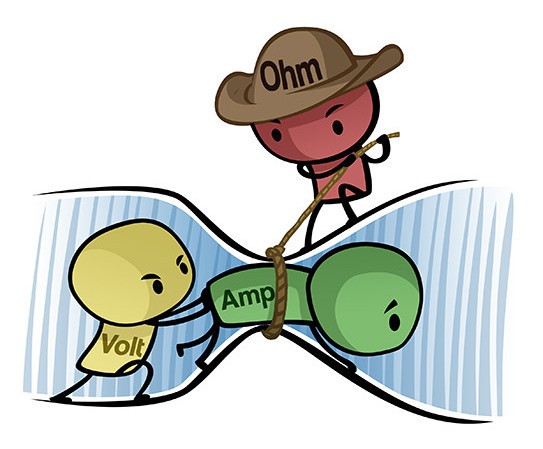
Resistance is the opposition to current:
$$ R=\frac{V}{I} $$
The unit is the ohm, where $1\ \Omega=1\text{ V/A}$. To determine resistance experimentally, connect an ammeter in series and a voltmeter in parallel with the component, record several $V$ and $I$ pairs, and calculate $R=V/I$ or use the gradient of a suitable graph.
For a uniform wire, resistance increases with length and decreases with cross-sectional area. A constant resistor has a straight current–voltage graph through the origin. A filament lamp graph curves because its temperature and resistance increase as current increases. A diode allows significant current mainly in one direction; its graph shows very little reverse current and a sharp forward-current increase after its threshold.
Electrical energy and power
Circuits transfer energy from a source to components and their surroundings. Electrical power is the rate of energy transfer:
$$ P=IV $$
Electrical energy transferred in time $t$ is:
$$ E=IVt $$
Worked example: A $12\text{ V}$ motor draws $2.0\text{ A}$ for $30\text{ s}$. Its power is $P=12\times2.0=24\text{ W}$, and energy transferred is $E=24\times30=720\text{ J}$.
For domestic electricity, energy is often measured in kilowatt-hours:
$$ \text{energy (kW h)}=\text{power (kW)}\times\text{time (h)}. $$
Worked example: A $2.0\text{ kW}$ heater runs for $3.0\text{ h}$, using $6.0\text{ kW h}$. At a tariff of $0.30$ currency units per kW h, cost is $6.0\times0.30=1.80$ currency units.